1.1 Change in Tandem

📈AP Precalculus Unit 1 Review
1.1 Change in Tandem
📈 AP Precalculus
1.1
Change in Tandem
1.2
Rates of Change
1.3
Rates of Change in Linear and Quadratic Functions
1.4
Polynomial Functions and Rates of Change
1.5
Polynomial Functions and Complex Zeros
1.6
Polynomial Functions and End Behavior
1.7
Rational Functions and End Behavior
1.8
Rational Functions and Zeros
1.9
Rational Functions and Vertical Asymptotes
1.10
Rational Functions and Holes
1.11
Equivalent Representations of Polynomial and Rational Expressions
1.12
Transformations of Functions
1.13
Function Model Selection and Assumption Articulation
1.14
Function Model Construction and Application
TLDR
In AP Precalculus, "change in tandem" is about how a function's input and output values move together according to the function rule. You describe whether output values increase or decrease as input increases, identify concave up or concave down sections based on how the rate of change behaves, and build graphs from word descriptions of real situations.
Why This Matters for the AP Precalculus Exam
This is the entry point for thinking about functions the way the rest of AP Precalculus expects. Every later topic, from polynomial end behavior to rational asymptotes to modeling with regression, depends on being able to read how two quantities change together.
On the exam, you will see this skill in both the multiple-choice and free-response sections. You may be asked to:
- Read a graph, table, or verbal description and state where a function is increasing or decreasing.
- Identify concave up and concave down intervals based on how the rate of change is behaving.
- Sketch or interpret a graph that matches a described scenario, such as volume vs. time or distance vs. time.
- Use precise language about domain, range, independent and dependent variables, and zeros.
Clear language and correct units matter for full-credit free-response work, so practicing precise descriptions now pays off later.
Key Takeaways
- A function maps each input in its domain to exactly one output in its range; the input is the independent variable and the output is the dependent variable.
- Two functions are equal only when they have the same domain and give the same output for every input in that domain.
- The function rule connecting input and output can be shown graphically, numerically, analytically, or verbally, and these forms describe the same relationship.
- The image of an input is the output the function gives, and the preimage of an output is the set of inputs that produce that output.
- A function is increasing on an interval if larger inputs give larger outputs, and decreasing if larger inputs give smaller outputs.
- Concave up means the rate of change is increasing; concave down means the rate of change is decreasing.
- Zeros are the input values where the output is zero, which is where the graph crosses or touches the x-axis.
- When a scenario is described in words, you can translate it into a graph by tracking how the two quantities change together.
A Refresher on Functions
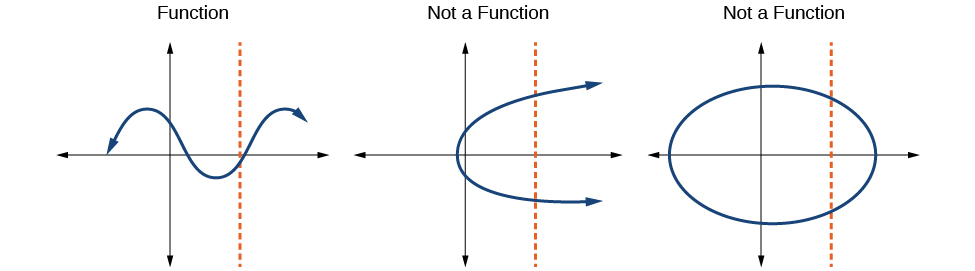
A function is a relation that maps a set of input values to a set of output values so that each input is paired with exactly one output. The set of all possible inputs is the domain, and the set of output values is the range.
Two functions can have the same formula and still not be the same function if their domains are different. To be equal, two functions must have the same domain and must give the same output for every input in that shared domain.
You can think of a function as a machine: it takes in input values and produces output values according to a rule. That rule can be simple, like adding a number, or more involved.
Not every input always produces a valid output, so sometimes the domain has to be restricted so the function returns meaningful results.
Variables
The independent variable is the input, the value you change or control. It is called independent because it is not affected by the other variable in the relationship.
The dependent variable is the output, the value that depends on the independent variable.
A quick way to keep them straight: the independent variable is the cause, and the dependent variable is the effect.
For example, in a relationship between time spent studying and grade on a test, time spent studying is the independent variable and the grade is the dependent variable, since study time is what drives changes in the grade.
The Function Rule
The relationship between input and output is set by the function rule, which tells you how inputs are transformed into outputs. 📐
The same rule can be expressed four ways:
- Graphical representation plots input-output pairs on a coordinate plane to show the shape and features of the function.
- Numerical representation lists input and output values in a table to show the pattern.
- Analytical representation uses a formula or equation, which lets you manipulate the function algebraically and predict behavior under different conditions.
- Verbal representation describes the rule in words, which helps when interpreting or communicating what the function means.
Being able to move between these four forms is a core habit for the whole course.
The image of an input value is the single output value the rule produces. The preimage of an output value is the set of all input values that produce that output. For example, if , then 5 is the image of 2; if too, then both -2 and 2 are in the preimage of 5.
Increasing vs. Decreasing Functions
An increasing function has output values that increase as the input values increase. Formally, a function f(x) is increasing over an interval [a, b] of its domain if for any two values a and b in the interval with a < b, we have f(a) < f(b).
For a simple example, take f(x) = x. This returns the same value it takes in. Moving left to right, the outputs rise at a constant rate: f(0) = 0, f(1) = 1, f(2) = 2, and so on. The function is increasing over its entire domain.
Another example is the exponential function f(x) = . Its outputs grow faster and faster as inputs increase: f(0) = 1, f(1) = e, f(2) = , and so on. It is increasing over its entire domain.
A decreasing function has output values that decrease as the input values increase. Formally, a function f(x) is decreasing over an interval [a, b] of its domain if for any two values a and b in the interval with a < b, we have f(a) > f(b).
For example, f(x) = -x returns the negative of each input. Moving left to right, the outputs fall at a constant rate: f(0) = 0, f(1) = -1, f(2) = -2, and so on. The function is decreasing over its entire domain.
The reciprocal function f(x) = also decreases as inputs increase on the positive side: f(1) = 1, f(2) = 1/2, f(3) = 1/3, and so on.
For AP Precalculus, do not overfocus on whether an increasing or decreasing interval should be written open or closed. The course and exam do not assess discriminating between open and closed intervals for intervals of increase or decrease.
Features of Functions
Concavity
The curvature of a graph, called its concavity, gives you information about how the rate of change is behaving:
- 🥣 A function is concave up on an interval if its graph curves upward, like a bowl. This means the rate of change is increasing.
- ☹️ A function is concave down on an interval if its graph curves downward, like a frown. This means the rate of change is decreasing.
Notice that concave up does not always mean increasing. A function can be decreasing and still be concave up, because concavity is about the rate of change, not the direction of the function itself.
Zeros
When the output value of a function is zero, the graph intersects the x-axis. The input values that produce those zero outputs are the zeros of the function. 0️⃣
Zeros are also called roots or solutions. Finding them means solving the equation f(x) = 0, where the solutions are the input values that make the output equal to zero.
How to Use This on the AP Precalculus Exam
Problem Solving
- When a problem gives a graph or table, scan left to right and label where outputs are rising (increasing) and falling (decreasing).
- Decide concavity separately from direction. Ask whether the rate of change itself is getting bigger (concave up) or smaller (concave down).
- For zeros, set the output to zero and find the input values, or read where the graph meets the x-axis.
Free Response
- Use precise language. Instead of "it goes up," write something like "on the interval from x = 0 to x = 3, as x increases, the output values increase."
- Name your variables and include units when the context gives them, such as "the average rate of change is 0.4 cubic meters per minute."
- When building a graph from a word description, track both quantities at once and make sure the direction and concavity match the situation described.
Common Trap
- Mixing up increasing/decreasing with concavity. A function can be increasing while concave down, or decreasing while concave up. Check direction and curvature as two separate questions.
Common Misconceptions
- Misconception: A function can give two outputs for one input.Actually: It cannot. Each input maps to exactly one output, or it is not a function.
- Misconception: Concave up means the function is increasing.Actually: Not necessarily. Concave up means the rate of change is increasing, even if the function is currently decreasing.
- Misconception: Increasing means positive values.Actually: Increasing is about outputs getting larger as inputs get larger, not about whether the outputs are positive or negative.
- Misconception: Zeros are where x equals zero.Actually: Zeros are the input values where the output is zero, which is where the graph crosses or touches the x-axis, not the y-intercept.
- Misconception: The four representations are different functions.Actually: Graphical, numerical, analytical, and verbal forms can all describe the same function. They just highlight different features.
- Misconception: Domain and range are interchangeable.Actually: Domain is the set of inputs; range is the set of outputs. Swapping them changes the meaning.
Related AP Precalculus Guides
Practice Questions for 1.1
1 of 10
The graph of , shown above, models the volume of water in a tank, in gallons, hours after 8:00 AM.
On which of the following intervals is the volume of water decreasing at an increasing rate?
A.
B.
C.
D.
Vocabulary
The following words are mentioned explicitly in the AP® course framework for this topic.Term | Definition |
|---|---|
concave down | A characteristic of a graph where the rate of change is decreasing, creating a curve that opens downward. |
concave up | A characteristic of a graph where the rate of change is increasing, creating a curve that opens upward. |
decreasing function | A function over an interval where output values always decrease as input values increase. |
dependent variable | The variable representing output values in a function. |
domain | The set of all possible input values for which a function is defined. |
function | A mathematical relation that maps each input value to exactly one output value. |
function rule | The mathematical relationship that determines how input values map to output values, which can be expressed graphically, numerically, analytically, or verbally. |
increasing function | A function over an interval where output values always increase as input values increase. |
independent variable | The variable representing input values in a function. |
input | The independent variable or value that is entered into a function. |
input value | The x-values or independent variable values used as inputs to a function. |
output | The dependent variable or value that results from applying a function to an input. |
output value | The y-values or results produced by a function for given input values. |
range | The set of all possible output values that a function can produce. |
rate of change | The measure of how quickly a function's output changes relative to changes in its input. |
x-axis | The horizontal axis on a coordinate plane representing input values. |
zero | A value of the input for which a polynomial function equals zero; also called a root of the equation p(x)=0. |
Frequently Asked Questions
What does change in tandem mean in AP Precalculus?
Change in tandem means describing how a function's input and output values vary together. As inputs change, you track whether outputs increase, decrease, stay constant, or change at a changing rate.
What is a function in Topic 1.1?
A function maps each input value in the domain to exactly one output value in the range. The input is the independent variable, and the output is the dependent variable.
How do I tell if a function is increasing or decreasing?
A function is increasing on an interval when larger input values always produce larger output values. It is decreasing when larger input values always produce smaller output values.
What does concavity mean in change in tandem?
Concavity describes how the rate of change is changing. Concave up means the rate of change is increasing, while concave down means the rate of change is decreasing.
What are zeros of a function?
Zeros are input values where the output is zero. On a graph, they are the x-values where the graph intersects the x-axis.
How does AP Precalculus test Change in Tandem?
Expect questions that ask you to compare function values, describe increasing or decreasing behavior, interpret concavity, identify zeros, or sketch a graph from a contextual description.
See Fiveable more often in Google
Mark Fiveable as a preferred source and Google is more likely to show you our guides in Top Stories, with a "preferred" badge in AI Mode and AI Overviews.