2.4 Exponential Function Manipulation

📈AP Precalculus Unit 2 Review
2.4 Exponential Function Manipulation
📈 AP Precalculus
2.1
Change in Arithmetic and Geometric Sequences
2.2
Change in Linear and Exponential Functions
2.3
Exponential Functions
2.4
Exponential Function Manipulation
2.5
Exponential Function Context and Data Modeling
2.6
Competing Function Model Validation
2.7
Composition of Functions
2.8
Inverse Functions
2.9
Logarithmic Expressions
2.10
Inverses of Exponential Functions
2.11
Logarithmic Functions
2.12
Logarithmic Function Manipulation
2.13
Exponential and Logarithmic Equations and Inequalities
2.14
Logarithmic Function Context and Data Modeling
2.15
Semi-log Plots
What is exponential function manipulation in AP Precalculus?
Exponential function manipulation is about rewriting expressions like using exponent properties so you can simplify, compare, or solve. The four tools you need are the product property, the power property, the negative exponent property, and unit-fraction (root) exponents. Each rewrite also connects to a graph transformation, so a horizontal shift can become a vertical stretch and a horizontal stretch can become a base change.
Why This Matters for the AP Precalculus Exam
This topic builds the algebra you reuse all over Unit 2. Once you can rewrite as or turn into , you can recognize that two different-looking exponential expressions are actually the same function, which shows up in both multiple-choice and free-response work.
The exam expects clear, step-by-step manipulation. Skipping steps with exponents is an easy way to introduce errors, so writing each rewrite plainly helps you earn credit and catch your own mistakes. These same skills carry directly into solving exponential and logarithmic equations later in the unit.
What you should be able to do
- Recognize an exponential expression and pick the property that simplifies it.
- Convert between equivalent forms (shifted, dilated, or rebased) and explain why they match.
- Tie each algebraic rewrite to its matching graph transformation.
Key Takeaways
- Product property: . A horizontal shift equals a vertical dilation with .
- Power property: . A horizontal dilation equals a base change when .
- Negative exponent property: .
- Unit-fraction exponent: is the th root of when it exists, where is a natural number.
- Exponential bases follow the conditions and , so these rewrites keep the function exponential.
- Show each rewrite step so equivalent forms are easy to check.
Properties of Exponential Functions
Think of each rule as a "property" you can apply to simplify an expression, solve an equation, or model a real situation. All four properties below assume a base with .
Product Property
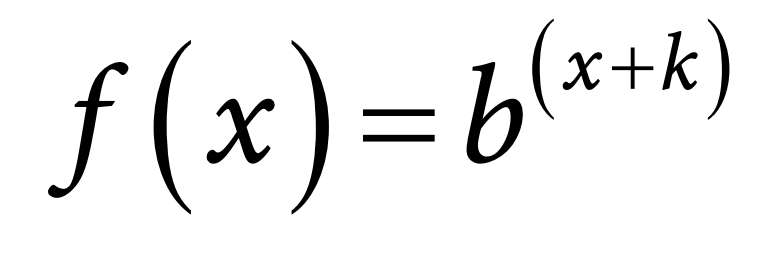

The product property for exponents states that for any base and exponents and ,
You add exponents when you multiply powers with the same base. This lets you simplify expressions that involve several factors with the same base.
Graphically, this property means that every horizontal translation of an exponential function, , is equivalent to a vertical dilation, , where . So shifting the graph of left or right is the same as stretching or shrinking it vertically.
For example, start with and shift it units to the right:
The factor is just a constant, so the shifted graph is a vertical dilation of by .
Power Property
The power property for exponents states that for any base and exponents and ,
You multiply exponents when you raise a power to another power. This helps simplify expressions with stacked exponents on the same base.
Graphically, this property means that every horizontal dilation of an exponential function, , is equivalent to a change of base, , where is a constant and . Stretching or shrinking the graph horizontally is the same as switching to a new base.
For example, take and apply a horizontal dilation with :
The rebased function produces the same outputs as the horizontally dilated .
Negative Exponent Property
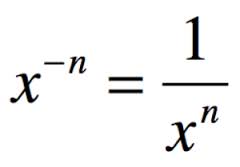
The negative exponent property states that for any base and exponent ,
A negative exponent means you take the reciprocal of the positive-exponent power. This is useful for clearing negative exponents out of an expression.
Graphically, reflecting over the -axis gives . For example, reflecting over the -axis gives
Keep the base positive when you use this property. With , the reciprocal form is always defined.
Value of Exponential Functions
An exponential unit fraction, such as where is a natural number, represents the th root of when it exists:
For example, is the cube root of , which is approximately . Likewise, is the square root of and is the cube root of .
For positive real numbers , the th root exists as a real number for any natural number . If the base is negative and the exponent is a unit fraction, the value may not exist in the real numbers, though it can exist in the complex numbers.
How to Use This on the AP Precalculus Exam
Problem Solving
- Identify the base first. If two expressions share a base, the product or power property usually simplifies them.
- When you see , split it into so you can read off the vertical dilation factor .
- When you see , rewrite it as to find the new base.
- Convert rational exponents to roots: , and check that the root actually exists for your base.
Common Trap
- Show every rewrite. With exponents, skipped steps lead to sign or base errors that are hard to catch later.
- On free-response questions, an answer without supporting work may not support a stronger score, so make each property step visible.
Connecting Algebra to Graphs
- A horizontal shift in the exponent () becomes a vertical stretch by .
- A horizontal dilation () becomes a base change to .
- A negative exponent () reflects the graph over the -axis.
Common Misconceptions
- Misconception: You add bases instead of exponents.Actually: , not or . You add exponents only when the bases match.
- Misconception: Multiplying like bases multiplies exponents; raising a power to a power adds exponents.Actually: Multiplying like bases adds exponents; raising a power to a power multiplies exponents.
- Misconception: A negative exponent makes the value negative.Actually: is a reciprocal, not a negative number, as long as .
- Misconception: Exponential bases can be nonpositive or equal to 1.Actually: Exponential bases satisfy and , which is why these rewrites keep the function exponential.
- Misconception: Every root exists in the reals.Actually: may fail for negative bases, where the value can only exist in the complex numbers.
Related AP Precalculus Guides
Practice Questions for 2.4
1 of 10
The graph shows the first four terms of a sequence a_n.
The sequence can be modeled by the function f(n) = 5 * 8^(k*n). What is the value of k?
A.
2
B.
1/2
C.
1/3
D.
3
Vocabulary
The following words are mentioned explicitly in the AP® course framework for this topic.Term | Definition |
|---|---|
exponential expressions | Mathematical expressions of the form b^x where b is a base and x is an exponent, which can be rewritten in multiple equivalent forms. |
exponential unit fraction | An exponent in the form of a unit fraction 1/k where k is a natural number, representing a root of the base. |
horizontal dilation | A transformation that stretches or compresses the graph of a function horizontally by multiplying the input by a constant factor b, written as g(x) = f(bx). |
horizontal translation | A transformation that shifts the graph of a function left or right by adding a constant to the input, written as g(x) = f(x + h). |
kth root | The value that, when raised to the power k, equals the base b, represented as b^(1/k). |
negative exponent property | The rule stating that b^(-n) = 1/b^n, which expresses negative exponents as reciprocals. |
power property for exponents | The rule stating that (b^m)^n = b^(mn), allowing an exponential expression raised to a power to be simplified. |
product property for exponents | The rule stating that b^m · b^n = b^(m+n), allowing products of exponential expressions with the same base to be combined. |
vertical dilation | A transformation that stretches or compresses the graph of a function vertically by multiplying the function by a constant factor a, written as g(x) = af(x). |
Frequently Asked Questions
What is exponential function manipulation in AP Precalculus?
Exponential function manipulation means rewriting exponential expressions in equivalent forms using exponent properties. These rewrites help you simplify expressions and connect algebra to graph transformations.
What is the product property for exponents?
The product property says b^m times b^n equals b^(m+n). Graphically, b^(x+k) can be rewritten as b^k times b^x, so a horizontal translation can appear as a vertical dilation.
What is the power property for exponents?
The power property says (b^m)^n equals b^(mn). Graphically, b^(cx) can be rewritten as (b^c)^x, so a horizontal dilation can appear as a change of base.
What does a negative exponent mean?
A negative exponent creates a reciprocal: b^(-n) = 1/b^n. It does not make the value negative when the base is positive.
What does a unit-fraction exponent mean?
A unit-fraction exponent such as b^(1/k) represents the kth root of b when that root exists. For example, b^(1/2) is the square root of b.
What is the common mistake with exponential properties?
Do not mix up the product and power properties. Multiplying powers with the same base adds exponents, while raising a power to a power multiplies exponents.
See Fiveable more often in Google
Mark Fiveable as a preferred source and Google is more likely to show you our guides in Top Stories, with a "preferred" badge in AI Mode and AI Overviews.