1.6 Polynomial Functions and End Behavior

📈AP Precalculus Unit 1 Review
1.6 Polynomial Functions and End Behavior
📈 AP Precalculus
1.1
Change in Tandem
1.2
Rates of Change
1.3
Rates of Change in Linear and Quadratic Functions
1.4
Polynomial Functions and Rates of Change
1.5
Polynomial Functions and Complex Zeros
1.6
Polynomial Functions and End Behavior
1.7
Rational Functions and End Behavior
1.8
Rational Functions and Zeros
1.9
Rational Functions and Vertical Asymptotes
1.10
Rational Functions and Holes
1.11
Equivalent Representations of Polynomial and Rational Expressions
1.12
Transformations of Functions
1.13
Function Model Selection and Assumption Articulation
1.14
Function Model Construction and Application
End behavior describes what happens to a polynomial's output values as heads toward positive or negative infinity. You can predict it using just two things: the degree of the polynomial and the sign of its leading coefficient, since the leading term has more influence than every other term when the inputs get very large.
Why This Matters for the AP Precalculus Exam
End behavior connects the algebra of a polynomial to its graph. On the AP Precalculus exam, you will need to move between graphical, numerical, analytical, and verbal representations of functions, and end behavior is a fast way to describe a graph's long-run shape without plotting every point.
This skill shows up when you sketch or match graphs, write limit notation, and explain why a graph rises or falls at its far left and far right. It also sets you up for the next topic, where end behavior helps you analyze rational functions and their horizontal and slant asymptotes.
Key Takeaways
- End behavior describes output values as inputs increase without bound (x → ∞) or decrease without bound (x → -∞).
- For a nonconstant polynomial, the outputs always go to ∞ or -∞ at each end; they never level off.
- The leading term, , has more influence than all lower-degree terms when |x| is large, so it controls end behavior.
- Even degree means both ends point the same direction; odd degree means the ends point in opposite directions.
- A positive leading coefficient sends the right end up; a negative leading coefficient sends the right end down.
- Limit notation like is the standard way to write end behavior.
Introducing End Behavior
The end behavior of a function describes what happens to the output values as the input values approach positive or negative infinity. It is a way to describe the long-run behavior of the function.
For a polynomial of degree n, end behavior depends on two features:
- the degree (the highest power of x)
- the sign of the leading coefficient (the coefficient on the highest-degree term)
As input values of a nonconstant polynomial function increase without bound, the output values either increase or decrease without bound. The same is true as input values decrease without bound. A nonconstant polynomial never flattens out at the ends, so each end runs off toward ∞ or -∞.
Why the Leading Term Controls End Behavior
When |x| is very large, the highest-degree term grows faster than every lower-degree term combined. For example, in , once x is large, is so much bigger than the other terms that they barely affect the total. That is why the degree and sign of the leading term determine the end behavior.
A quick way to organize the four cases:
| Degree | Leading coefficient | Left end (x → -∞) | Right end (x → ∞) |
|---|---|---|---|
| Even | Positive | Up (→ ∞) | Up (→ ∞) |
| Even | Negative | Down (→ -∞) | Down (→ -∞) |
| Odd | Positive | Down (→ -∞) | Up (→ ∞) |
| Odd | Negative | Up (→ ∞) | Down (→ -∞) |
Writing End Behavior with Limit Notation
Limit notation is the standard way to record end behavior:
- means outputs increase without bound as x increases without bound.
- means outputs decrease without bound as x increases without bound.
- means outputs increase without bound as x decreases without bound.
- means outputs decrease without bound as x decreases without bound.
Worked Examples
Example 1: Even degree, positive leading coefficient
Consider .
The highest-degree term is . The degree is even and the leading coefficient is positive, so both ends point up. The end behavior is:
Example 2: Odd degree, negative leading coefficient
Consider .
The highest-degree term is . The degree is odd and the leading coefficient is negative, so the ends point in opposite directions: down on the right and up on the left. The end behavior is:
Example 3: Odd degree, positive leading coefficient
Consider .
The highest-degree term is . The degree is odd and the leading coefficient is positive, so the ends point in opposite directions: up on the right and down on the left. The end behavior is:
Example 4: Even degree, negative leading coefficient
Consider .
The highest-degree term is . The degree is even and the leading coefficient is negative, so both ends point down. The end behavior is:
How to Use This on the AP Precalculus Exam
MCQ
- Match an equation to a graph by checking which way both ends point. First decide even versus odd degree, then check the sign of the leading coefficient.
- Read end behavior straight off a graph and choose the matching limit statement. Make sure the arrow direction matches whether x is going to ∞ or -∞.
Free Response
- When a question asks you to describe end behavior, name the degree and the sign of the leading coefficient as your reason, then state both limits.
- Use clear language and correct limit notation. Precise setup and notation are important for clear exam work.
Common Trap
- You only need the leading term to find end behavior. Do not waste time analyzing middle terms.
- The left and right ends can be different. Only commit both ends to the same direction when the degree is even.
Common Misconceptions
- Misconception: The leading coefficient alone decides everything.Actually: You also need the degree. The sign tells you the direction of the right end, but the degree (even or odd) decides whether the left end matches or opposes it.
- Misconception: Both ends always go the same way.Actually: That is only true for even-degree polynomials. Odd-degree polynomials have ends that point in opposite directions.
- Misconception: Polynomials can level off at the ends.Actually: A nonconstant polynomial always runs off to ∞ or -∞ at each end. Leveling off toward a horizontal line is a feature of certain rational functions, not polynomials.
- Misconception: A bigger leading coefficient changes the end behavior direction.Actually: The size of the leading coefficient does not change the direction; only its sign and the degree do. A steeper graph still points the same way.
- Misconception: Limit notation and increasing/decreasing are the same thing.Actually: End behavior describes the long-run direction of outputs, not whether the function is increasing or decreasing on a specific interval. A graph can wiggle up and down in the middle and still have clear end behavior.
Related AP Precalculus Guides
Practice Questions for 1.6
1 of 10
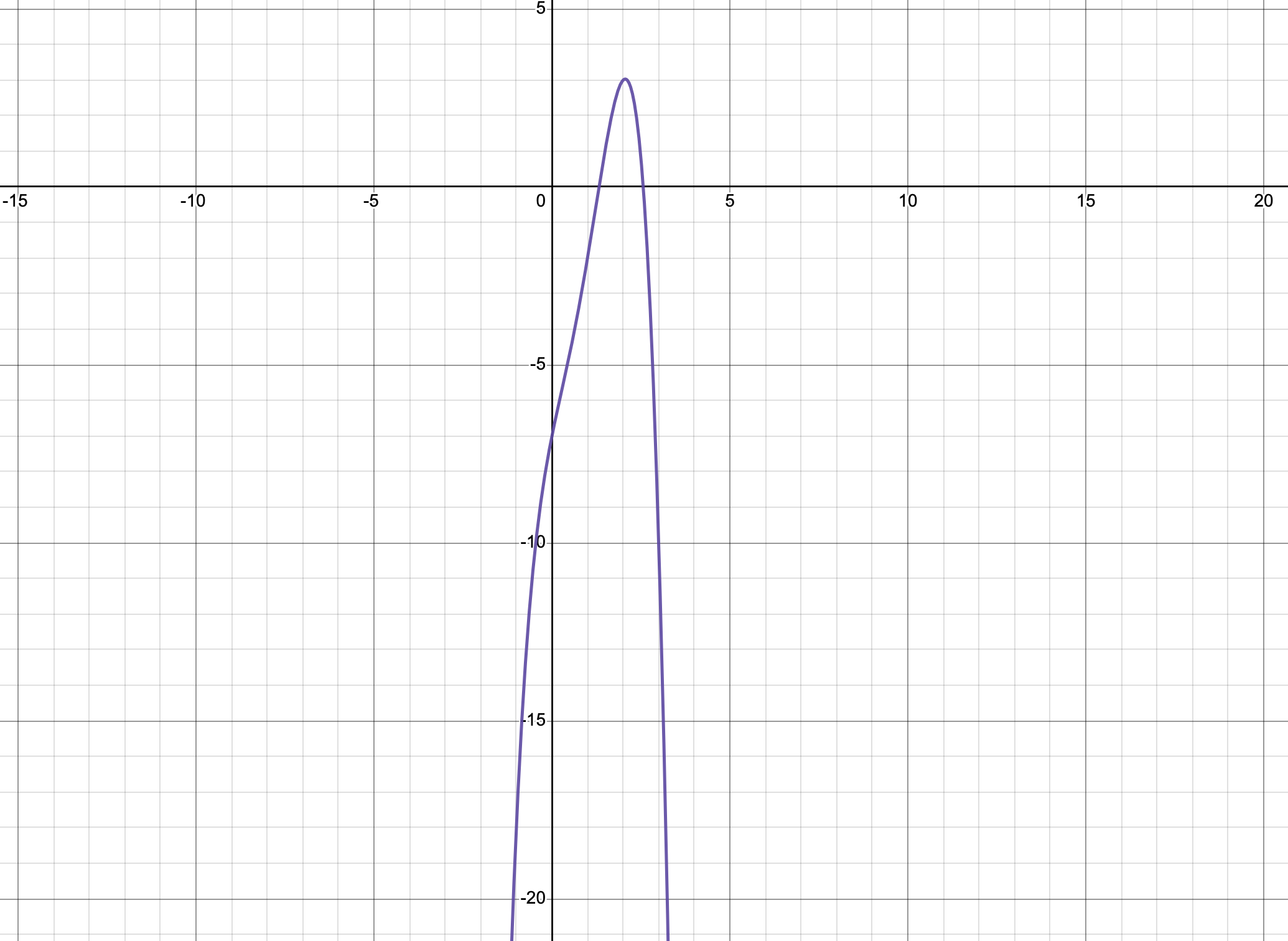
The graph of the polynomial function is shown.
The function can be written in the form . Which of the following must be true about the constant and the integer ?
A.
and is an even integer.
B.
and is an even integer.
C.
and is an odd integer.
D.
and is an odd integer.
Vocabulary
The following words are mentioned explicitly in the AP® course framework for this topic.Term | Definition |
|---|---|
degree | The highest power of the variable in a polynomial function, which determines the number of differences needed to reach a constant value. |
end behavior | The behavior of a function as the input values approach positive or negative infinity. |
leading term | The term in a polynomial with the highest degree, which dominates the function's behavior as input values increase or decrease without bound. |
nonconstant polynomial function | A polynomial function with degree greater than zero. |
polynomial function | A function that can be expressed in the form p(x) = a_n x^n + a_{n-1} x^{n-1} + ... + a_1 x + a_0, where n is a positive integer and a_n is nonzero. |
Frequently Asked Questions
What are end behavior rules for polynomial functions?
End behavior rules describe what happens to a polynomial as x approaches positive or negative infinity. For nonconstant polynomials, the degree and sign of the leading coefficient determine whether the left and right ends rise or fall.
How do degree and leading coefficient determine end behavior?
Even degree means both ends go the same direction, while odd degree means the ends go opposite directions. A positive leading coefficient makes the right end rise, and a negative leading coefficient makes the right end fall.
What is the end behavior of an even-degree polynomial?
An even-degree polynomial has both ends going the same direction. If the leading coefficient is positive, both ends rise; if it is negative, both ends fall.
What is the end behavior of an odd-degree polynomial?
An odd-degree polynomial has ends going in opposite directions. If the leading coefficient is positive, the left end falls and the right end rises; if it is negative, the left end rises and the right end falls.
How do you write end behavior in limit notation?
Use limits such as lim as x approaches infinity of p(x) equals infinity or negative infinity, and lim as x approaches negative infinity of p(x) equals infinity or negative infinity. The signs depend on the polynomial’s degree and leading coefficient.
What is a common AP Precalculus end behavior mistake?
A common mistake is using the sign of the constant term or a middle term. End behavior is controlled by the leading term because it dominates all lower-degree terms for very large positive or negative x-values.
See Fiveable more often in Google
Mark Fiveable as a preferred source and Google is more likely to show you our guides in Top Stories, with a "preferred" badge in AI Mode and AI Overviews.