1.12 Transformations of Functions

📈AP Precalculus Unit 1 Review
1.12 Transformations of Functions
📈 AP Precalculus
1.1
Change in Tandem
1.2
Rates of Change
1.3
Rates of Change in Linear and Quadratic Functions
1.4
Polynomial Functions and Rates of Change
1.5
Polynomial Functions and Complex Zeros
1.6
Polynomial Functions and End Behavior
1.7
Rational Functions and End Behavior
1.8
Rational Functions and Zeros
1.9
Rational Functions and Vertical Asymptotes
1.10
Rational Functions and Holes
1.11
Equivalent Representations of Polynomial and Rational Expressions
1.12
Transformations of Functions
1.13
Function Model Selection and Assumption Articulation
1.14
Function Model Construction and Application
What are transformations of functions in AP Precalculus?
Transformations let you build a new function from a known one by shifting, stretching, shrinking, or reflecting its graph. Additive changes (adding or subtracting a constant) move the graph, while multiplicative changes (multiplying by a constant) stretch, compress, or flip it. Once you can read the form of an equation like , you can predict the new graph and how the domain and range change.
Why This Matters for the AP Precalculus Exam
This topic shows up across all four units because every function family (polynomial, rational, exponential, logarithmic, trigonometric) can be transformed the same way. On the AP Precalculus exam, you may need to:
- Recognize a transformation from an equation, table, or graph.
- Construct a new function rule when given a parent function and a described shift, dilation, or reflection.
- Explain how the domain and range change after a transformation.
- Connect the structure of an equation to the behavior of its graph.
Free-response questions in this course ask you to justify conclusions, not just state them. Being able to clearly describe what each constant does to a graph helps you write precise explanations and keeps your work easy to follow.
Key Takeaways
- shifts the graph up by units (down if is negative).
- shifts the graph by units horizontally: moves it left, moves it right.
- is a vertical dilation by a factor of ; if , it also reflects over the x-axis.
- is a horizontal dilation by a factor of ; if , it also reflects over the y-axis.
- Translations move the graph without changing its shape; dilations and reflections change size or orientation.
- A transformation can change the domain and range compared to the parent function.
- A transformation maps preimages on the original graph to images on the transformed graph, so tracking a point before and after the transformation helps you describe the change precisely.
Additive Transformations (Translations)
An additive transformation of a function involves adding or subtracting a constant value, either to the output or inside the input.
Vertical Translations
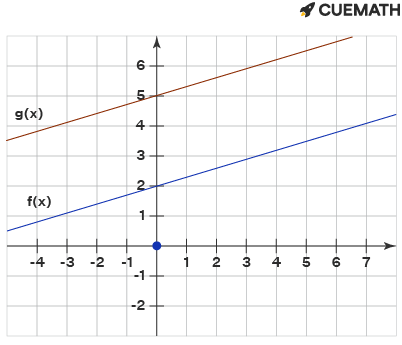
The function is an additive transformation of . The constant produces a vertical translation of the graph by units. If the graph moves up; if the graph moves down.
The shape stays the same. Each output value is just raised or lowered by , so the point moves to .
Horizontal Translations
The function is also an additive transformation, but the constant is added inside the function. This produces a horizontal translation of the graph by units. The sign flips your intuition: moves the graph 3 units left, and moves it 3 units right.
In point terms, moves to .
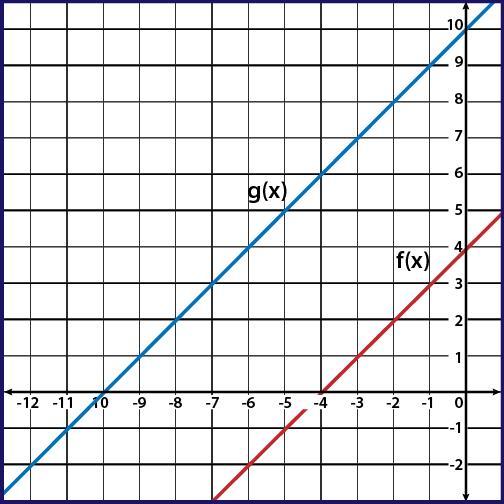
For both vertical and horizontal translations, the shape of the graph does not change. Only its position on the coordinate plane changes. If you know the graph of , you can sketch by applying the correct shifts.
The point you start with on the original graph is a preimage, and the point it lands on after the transformation is its image. For example, if is on and , then the preimage maps to the image on .
Multiplicative Transformations (Dilations and Reflections)
A multiplicative transformation involves multiplying by a constant, either the whole output or the input.
Vertical Dilations
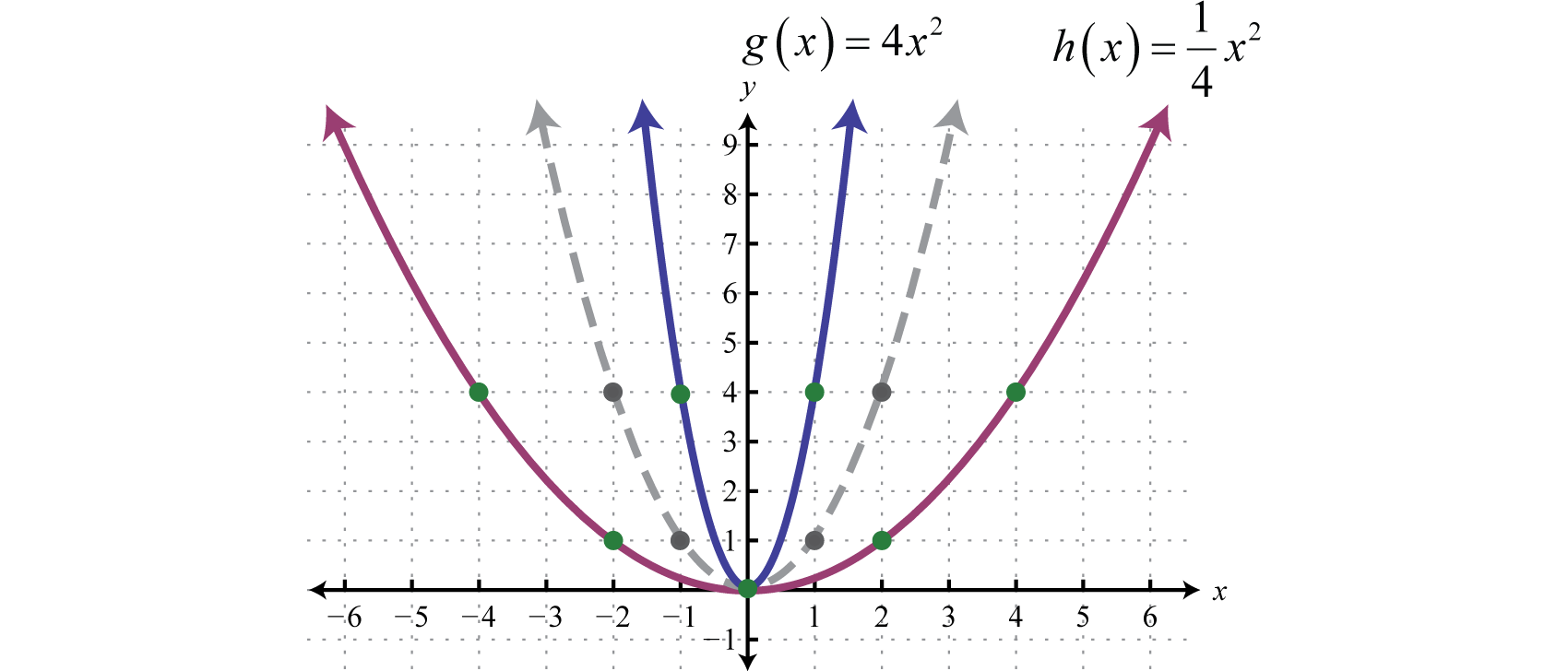
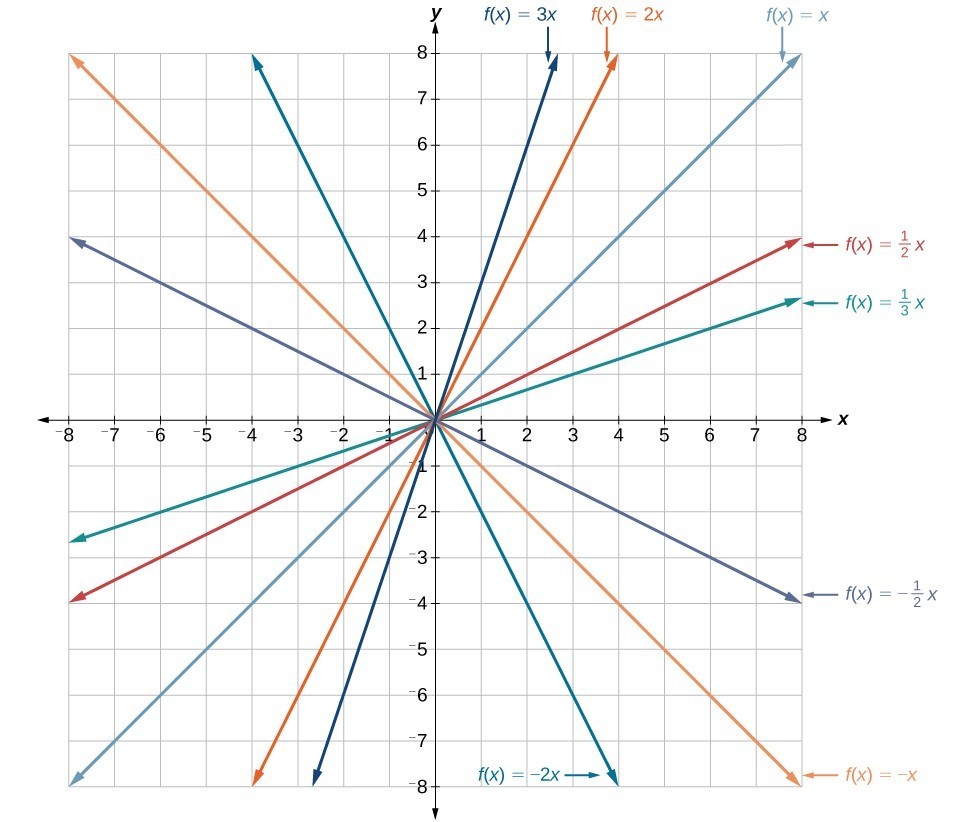
The function , where , is a multiplicative transformation that scales the graph vertically by a factor of . The distance from each point to the x-axis is multiplied by .
- If , the graph is stretched vertically and looks "taller."
- If , the graph is compressed vertically and looks "shorter."
- If , the transformation also includes a reflection over the x-axis, flipping the graph.
In point terms, moves to .
Horizontal Dilations
The function , where , scales the graph horizontally by a factor of . This one is counterintuitive because the factor uses the reciprocal of .
- If , the graph is compressed horizontally and looks "narrower."
- If , the graph is stretched horizontally and looks "wider."
- If , the transformation also includes a reflection over the y-axis, flipping the graph.
In point terms, moves to .
For both vertical and horizontal dilations, the basic shape stays similar but the size changes. Reflections flip the orientation. If you know the graph of , you can sketch by applying the correct dilation and any reflection.
Working with Combined Transformations
Additive and multiplicative transformations can be combined into a single function. Consider:
Here you have four constants doing four jobs:
- produces a horizontal dilation by a factor of (and a y-axis reflection if ).
- produces a horizontal translation by units.
- produces a vertical dilation by a factor of (and an x-axis reflection if ).
- produces a vertical translation by units.
A useful pattern to remember: anything inside the function (with the input ) affects the graph horizontally and often behaves opposite to what the sign suggests. Anything outside the function affects the graph vertically and behaves the way you expect.
A transformation can also change the domain and range of a function compared to its parent function. Horizontal translations and dilations can shift or scale the domain, while vertical translations and dilations can shift or scale the range. Always check whether features like asymptotes, endpoints, or restricted values move when you transform a function.
How to Use This on the AP Precalculus Exam
MCQ
- Match an equation to its graph by checking each constant one at a time: vertical shift (), horizontal shift (), vertical dilation/reflection (), horizontal dilation/reflection ().
- Watch the signs inside the function. moves left, not right.
- When a problem gives you a table, track how specific points move. Use the mappings and .
Free Response
- When asked to construct a transformed function, write the new rule explicitly and state what each constant does.
- When explaining a graph, name the transformation (translation, dilation, or reflection), the direction, and the size of the change.
- If the question involves domain or range, state how each changes and why, referencing the specific shift or dilation that caused it.
Common Trap
- Mixing up horizontal stretch and compression. Remember compresses horizontally and stretches horizontally.
- Forgetting that the horizontal factor is , not .
Common Misconceptions
- Misconception: shifts right because of the plus sign.Actually: Inside changes work in reverse. shifts the graph units, so a plus moves it left.
- Misconception: stretches the graph by a factor of .Actually: The horizontal scale factor is . A larger compresses the graph; a smaller stretches it.
- Misconception: A reflection always changes the domain.Actually: A reflection over the x-axis () flips outputs and changes the range, not the domain. A reflection over the y-axis () flips inputs. Whether the domain or range actually changes depends on the parent function and any restrictions, so check each case instead of assuming.
- Misconception: Vertical and horizontal transformations behave the same way.Actually: Outside changes (vertical) match the sign you expect; inside changes (horizontal) often work opposite to the sign.
- Misconception: Translations change the shape of the graph.Actually: Translations only move the graph. Its shape stays identical; only dilations and reflections change size or orientation.
Related AP Precalculus Guides
Practice Questions for 1.12
1 of 10
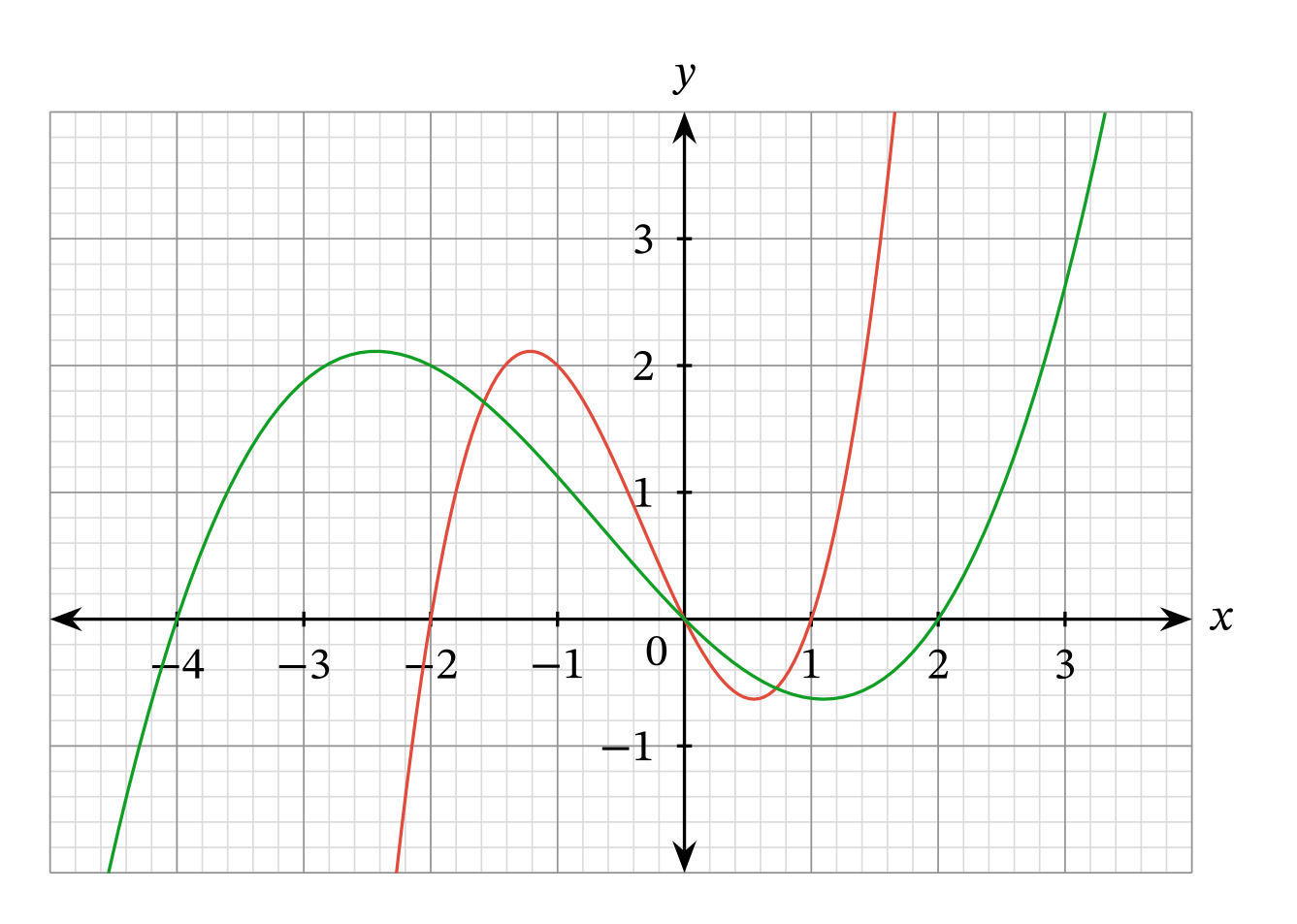
The graph of the function is shown above.
The function is defined by . What are the coordinates of the local maximum of the graph of ?
A.
B.
C.
D.
Vocabulary
The following words are mentioned explicitly in the AP® course framework for this topic.Term | Definition |
|---|---|
additive transformation | A transformation of a function involving addition or subtraction, resulting in vertical and horizontal translations. |
domain | The set of all possible input values for which a function is defined. |
horizontal dilation | A transformation that stretches or compresses the graph of a function horizontally by multiplying the input by a constant factor b, written as g(x) = f(bx). |
horizontal translation | A transformation that shifts the graph of a function left or right by adding a constant to the input, written as g(x) = f(x + h). |
multiplicative transformation | A transformation of a function involving multiplication, resulting in vertical and horizontal dilations. |
parent function | The simplest form of a family of functions, used as a base for creating transformed functions. |
range | The set of all possible output values that a function can produce. |
reflection over the x-axis | A transformation that flips the graph of a function across the x-axis, occurring when the multiplicative factor is negative in a vertical dilation. |
reflection over the y-axis | A transformation that flips the graph of a function across the y-axis, occurring when the multiplicative factor is negative in a horizontal dilation. |
vertical dilation | A transformation that stretches or compresses the graph of a function vertically by multiplying the function by a constant factor a, written as g(x) = af(x). |
vertical translation | A transformation that shifts the graph of a function up or down by adding a constant k to the function, written as g(x) = f(x) + k. |
Frequently Asked Questions
What are transformations of functions in AP Precalculus?
Transformations create a new function from a parent function by translating, dilating, or reflecting the graph. They change the graph's position, size, orientation, domain, or range depending on the rule.
What does g(x) = f(x) + k do?
The rule g(x) = f(x) + k shifts the graph vertically by k units. Positive k moves the graph up, and negative k moves it down.
What does g(x) = f(x + h) do?
The rule g(x) = f(x + h) shifts the graph horizontally by -h units. This means f(x + 3) moves left 3 units, while f(x - 3) moves right 3 units.
What does g(x) = af(x) do?
The rule g(x) = af(x) vertically dilates the graph by a factor of |a|. If a is negative, the graph also reflects over the x-axis.
What does g(x) = f(bx) do?
The rule g(x) = f(bx) horizontally dilates the graph by a factor of |1/b|. If b is negative, the graph also reflects over the y-axis.
What is the most common mistake with function transformations?
The most common mistake is treating horizontal transformations like vertical ones. Inside changes use the opposite sign for translations and the reciprocal scale factor for dilations.
See Fiveable more often in Google
Mark Fiveable as a preferred source and Google is more likely to show you our guides in Top Stories, with a "preferred" badge in AI Mode and AI Overviews.