4.3 Parametric Functions and Rates of Change

📈AP Precalculus Unit 4 Review
4.3 Parametric Functions and Rates of Change
📈 AP Precalculus
4.1
Parametric Functions
4.2
Parametric Functions Modeling Planar Motion
4.3
Parametric Functions and Rates of Change
4.4
Parametrically Defined Circles and Lines
4.5
Implicitly Defined Functions
4.6
Conic Sections
4.7
Parametrization of Implicitly Defined Functions
4.8
Vectors
4.9
Vector-Valued Functions
4.10
Matrices
4.11
The Inverse and Determinant of a Matrix
4.12
Linear Transformations and Matrices
4.13
Matrices as Functions
4.14
Matrices Modeling Contexts
A parametric planar motion function uses two equations, x(t) and y(t), to describe where an object is and how it moves as the parameter t changes. By looking at whether x(t) and y(t) are increasing or decreasing, you can tell the direction of motion, and by comparing their average rates of change over an interval, you can find the slope of the curve between two points.
Why This Matters for the AP Precalculus Exam
Unit 4 topics, including parametric functions and rates of change, are not assessed on the AP Precalculus exam. Schools choose whether to teach this unit. Still, this topic builds reasoning that pays off later: it splits motion into independent horizontal and vertical pieces, which is exactly how problems in physics, calculus, and other sciences treat motion. Getting comfortable with reading direction from x(t) and y(t) and computing slope from average rates of change strengthens skills you use throughout the course, like interpreting rates of change and working across graphs, tables, and equations.
Key Takeaways
- A parametric function f(t) = (x(t), y(t)) gives both position and motion as the parameter t increases.
- If x(t) increases, motion is to the right; if it decreases, motion is to the left. If y(t) increases, motion is up; if it decreases, motion is down.
- The direction of motion can be different at different values of t, even at the same point in the plane.
- The same curve can be parametrized in different ways and traced in different directions.
- Over an interval [t1, t2], find the average rate of change of x(t) and y(t) separately. Their ratio gives the slope of the curve between the two points, as long as the average rate of change of x(t) is not zero.
Reading Direction of Motion
When you analyze the motion of a particle in the plane, look at the x and y components separately. The direction in the x-y plane comes from how x(t) and y(t) behave on their own as the parameter t increases.
- If x(t) is increasing as t increases, the particle moves to the right.
- If x(t) is decreasing as t increases, the particle moves to the left.
- If y(t) is increasing as t increases, the particle moves up.
- If y(t) is decreasing as t increases, the particle moves down.
So if x(t) is increasing and y(t) is decreasing at the same time, the particle is moving down and to the right (a diagonal direction).
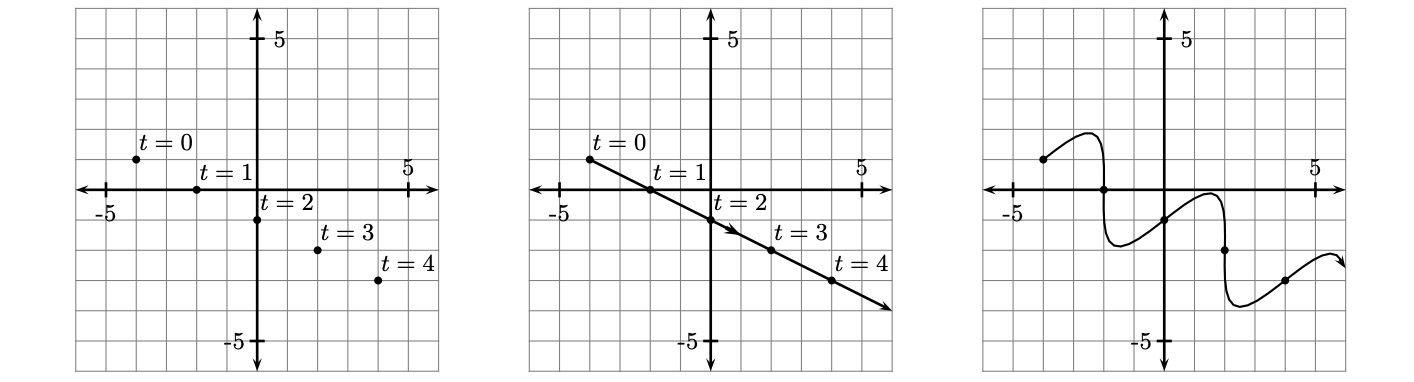
The direction of motion can change as t changes. At a single point in the plane, the direction may even be different for different values of t. For example, if x(t) switches from increasing to decreasing, the horizontal direction flips from right to left at that moment.
Same Curve, Different Parametrizations
A single curve in the plane can be described by more than one set of parametric equations, and those equations can trace the curve in different directions.
For example, one parametrization might have t increase from 0 to 1 as the particle moves from a starting point to an end point. A different parametrization of the same curve might have t decrease from 1 to 0, sending the particle along the curve in the opposite direction. The picture of the curve looks the same, but the motion along it is reversed.
This is why it helps to describe motion precisely. Two parametric functions can produce the identical curve while differing in starting point, direction, and how fast the point moves along it.
Average Rates of Change and Slope
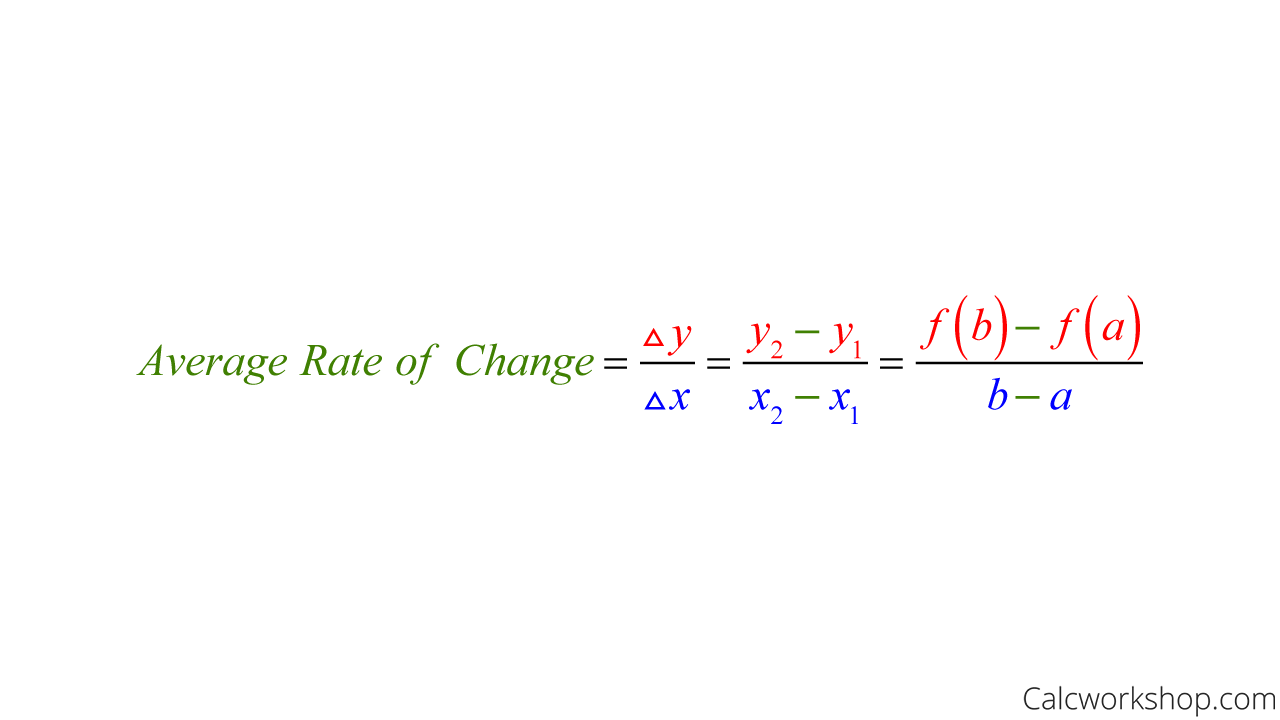
Over an interval [t1, t2] in the domain, you can compute the average rate of change of x(t) and y(t) independently. To find the average rate of change of a function over [t1, t2], use:
Apply this to x(t) and y(t) separately to get the average rate of change of each over the interval.
The slope of the curve between the points at t1 and t2 is the ratio of the average rate of change of y to the average rate of change of x, as long as the average rate of change of x(t) is not zero:
In words, the change in y divided by the change in x gives the slope of the line connecting the two points on the curve. If the average rate of change of x is zero, this ratio is undefined, so the slope between those points cannot be found this way.
How to Use This on the AP Precalculus Exam
Unit 4 is not tested on the AP Precalculus exam, but the reasoning here is good practice. Use these approaches when working through parametric problems in class or on Topic Questions and Progress Checks in AP Classroom.
Problem Solving
- To find direction of motion at a value of t, decide whether x(t) and y(t) are increasing or decreasing there, then combine the horizontal and vertical results.
- To find the slope between two parameter values, compute the change in y and the change in x over [t1, t2], then divide change in y by change in x.
- Check that the average rate of change of x is not zero before reporting a slope. If it is zero, the slope is undefined for that interval.
- When graphing parametric functions with technology, set an appropriate viewing window and restrict the parameter to the interval you care about.
Common Trap
- Do not assume increasing t always means moving right or up. The direction depends on whether each component function is increasing or decreasing.
- Keep x and y reasoning separate. Mixing them up leads to wrong directions and wrong slopes.
Common Misconceptions
- Misconception: Bigger t means moving right.Actually: Not necessarily. Direction depends on whether x(t) is increasing or decreasing, not on t by itself.
- Misconception: Each point on the curve has one direction of motion.Actually: A particle can pass through the same point at different t values heading in different directions.
- Misconception: A curve has only one parametrization.Actually: The same curve can be written many ways and traced in either direction at different speeds.
- Misconception: Slope between two points is change in x over change in y.Actually: It is change in y over change in x. Flipping the ratio gives the wrong slope.
- Misconception: You can always compute the slope between two parameter values.Actually: If the average rate of change of x(t) is zero over the interval, the ratio is undefined, so the slope cannot be found this way.
Related AP Precalculus Guides
Practice Questions for 4.3
1 of 10
The position of a particle is given by and for . Which of the following describes the direction of the particle's motion at and ?
A.
At , it moves right and downward; at , it moves left and upward.
B.
At , it moves right and upward; at , it moves left and downward.
C.
At , it moves left and upward; at , it moves right and downward.
D.
At , it moves left and downward; at , it moves right and upward.
Vocabulary
The following words are mentioned explicitly in the AP® course framework for this topic.Term | Definition |
|---|---|
average rate of change | The change in the output of a function divided by the change in the input over a specified interval, calculated as (f(b) - f(a))/(b - a) for the interval [a, b]. |
direction of motion | The path direction a particle follows in the plane, determined by whether x(t) and y(t) are increasing or decreasing. |
parametric planar motion function | A function that describes the motion of a particle in a plane using a parameter (typically time) to define both x and y coordinates independently. |
parametrization | A representation of a curve using a pair of functions (x(t), y(t)) where both x and y are expressed in terms of a parameter t. |
rate of change | The measure of how quickly a function's output changes relative to changes in its input. |
slope of the graph | The ratio of the average rate of change of y to the average rate of change of x between two points on a parametric curve. |
Frequently Asked Questions
What is AP Precalculus 4.3 about?
AP Precalculus 4.3 focuses on parametric functions and rates of change. A parametric function uses x(t) and y(t) to describe position as a parameter changes, so you analyze horizontal motion, vertical motion, direction, and slope by comparing how x and y change over the same parameter interval.
How do you find direction of motion from parametric functions?
Look at x(t) and y(t) separately as t increases. If x(t) increases, motion is to the right; if x(t) decreases, motion is to the left. If y(t) increases, motion is upward; if y(t) decreases, motion is downward. Combining the two gives the overall direction in the plane.
What is the AROC formula for parametric functions?
Average rate of change over [t1, t2] is change in output divided by change in t. For parametric functions, compute the AROC of x(t) and the AROC of y(t) separately: [x(t2)-x(t1)]/(t2-t1) and [y(t2)-y(t1)]/(t2-t1).
How do you find slope from parametric equations?
Between two parameter values, slope is change in y divided by change in x: [y(t2)-y(t1)]/[x(t2)-x(t1)]. This is the same as the ratio of the average rate of change of y(t) to the average rate of change of x(t), as long as the change in x is not zero.
Can two parametric functions trace the same curve differently?
Yes. Different parametrizations can create the same curve but trace it in different directions, at different speeds, or over different parameter intervals. That is why AP Precalculus asks you to pay attention to direction of motion, not just the shape of the graph.
Is AP Precalculus Unit 4 on the AP exam?
No. AP Precalculus Unit 4, including parametric functions and rates of change, is not assessed on the AP Precalculus exam. It is still useful course content because it strengthens motion, graph, and rate-of-change reasoning used in later math and science courses.
See Fiveable more often in Google
Mark Fiveable as a preferred source and Google is more likely to show you our guides in Top Stories, with a "preferred" badge in AI Mode and AI Overviews.