4.1 Parametric Functions

📈AP Precalculus Unit 4 Review
4.1 Parametric Functions
📈 AP Precalculus
4.1
Parametric Functions
4.2
Parametric Functions Modeling Planar Motion
4.3
Parametric Functions and Rates of Change
4.4
Parametrically Defined Circles and Lines
4.5
Implicitly Defined Functions
4.6
Conic Sections
4.7
Parametrization of Implicitly Defined Functions
4.8
Vectors
4.9
Vector-Valued Functions
4.10
Matrices
4.11
The Inverse and Determinant of a Matrix
4.12
Linear Transformations and Matrices
4.13
Matrices as Functions
4.14
Matrices Modeling Contexts
A parametric function in uses two equations, and , that both depend on one input called the parameter. As increases, the pair traces a curve in the plane, and you can build that curve from a table of values or by graphing the points in order of increasing .
Why This Matters for the AP Precalculus Exam
This topic supports your course understanding and modeling skills, but it is not directly tested on the AP Precalculus exam. The exam assesses Unit 1, Unit 2, and Unit 3, so parametric functions show up in class and on classroom assessments rather than on the official AP test.
Even though it is not tested, parametric functions are worth learning. They let you describe motion in the plane by tracking horizontal and vertical position separately, which is a key idea in calculus and in science courses. Getting comfortable now with reading two equations at once, building tables, and tracing curves in order of builds reasoning skills you will reuse later.
Key Takeaways
- A parametric function pairs two equations, and , with a single independent variable , and is written as .
- Build a table by choosing several values in the domain and evaluating both and at each one.
- Sketch the curve by plotting the ordered pairs and connecting them in order of increasing , which shows the direction of motion.
- A restricted domain gives the curve a start point and an end point.
- The same curve can come from different sets of parametric equations, so the equations carry extra information about direction and timing that a plain - equation does not.
Parametric Functions Explained
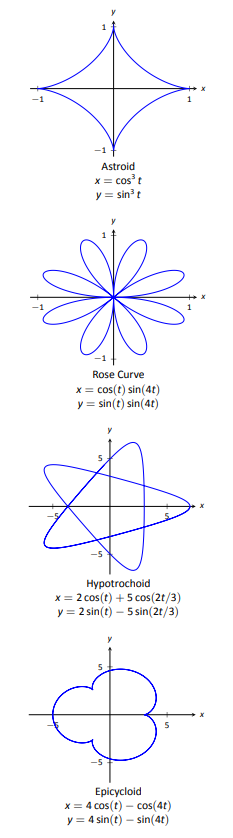
A parametric function in describes a curve using two equations instead of one. The variables and are both dependent on a single independent variable , called the parameter. You write the whole thing as a single function:
Here and are the names of two functions. At any input , you get a coordinate pair that marks one point on the curve. As changes, that point moves, so a parametric function naturally describes motion in the plane.
Why use two equations instead of writing in terms of ? Because some curves, like circles and ellipses, are not functions of on their own. Splitting the description into and lets you handle the horizontal and vertical parts separately, and it records the direction and order in which the curve is traced.
Building a Table of Values
To generate a numerical table, pick several values of inside the domain and evaluate both functions at each one:
Using equally spaced values keeps the spacing predictable and makes patterns easier to see. The more points you sample, the smoother your sketch will be.
Graphing the Curve
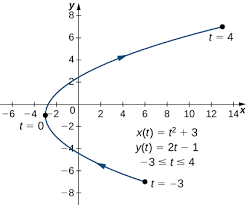
Once you have the table, plot each ordered pair and connect the points in order of increasing . The order matters: it shows the direction the curve is traced, often called the orientation. Two different parametrizations can draw the same shape but move along it in opposite directions or at different speeds.
Domain Restrictions, Start Points, and End Points
The domain of a parametric function is often restricted to a specific interval of . When it is, the curve has a definite start point (at the smallest allowed ) and an end point (at the largest allowed ). For example, if the domain is , the curve only exists for values from to , and the points at those endpoints are where the trace begins and stops.
A Quick Example: The Unit Circle
A point moving around a circle is a classic parametric example. A circle with center and radius can be written as:
As increases, the point moves around the circle. With center and radius , this becomes , the unit circle. This shows how parametric form captures motion that a single equation cannot.
How to Use This on the AP Precalculus Exam
Parametric functions are not on the AP Precalculus exam, but the work you do here strengthens skills that carry into class assessments and later courses. Focus on doing the procedures cleanly and reading the curve correctly.
Problem Solving
- When given and , build an organized table before sketching. Keep your values in order and evaluate both functions carefully.
- Label start and end points whenever the domain is restricted.
- Add an arrow or note the direction of increasing so the orientation is clear.
Using Technology
- When graphing parametric functions on a calculator, set an appropriate viewing window and restrict the parameter to the given interval. The wrong window or -range can hide part of the curve or draw extra pieces.
Common Trap
- Plotting points by -value instead of by increasing changes the path you draw. Always connect in order of .
Common Misconceptions
- Misconception: Thinking is plotted on an axis.Actually: The parameter is not graphed directly. Only and become coordinates; is the input that generates them.
- Misconception: Assuming one curve has only one set of equations.Actually: The same curve can be parametrized many ways, with different directions or speeds, so the equations tell you more than the shape alone.
- Misconception: Ignoring the order of when connecting points.Actually: Connecting by -value or at random can produce the wrong curve. Always connect points in order of increasing .
- Misconception: Forgetting domain restrictions.Actually: Leaving off the interval for drops the start and end points and can make the curve look longer or different than intended.
- Misconception: Treating and as directly dependent on each other.Actually: In parametric form, both depend on , not on each other. You compare them through the shared parameter.
Related AP Precalculus Guides
Practice Questions for 4.1
1 of 10
The parametric function is defined by and for . Which statement correctly identifies the center and radius?
A.
Center and radius ; cosine and sine alone produce circles at origin.
B.
Center and radius ; radius is the sum of constants and coefficient.
C.
Center and radius ; coefficients form center, constants determine radius.
D.
Center and radius ; constants shift the center, coefficient sets radius.
Vocabulary
The following words are mentioned explicitly in the AP® course framework for this topic.Term | Definition |
|---|---|
domain | The set of all possible input values for which a function is defined. |
parameter | An independent variable (often denoted t) used to express the coordinates of points on a curve in parametric form. |
parametric equations | A pair of equations that express x and y coordinates as functions of a parameter, typically written as x(t) and y(t). |
parametric function | A function that expresses the coordinates of a point as functions of a parameter, typically time t, written as f(t) = (x(t), y(t)). |
Frequently Asked Questions
What is a parametric function in AP Precalculus?
A parametric function in R2 uses two equations, x(t) and y(t), that depend on one parameter t. Together they create ordered pairs f(t) = (x(t), y(t)).
How do you graph a parametric function?
Choose t-values in the domain, evaluate x(t) and y(t), make a table of ordered pairs, plot the points, and connect them in order of increasing t.
Why does the order of t matter for parametric graphs?
The order of t shows the direction the curve is traced. Two parametrizations can create the same shape but move through it in different directions or at different speeds.
What does a restricted domain do to a parametric function?
A restricted domain limits the t-values you use, which creates a start point and an end point on the graph. Without the interval, the graph may include extra pieces.
Are parametric functions tested on the AP Precalculus exam?
Parametric functions support course learning, but the AP Precalculus exam assesses Units 1, 2, and 3. Topic 4.1 is still useful for class assessments and later calculus work.
How is AP Precalculus 4.1 used in class?
AP Precalculus 4.1 is used for building tables, sketching curves, interpreting motion, and understanding how x and y can both depend on a shared parameter.
See Fiveable more often in Google
Mark Fiveable as a preferred source and Google is more likely to show you our guides in Top Stories, with a "preferred" badge in AI Mode and AI Overviews.