4.2 Parametric Functions Modeling Planar Motion

📈AP Precalculus Unit 4 Review
4.2 Parametric Functions Modeling Planar Motion
📈 AP Precalculus
4.1
Parametric Functions
4.2
Parametric Functions Modeling Planar Motion
4.3
Parametric Functions and Rates of Change
4.4
Parametrically Defined Circles and Lines
4.5
Implicitly Defined Functions
4.6
Conic Sections
4.7
Parametrization of Implicitly Defined Functions
4.8
Vectors
4.9
Vector-Valued Functions
4.10
Matrices
4.11
The Inverse and Determinant of a Matrix
4.12
Linear Transformations and Matrices
4.13
Matrices as Functions
4.14
Matrices Modeling Contexts
A parametric function models a particle's position in the plane at each time . You can find where the particle goes farthest left, right, up, or down by looking at the max and min of and , and you can find axis crossings using the real zeros of and .
Why This Matters for the AP Precalculus Exam
Topics in Unit 4, including parametric planar motion, are not assessed on the AP Precalculus exam. The exam covers material from Units 1, 2, and 3. Some schools still teach this unit because it builds reasoning you will use in calculus and science courses, where breaking motion into horizontal and vertical pieces is a core skill.
Even though this topic is off the exam, the thinking transfers. You practice reading multiple representations (equations, tables, and graphs), choosing a procedure to find key features, and interpreting what those features mean for a moving object. That same habit of recognizing representations and explaining your reasoning shows up across the parts of the course that are tested.
Key Takeaways
- A parametric function f(t) = (x(t), y(t)) gives a particle's position in the plane, with x(t) for horizontal position and y(t) for vertical position at time t.
- The graph traces the particle's path, and the domain of t sets the start and end of the motion.
- Horizontal extrema come from the max and min of x(t); vertical extrema come from the max and min of y(t).
- The real zeros of x(t) give y-intercepts of the path; the real zeros of y(t) give x-intercepts.
- A table of values built from several t values lets you compare outputs and locate key features.
- Restricting the domain of t creates start and end points on the graph.
Modeling Motion with Parametric Functions
A parametric function f(t) = (x(t), y(t)) can model the motion of a particle in the plane. The function x(t) gives the horizontal position and y(t) gives the vertical position at time t. The graph of the function shows where the particle is for each value of t, which traces out the path of motion.
The domain of t sets the time interval for the motion. For example, if t is in [0, 10], the motion is modeled over a 10 second window starting at t = 0. The graph of the parametric function lets you visualize that path, which makes it easier to understand how the particle moves.
Restricting the domain of t produces a start point and an end point on the graph, so the path does not run forever in both directions.
Horizontal and Vertical Extrema
The horizontal and vertical extrema of a particle's motion come from the maximum and minimum values of x(t) and y(t).
The graph of the parametric function shows the path of the particle. The horizontal extrema are the largest and smallest x-coordinates, and the vertical extrema are the largest and smallest y-coordinates. These are the farthest points the particle reaches left, right, up, and down during its motion.
To find horizontal extrema, identify the max and min of x(t). To find vertical extrema, identify the max and min of y(t).
One direct method is to evaluate x(t) and y(t) at several values of t and compare the outputs.
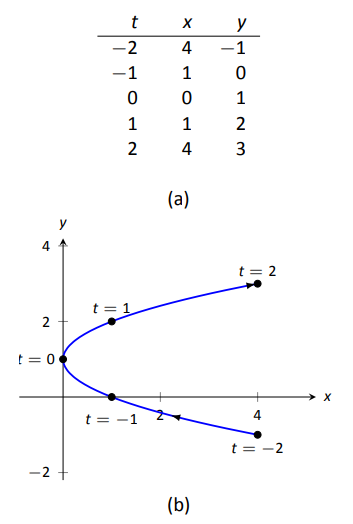
For example, if the domain is 0 < t < 10, choose several t values in that interval and evaluate x(t) and y(t). Comparing the outputs tells you the largest and smallest value of x(t) and the largest and smallest value of y(t). Those values are the horizontal and vertical extrema of the motion.
You can also reason about the shape of each function. If a function is periodic, it repeats after a fixed interval, so the extrema show up at predictable points in each cycle. If a function is symmetric, the extrema relate to that symmetry. Recognizing these patterns can help you locate extrema without testing every value of t.
Intercepts
The real zeros of x(t) correspond to y-intercepts of the path, and the real zeros of y(t) correspond to x-intercepts.
When x(t) = 0, the particle is on the y-axis, so that moment gives a y-intercept. When y(t) = 0, the particle is on the x-axis, so that moment gives an x-intercept. The real zeros of x(t) are the t values where x(t) = 0, and the real zeros of y(t) are the t values where y(t) = 0.
For example, take f(t) = (t^2 - 4, t). The x-intercepts happen where y = 0. Here y(t) = t = 0, so t = 0 gives an x-intercept. The y-intercepts happen where x = 0, so x(t) = t^2 - 4 = 0, which gives t = 2 and t = -2 as the y-intercepts.
How to Use This on the AP Precalculus Exam
Unit 4 is not tested on the AP Precalculus exam, so treat this topic as skill-building for later courses rather than direct exam prep. The problem-solving moves below are still worth practicing because they reinforce reasoning used throughout the course.
Problem Solving
- Read the parametric function carefully and separate it into x(t) and y(t) before doing anything else.
- To find extrema, work with x(t) and y(t) one at a time. Find the max and min of each.
- To find intercepts, set x(t) = 0 for y-intercepts and y(t) = 0 for x-intercepts, then solve for t.
- Build a table of values when the functions are hard to analyze directly. Pick several t values across the domain and compare outputs.
- Use a graphing calculator to set an appropriate viewing window and parameter range when graphing parametric functions, since the t domain controls what part of the path appears.
Common Trap
Keep the role of each component straight. Zeros of x(t) give y-intercepts, not x-intercepts, because x = 0 places the particle on the y-axis. Mixing these up is the easiest mistake to make on this topic.
Common Misconceptions
- Misconception: Zeros of x(t) give x-intercepts.Actually: Zeros of x(t) do not give x-intercepts. When x(t) = 0 the particle sits on the y-axis, so those t values give y-intercepts. Likewise, zeros of y(t) give x-intercepts.
- Misconception: The parameter t is an axis on the graph.Actually: The parameter t is not an axis on the graph. The path is drawn in the xy-plane, and t is the input that moves the particle along that path.
- Misconception: A point on the graph and a value of t are the same thing.Actually: A point on the graph and a value of t are not the same thing. Several different t values can land on the same point, and you often need the t value, not just the location.
- Misconception: Extrema of the motion are found by combining x(t) and y(t).Actually: Extrema of the motion are not found by combining x(t) and y(t). Horizontal extrema come only from x(t), and vertical extrema come only from y(t).
- Misconception: Changing the domain of t does not change the path you see.Actually: Changing the domain of t changes the path you see. A restricted domain gives start and end points, so the full curve and a restricted piece of it are not the same motion.
Related AP Precalculus Guides
Practice Questions for 4.2
1 of 10
A Ferris wheel passenger's position is modeled by and for minutes. The model predicts a minimum vertical position of 5 feet. Residuals for show no pattern and RMSE is 0.5 feet. However, the model predicts a maximum vertical position of 105 feet, while the physical structure has a maximum height of 80 feet. Which evaluation of this model is most justified?
A.
Accept the model: the random residuals and low RMSE of 0.5 feet confirm the trigonometric functions perfectly capture the periodic vertical extrema.
B.
Reject the model: despite random residuals and low RMSE, the predicted vertical extremum of 105 feet violates the physical constraints of the structure.
C.
Accept the model: the random residuals and low RMSE of 0.5 feet demonstrate that the predicted minimum vertical position of 5 feet is physically valid.
D.
Reject the model: despite random residuals and low RMSE, vertical extrema must be determined by analyzing the maximum values of the horizontal function.
Vocabulary
The following words are mentioned explicitly in the AP® course framework for this topic.Term | Definition |
|---|---|
horizontal extrema | The maximum and minimum x-coordinates reached by a particle during its motion, found by identifying extrema of x(t). |
parametric function | A function that expresses the coordinates of a point as functions of a parameter, typically time t, written as f(t) = (x(t), y(t)). |
particle motion | The path and position of a particle as it moves through space over time, modeled using parametric equations. |
planar motion | The movement of a particle or object in a two-dimensional plane. |
real zero | A real number value that makes a polynomial function equal to zero, corresponding to an x-intercept on the graph. |
vertical extrema | The maximum and minimum y-coordinates reached by a particle during its motion, found by identifying extrema of y(t). |
x-intercept | The point where a graph crosses or touches the x-axis, occurring at (a, 0) when a is a real zero of the function. |
y-intercepts | The points where the particle's path crosses the y-axis, corresponding to the real zeros of x(t). |
Frequently Asked Questions
What is AP Precalculus 4.2 about?
AP Precalculus 4.2 covers parametric functions modeling planar motion. A function f(t) = (x(t), y(t)) gives a particle's position in the plane at time t, with x(t) tracking horizontal position and y(t) tracking vertical position.
Is Unit 4 tested on the AP Precalculus exam?
No. AP Precalculus Unit 4 is not assessed on the AP exam, which covers Units 1, 2, and 3. This topic is still useful because parametric motion builds skills for calculus, physics, and later function modeling.
How do x(t) and y(t) work in parametric planar motion?
The function x(t) gives horizontal position and y(t) gives vertical position at the same time t. Together, the ordered pair (x(t), y(t)) traces the particle's path in the xy-plane.
How do I find horizontal and vertical extrema in parametric motion?
Find the maximum and minimum values of x(t) to locate horizontal extrema, and find the maximum and minimum values of y(t) to locate vertical extrema. The domain of t controls which part of the motion counts.
How do I find intercepts for a parametric path?
Solve x(t) = 0 to find y-intercepts, because the particle is on the y-axis when x equals 0. Solve y(t) = 0 to find x-intercepts, because the particle is on the x-axis when y equals 0.
Why does the t-domain matter for parametric functions?
The t-domain sets the time interval for the motion. Restricting t can create start and end points and can change which extrema, intercepts, and parts of the path appear on the graph.
See Fiveable more often in Google
Mark Fiveable as a preferred source and Google is more likely to show you our guides in Top Stories, with a "preferred" badge in AI Mode and AI Overviews.