2.13 Exponential and Logarithmic Equations and Inequalities

📈AP Precalculus Unit 2 Review
2.13 Exponential and Logarithmic Equations and Inequalities
📈 AP Precalculus
2.1
Change in Arithmetic and Geometric Sequences
2.2
Change in Linear and Exponential Functions
2.3
Exponential Functions
2.4
Exponential Function Manipulation
2.5
Exponential Function Context and Data Modeling
2.6
Competing Function Model Validation
2.7
Composition of Functions
2.8
Inverse Functions
2.9
Logarithmic Expressions
2.10
Inverses of Exponential Functions
2.11
Logarithmic Functions
2.12
Logarithmic Function Manipulation
2.13
Exponential and Logarithmic Equations and Inequalities
2.14
Logarithmic Function Context and Data Modeling
2.15
Semi-log Plots
To solve exponential and logarithmic equations and inequalities, use exponent rules, log rules, and the fact that exponentials and logarithms undo each other. Always check your answers for extraneous solutions, since log arguments must stay positive.
Exponential and Logarithmic Equations Summary
In AP Precalculus Topic 2.13, exponential and logarithmic equations are usually about choosing the right rewrite. If the bases match, set the exponents equal. If the variable is in an exponent and the bases do not match, take or of both sides and use the power rule. If the equation has logarithms, combine or rewrite them carefully while keeping the original domain restrictions. For transformed exponentials and logarithms, undo the additive transformations in reverse order to find the inverse mapping.
The most important check is whether your answer is allowed in the original problem. Log arguments must be positive, contextual quantities may have limits, and inequalities can flip when you apply a decreasing exponential or logarithmic function with base between 0 and 1.
Why This Matters for the AP Precalculus Exam
This topic pulls together everything you have learned about exponential and logarithmic functions in Unit 2 and turns it into a problem-solving skill. Exponential and logarithmic functions carry a large share of weight on the exam, so being able to solve these equations cleanly matters.
You will see these skills on both the multiple-choice and free-response sections. Some questions can be done by hand, while others let you use a graphing calculator to find points of intersection or numerical solutions. On free-response questions, answers without supporting work may not support a stronger score, so showing each step is important for clear exam work. Because exponential and logarithmic manipulation needs precision, skipping steps is where most errors sneak in.
Key Takeaways
- Use properties of exponents, properties of logarithms, and the inverse relationship between exponentials and logs to rewrite and solve equations and inequalities.
- A logarithm and an exponential with the same base undo each other: exactly when .
- Always check for extraneous solutions, especially solutions that would make a log argument zero or negative.
- The identity lets you rewrite an exponential expression with a different base when that is useful.
- To find the inverse of or , reverse each operation in the opposite order it was applied.
- Logarithms have a restricted domain (argument greater than zero), so keep that in mind for both solving and inverses.
Solving Exponential and Logarithmic Equations and Inequalities
Properties of exponents, properties of logarithms, and the inverse relationship between exponential and logarithmic functions can all be used to solve equations and inequalities. These tools let you change the form of an equation into something easier to solve.
Using Exponent and Log Properties
Exponent rules like the product, quotient, and power properties help you combine or split exponential expressions. For example, if you have
you can use the product property to write
Once the bases match, the exponents must be equal, so .
Logarithm rules work the same way. The product rule lets you combine two logs with the same base:
Combining logs into a single logarithm is often the first step in solving a logarithmic equation, because once you have a single log you can rewrite the equation in exponential form.
Using the Inverse Relationship
Because exponentials and logarithms are inverses, you can switch between the two forms to isolate a variable. For example, to solve
rewrite it as a logarithm:
If the bases do not match nicely, take a logarithm of both sides instead. For an equation like , take or of both sides and use the power rule to bring the exponent down.
Changing the Base
You can rewrite an exponential expression using a different base with the identity
This is handy when you want everything written with the same base, or with base , so the rest of the problem is easier to manage.
Inequalities and Direction
Solving an inequality works much like solving the matching equation, but you have to watch the direction of the inequality. Exponential and logarithmic functions with a base greater than 1 are increasing, so applying them keeps the inequality direction the same. With a base between 0 and 1 the function is decreasing, which flips the inequality. Always think about whether the function you are applying is increasing or decreasing.
Extraneous Solutions
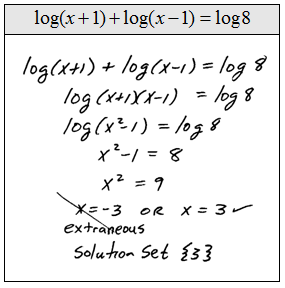
When you solve exponential and logarithmic equations, some answers you find may not actually be valid. These are called extraneous solutions, and they can show up from either algebraic steps or graphing.
The most common trap with logarithms is the domain. A logarithm is only defined when its argument is greater than zero, so any candidate solution that makes a log argument zero or negative must be thrown out.
For example, when solving
you can combine the left side into , set the arguments equal, and solve. After finding candidate values, plug each one back into the original equation. Any value that makes or zero or negative is not a real solution, since the log of that argument does not exist.
Always finish by checking your results against the domain and any limits from the context of the problem.
Building Inverses of Exponential and Logarithmic Functions
You can build the inverse of transformed exponential and logarithmic functions by reversing each operation. The idea is the same as undoing a chain of steps: reverse them in the opposite order they were applied.
Inverse of an Exponential Function
The function
is the general exponential function with shifts and a vertical stretch. To find its inverse, start from and undo each piece:
- Subtract from both sides:
- Divide both sides by :
- Take a logarithm (here ) of both sides:
- Solve for :
This gives you the input that produces a given output .
Inverse of a Logarithmic Function
The function
is the general logarithmic function with the same kinds of transformations. Starting from , undo each operation:
- Subtract from both sides:
- Divide both sides by :
- Rewrite in exponential form (raise to both sides):
- Subtract from both sides:
So the inverse is once you swap the roles of and . Notice that the exponential inverse uses a log step, and the logarithmic inverse uses an exponential step, which matches the inverse relationship between the two function types.
How to Use This on the AP Precalculus Exam
Problem Solving
- Decide first whether to match bases or take a logarithm of both sides. Matching bases is cleaner when both sides can be written with the same base.
- When a variable is stuck in an exponent, take or of both sides and use the power rule to bring it down.
- Combine logs into a single logarithm before rewriting a logarithmic equation in exponential form.
- For inequalities, check whether the base is greater than 1 (direction stays) or between 0 and 1 (direction flips).
Free Response
- Show each step of your manipulation. Answers without supporting work may not support a stronger score, so write out your log and exponent moves clearly.
- State any solutions you reject and why, such as a value that makes a log argument negative.
- If a question allows a calculator, you can confirm a solution by finding the intersection of the two sides graphed as separate functions.
Common Trap
- Forgetting to check the domain after solving a log equation. Always test candidate solutions in the original equation.
Common Misconceptions
- Misconception: Every algebraic solution is valid.Actually: Some answers are extraneous. A value that makes a log argument zero or negative is not a real solution, even if the algebra looked fine.
- Misconception: Inequalities always keep the same direction.Actually: With an exponential or logarithmic base between 0 and 1, the function is decreasing, so the inequality direction flips.
- Misconception: is the same as with no restrictions.Actually: The combined form is only valid where both original arguments are positive, so you still have to respect the original domain.
- Misconception: You can only solve when the bases match.Actually: If they do not match, take a logarithm of both sides and use the power rule to bring the exponent down.
- Misconception: Finding an inverse just means flipping a sign.Actually: Building an inverse means reversing every operation in the opposite order, including the log or exponential step that undoes the function type.
Related AP Precalculus Guides
Practice Questions for 2.13
1 of 10
A student solves the equation algebraically and finds a potential solution. Which statement correctly describes the validity of this solution and explains why?
A.
The solution is valid because the logarithm domain includes all real numbers when equations are simplified.
B.
The solution is extraneous because the logarithm range requires all evaluated outputs to be strictly positive.
C.
The solution is extraneous because the logarithm domain requires all input arguments to be strictly positive.
D.
The solution is valid because the logarithm range includes all real numbers when the equations are evaluated.
Vocabulary
The following words are mentioned explicitly in the AP® course framework for this topic.Term | Definition |
|---|---|
additive transformations | Shifts of a function's graph vertically or horizontally, represented by the parameters h and k in transformed function forms. |
exponential equations | Equations in which the variable appears in the exponent, solved using properties of exponents and logarithms. |
exponential function | A function of the form f(x) = ab^x where a ≠ 0 is the initial value and b > 0, b ≠ 1 is the base. |
exponential inequalities | Inequalities in which the variable appears in the exponent, solved using properties of exponents and logarithms. |
extraneous solutions | Solutions obtained through algebraic manipulation that do not satisfy the original equation or are excluded by mathematical or contextual limitations. |
inverse function | A function that reverses the mapping of another function, such that if f(x) = y, then f⁻¹(y) = x. |
inverse operations | Operations that undo each other, such as addition and subtraction or exponentiation and logarithms, used to reverse a function's mapping. |
inverse relationship between exponential and logarithmic functions | The mathematical relationship where exponential and logarithmic functions undo each other, allowing conversion between exponential and logarithmic forms. |
logarithmic equations | Equations involving logarithms, solved using properties of logarithms and the inverse relationship with exponential functions. |
logarithmic function | A function of the form f(x) = a log_b x where b > 0, b ≠ 1, and a ≠ 0, characterized by output values changing additively as input values change multiplicatively. |
logarithmic inequalities | Inequalities involving logarithms, solved using properties of logarithms and the inverse relationship with exponential functions. |
properties of exponents | Rules governing operations with exponential expressions, used to simplify and solve exponential equations. |
properties of logarithms | Rules governing operations with logarithmic expressions, including product, quotient, and power properties, used to solve logarithmic equations. |
Frequently Asked Questions
How do you solve exponential equations in AP Precalculus?
First check whether both sides can be written with the same base. If they can, set the exponents equal. If not, take ln or log of both sides and use the power rule to bring the variable down.
How do you solve logarithmic equations?
Use log properties to combine or simplify logarithms, then rewrite the equation in exponential form when helpful. After solving, check every candidate in the original equation because log arguments must be positive.
When should you use ln and e?
Use ln when an exponential equation has base e or when taking natural logs makes the algebra cleaner. Since ln and e are inverse operations, ln(e^x) = x and e^(ln x) = x for x greater than 0.
Why do logarithmic equations have extraneous solutions?
Logarithmic equations can create extraneous solutions when algebraic steps produce values that make an original log argument zero or negative. Always check candidate answers in the original equation, not just the simplified form.
How do inequalities work with exponential and logarithmic functions?
Solve the related equation, then use monotonicity. If the base is greater than 1, the function is increasing and the inequality direction stays the same; if the base is between 0 and 1, it is decreasing and the direction flips.
How do you find inverses of exponential and logarithmic functions?
Reverse the operations in the opposite order. For transformed exponential functions, a logarithm undoes the exponential step; for transformed logarithmic functions, an exponential step undoes the logarithm.
See Fiveable more often in Google
Mark Fiveable as a preferred source and Google is more likely to show you our guides in Top Stories, with a "preferred" badge in AI Mode and AI Overviews.