4.12 Linear Transformations and Matrices

📈AP Precalculus Unit 4 Review
4.12 Linear Transformations and Matrices
📈 AP Precalculus
4.1
Parametric Functions
4.2
Parametric Functions Modeling Planar Motion
4.3
Parametric Functions and Rates of Change
4.4
Parametrically Defined Circles and Lines
4.5
Implicitly Defined Functions
4.6
Conic Sections
4.7
Parametrization of Implicitly Defined Functions
4.8
Vectors
4.9
Vector-Valued Functions
4.10
Matrices
4.11
The Inverse and Determinant of a Matrix
4.12
Linear Transformations and Matrices
4.13
Matrices as Functions
4.14
Matrices Modeling Contexts
A linear transformation from to is a function that sends each input vector to an output vector using a unique matrix , where . To find an output vector, you multiply the transformation matrix by the input column vector, and you can transform many vectors at once by putting them in a matrix.
Why This Matters for the AP Precalculus Exam
Unit 4 topics, including this one, are not assessed on the AP Precalculus exam. The exam covers material from Units 1, 2, and 3. Still, learning linear transformations is worth your time because it builds the reasoning skills that show up across AP Precalculus: working with multiple representations, choosing the right procedure, and explaining why your steps work. This topic also connects directly to matrix multiplication, inverses, and determinants, so practicing it strengthens your overall comfort with matrices and vectors. If your school includes Unit 4, you will also get practice using a graphing calculator to build matrices and compute products.
Key Takeaways
- A linear transformation maps each component of the output vector as a sum of constant multiples of the input vector's components.
- Every linear transformation sends the zero vector to the zero vector.
- A single vector in is a 2 x 1 column vector; a set of vectors is a 2 x n matrix.
- For any linear transformation from to , there is exactly one 2 x 2 matrix with , and any 2 x 2 matrix defines a linear transformation.
- Multiplying a 2 x 2 matrix by a 2 x n matrix of input vectors gives a 2 x n matrix of output vectors, so you can transform many vectors in one step.
What a Linear Transformation Does
A linear transformation is a function that maps an input vector to an output vector so that each component of the output is the sum of constant multiples of the input vector's components. This is what makes the function "linear."
For an input vector , you find the output by multiplying by the matrix that represents the transformation:
Because the output is built from constant multiples of the input components, transformations preserve vector addition and scalar multiplication. In other words, for vectors and and a scalar :
The 2 x 2 matrix that represents the transformation is often called the transformation matrix.
Expressing Zero, Single, and n-Vectors
The set of all two-dimensional vectors is written .
The zero vector
One key property of every linear transformation is that it maps the zero vector to the zero vector. The zero vector has all components equal to zero.
Because a linear transformation preserves scalar multiplication, you can see why this always works:
So no matter what transformation you have, the zero vector stays put.
Single vectors and sets of vectors
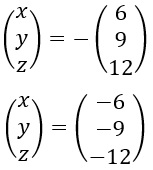
A single vector in can be written as a 2 x 1 matrix, also called a column vector. It has two rows and one column and looks like , where and are the coordinates of the vector.
A set of vectors in can be written as a 2 x n matrix by placing the column vectors side by side. The result has two rows and columns and can be written as .
Writing a set of vectors as one matrix lets you use matrix multiplication to transform all of them in a single operation instead of one at a time.
Working Out Linear Transformations
For a linear transformation from to , there is a unique 2 x 2 matrix such that for every vector in . This matrix is the transformation matrix, and it holds all the information about how stretches, rotates, or reflects vectors. Different transformations have different matrices.
The connection works both ways. For any 2 x 2 matrix , the function is a linear transformation from to , because it preserves vector addition and scalar multiplication:
Multiplying to Transform Many Vectors at Once
Multiplying a 2 x 2 transformation matrix by a 2 x n matrix of input vectors gives a 2 x n matrix of the output vectors for the transformation . Each column of the result is the output vector that goes with the matching input column.
To compute the product, use the row-by-column rule: the entry in row , column of the result is the dot product of row of and column of the input matrix. The output matrix has the same number of columns as the input matrix, and each column is the transformed version of the corresponding input vector.
This is the efficient part of linear transformations: you set up all your input vectors as columns, multiply once, and read off every output vector from the result.
How to Use This on the AP Precalculus Exam
Unit 4 is not tested on the AP Precalculus exam, so treat this section as guidance for class assessments and for building skills that carry into calculus.
Problem Solving
- To transform a single vector, write it as a 2 x 1 column vector and compute using the row-by-column rule.
- To transform several vectors at once, stack them as columns in a 2 x n matrix, then multiply by that matrix.
- Use the zero vector check: if your transformation does not send to , something is off, because every linear transformation must fix the zero vector.
- Keep your matrix dimensions clear. A 2 x 2 matrix times a 2 x n matrix gives a 2 x n result, so the number of output vectors matches the number of input vectors.
Common Trap
- Order matters in matrix multiplication. The transformation matrix goes on the left and the vector or vector matrix on the right: , not .
- Showing each dot product step keeps your work clear and easy to check, which is important for clean problem solving.
Common Misconceptions
- Misconception: Any function on vectors is a linear transformation.Actually: Only functions where each output component is a sum of constant multiples of the input components qualify. If a function does not send the zero vector to the zero vector, it is not linear.
- Misconception: and give the same thing.Actually: Matrix multiplication is not commutative. The transformation matrix must multiply the vector from the left.
- Misconception: Each transformation could match several different 2 x 2 matrices.Actually: For a transformation from to , the 2 x 2 matrix is unique.
- Misconception: Transforming many vectors means repeating the work for each one.Actually: You can place all input vectors as columns in a 2 x n matrix and transform them with a single multiplication.
- Misconception: The output column matches the wrong input.Actually: In the result, column is always the transform of column of the input matrix, so keep your columns lined up.
Related AP Precalculus Guides
Practice Questions for 4.12
1 of 10
A linear transformation is defined by , where . For which of the following input vectors does the transformation map to itself, such that ?
A.
B.
C.
D.
Vocabulary
The following words are mentioned explicitly in the AP® course framework for this topic.Term | Definition |
|---|---|
input vector | The vector that is mapped or transformed by a linear transformation. |
linear transformation | A function that maps vectors to vectors while preserving vector addition and scalar multiplication, represented by a matrix. |
matrix multiplication | The operation of multiplying a transformation matrix by a vector or matrix to produce output vectors. |
output vector | The resulting vector produced by applying a linear transformation to an input vector. |
ℝ² | The two-dimensional real vector space consisting of all ordered pairs of real numbers. |
transformation matrix | A 2 × 2 matrix A that represents a linear transformation, where L(v) = Av for vectors v in ℝ². |
zero vector | A vector with components ⟨0, 0⟩ that occurs when the tail and head are at the same point. |
Frequently Asked Questions
What is a matrix in AP Precalculus?
A matrix is a rectangular array of numbers. In Topic 4.12, a 2 x 2 matrix represents a linear transformation from R^2 to R^2.
What is a linear transformation?
A linear transformation maps an input vector to an output vector so each output component is a sum of constant multiples of the input components.
How do you use a matrix to transform a vector?
Write the vector as a column vector and multiply it by the transformation matrix on the left, using L(v)=Av.
What happens to the zero vector under a linear transformation?
Every linear transformation maps the zero vector to the zero vector. If a function does not do that, it is not linear.
How can a matrix transform many vectors at once?
Place the input vectors as columns in a 2 x n matrix, then multiply the 2 x 2 transformation matrix by that input matrix.
Is Unit 4 tested on the AP Precalculus exam?
No. Unit 4 is not assessed on the AP Precalculus exam, but it builds useful matrix, vector, and representation skills for class and later math.
See Fiveable more often in Google
Mark Fiveable as a preferred source and Google is more likely to show you our guides in Top Stories, with a "preferred" badge in AI Mode and AI Overviews.