1.8 Rational Functions and Zeros

📈AP Precalculus Unit 1 Review
1.8 Rational Functions and Zeros
📈 AP Precalculus
1.1
Change in Tandem
1.2
Rates of Change
1.3
Rates of Change in Linear and Quadratic Functions
1.4
Polynomial Functions and Rates of Change
1.5
Polynomial Functions and Complex Zeros
1.6
Polynomial Functions and End Behavior
1.7
Rational Functions and End Behavior
1.8
Rational Functions and Zeros
1.9
Rational Functions and Vertical Asymptotes
1.10
Rational Functions and Holes
1.11
Equivalent Representations of Polynomial and Rational Expressions
1.12
Transformations of Functions
1.13
Function Model Selection and Assumption Articulation
1.14
Function Model Construction and Application
The real zeros of a rational function are the x-values that make the numerator zero, as long as those x-values are still in the function's domain. If a value makes both the numerator and denominator zero, check whether it cancels out (creating a hole) before calling it a zero.
Why This Matters for the AP Precalculus Exam
Finding zeros of rational functions shows up when you analyze graphs, match equations to features like x-intercepts, and solve rational inequalities. This connects directly to nearby skills in Unit 1: end behavior and horizontal asymptotes, vertical asymptotes, and holes. Being able to factor, cancel common factors carefully, and track domain restrictions helps you interpret rational function behavior across graphs, tables, and equations. Some exam questions allow a graphing calculator, so you should be comfortable finding real zeros both by hand and by reading a graph.
Key Takeaways
- A real zero of a rational function comes from a real zero of the numerator that is still in the domain.
- Always exclude x-values that make the denominator zero before listing zeros.
- If a factor cancels from numerator and denominator, that x-value is a hole, not a zero and not a vertical asymptote.
- Zeros give x-intercepts; denominator zeros that do not cancel give vertical asymptotes.
- To solve r(x) >= 0 or r(x) <= 0, use the numerator zeros and the asymptotes as boundary points on a sign chart.
- Pay attention to whether endpoints are included or excluded when writing solution sets in interval notation.
Finding Real Zeros
The real zeros of a rational function correspond to the real zeros of the numerator for values that are still in the domain. So to find real zeros, you mainly look at the polynomial in the numerator, but you have to respect domain restrictions from the denominator.
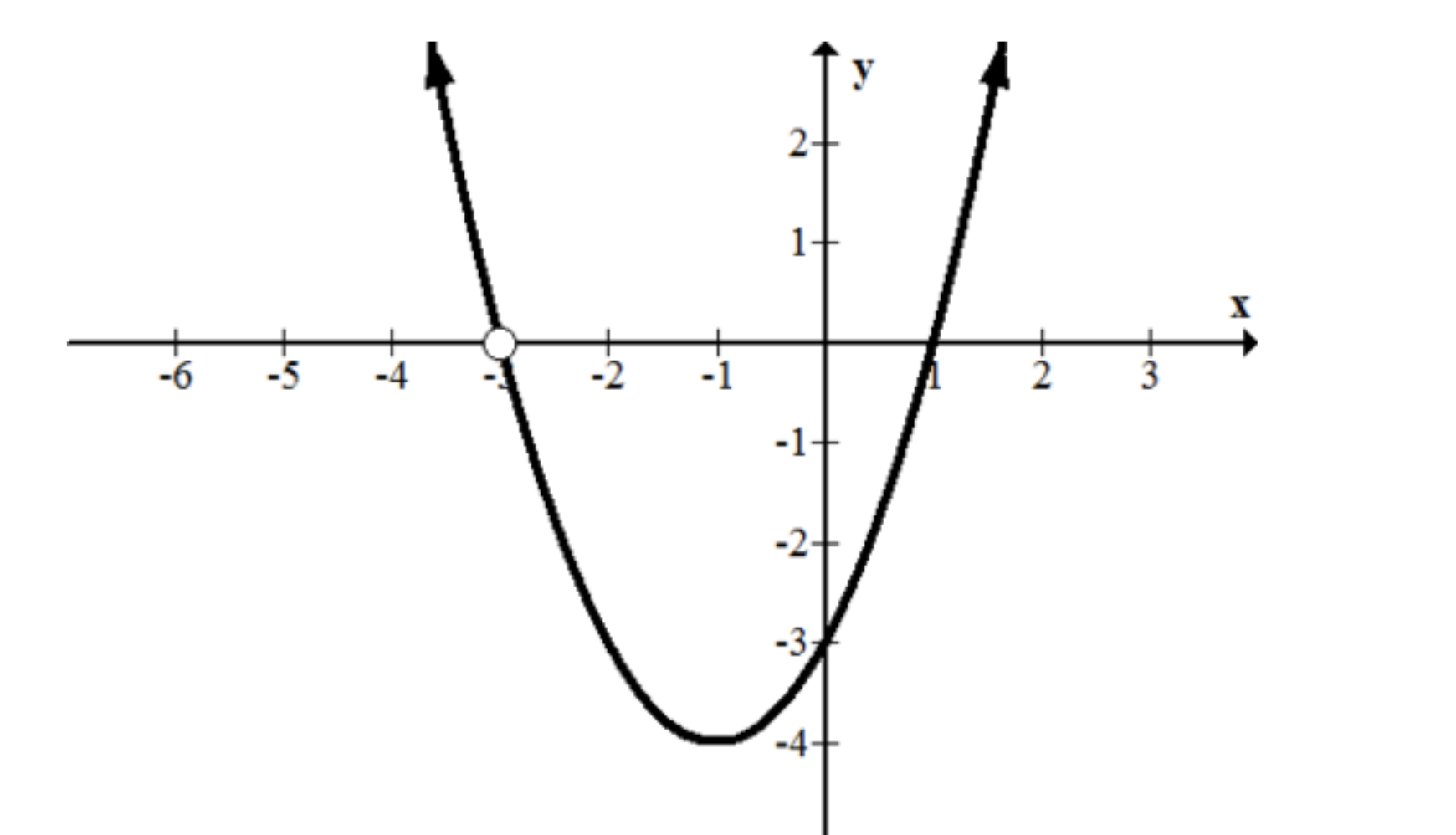
Consider this rational function:
Factor the numerator:
The denominator has a zero at x = 2, so x = 2 is not in the domain. You must exclude it from the start. After canceling the common factor for all x not equal to 2, the function simplifies to:
From this form, the real zero is at x = -2, which matches the real zero of the numerator factor x + 2.
A reliable process for any rational function:
- Factor the numerator and the denominator.
- Exclude any x-values where the denominator equals zero.
- Simplify, then read the real zeros from the remaining numerator factors that are still in the domain.
Zeros and Asymptotes as Boundary Points
The real zeros of both the numerator and denominator matter when you solve inequalities like or . These x-values act as boundary points where the function can change sign. Numerator zeros that are in the domain can be endpoints of solution intervals, and denominator zeros that do not cancel give vertical asymptotes that split the number line.
To solve a rational inequality, find where the function is positive or negative on each interval between boundary points. A sign chart helps: mark the numerator zeros and the asymptotes on a number line, then test a point in each interval.
Walkthrough
Using the same function:
The numerator has real zeros at and . The denominator has a zero at , so the function is undefined there. Exclude x = 2 from your analysis.
Check the sign around . Test a value just less than -2, like :
So the function is negative just to the left of x = -2. Now test a value just greater than -2, like :
So the function is positive just to the right of x = -2. The sign changes at x = -2, which confirms it is a real zero where the graph crosses the x-axis.
Now look at . This is a hole (removable discontinuity), not a vertical asymptote. Because the factor cancels from numerator and denominator, the function simplifies to for all . As x approaches 2 from either side, the output approaches , not infinity. Since the function is undefined at (and not equal to zero there), this point is excluded from the domain. It is neither a zero nor a place where the inequality solution can include an endpoint. The only real zero of this rational function is .
How to Use This on the AP Precalculus Exam
MCQ
- When asked for zeros or x-intercepts, factor the numerator and check that each candidate is still in the domain.
- Watch for canceling factors. A value that cancels is a hole, so it is not an x-intercept.
- For "where is r(x) positive or negative" questions, mentally place numerator zeros and vertical asymptotes as boundary points and test signs between them.
Free Response
- Show your factoring and clearly state which x-values are excluded from the domain.
- When you cancel a common factor, note the restriction like so your work stays accurate.
- For rational inequalities, write your solution in interval notation and be clear about whether each endpoint is included or excluded.
Common Trap
- Do not list a value as a zero just because it makes the numerator zero. It must also be in the domain.
- A horizontal or vertical asymptote is not a zero. Keep zeros (numerator) and asymptotes (denominator) separate in your reasoning.
Common Misconceptions
- Misconception: Every numerator zero is an x-intercept.Actually: Not true if that value also makes the denominator zero. Check the domain first.
- Misconception: A canceled factor gives a vertical asymptote.Actually: A factor that cancels gives a hole, not a vertical asymptote. A denominator zero that does not cancel gives the vertical asymptote.
- Misconception: The function value at a hole is undefined, so it equals zero.Actually: Undefined is not the same as zero. At a hole, the graph has a gap, and the y-value the graph approaches is a finite number, not zero.
- Misconception: Setting the whole rational expression equal to zero means setting numerator and denominator to zero.Actually: Only the numerator equals zero for a real zero. The denominator equals zero gives excluded values, not zeros.
- Misconception: Endpoints in inequality solutions are always included.Actually: Whether an endpoint is included depends on the inequality sign and whether that point is in the domain. A hole or asymptote location cannot be included.
Related AP Precalculus Guides
Practice Questions for 1.8
1 of 10
The rational function has both a zero and a discontinuity. Which statement correctly identifies these features?
A.
Zero at ; vertical asymptote at from the denominator factor.
B.
Zero at ; hole at from the canceled factor .
C.
Zero at ; hole at from the canceled factor .
D.
Zero at ; vertical asymptote at from the denominator.
Vocabulary
The following words are mentioned explicitly in the AP® course framework for this topic.Term | Definition |
|---|---|
asymptote | Lines that a graph approaches but never reaches, indicating behavior at infinity or at points of discontinuity. |
domain | The set of all possible input values for which a function is defined. |
numerator | The polynomial expression in the top part of a rational function. |
rational function inequalities | Inequalities of the form r(x) ≥ 0 or r(x) ≤ 0 where r is a rational function, used to determine intervals where the function is non-negative or non-positive. |
zeros of rational functions | The real values of x for which a rational function equals zero, which correspond to the real zeros of the numerator when those values are in the domain of the function. |
Frequently Asked Questions
How do you find zeros of a rational function?
Factor the numerator and denominator, exclude values that make the denominator zero, and then solve for the numerator zeros that remain in the domain.
Can a denominator zero be a zero of a rational function?
No. If a value makes the denominator zero, the function is not defined there, so it cannot be a zero. It may create a hole or a vertical asymptote instead.
What is the difference between a hole and a zero?
A zero is an x-value in the domain where the function equals 0. A hole is an excluded x-value caused by a factor that cancels from the numerator and denominator.
How do zeros and asymptotes help solve rational inequalities?
Zeros and vertical asymptotes create boundary points on a sign chart. Test intervals between those points to decide where the rational function is positive or negative.
What is the AP Precalculus trap with rational function zeros?
The trap is listing every numerator zero without checking the domain. Always remove denominator zeros first, including values that become holes after cancellation.
See Fiveable more often in Google
Mark Fiveable as a preferred source and Google is more likely to show you our guides in Top Stories, with a "preferred" badge in AI Mode and AI Overviews.