2.1 Change in Arithmetic and Geometric Sequences

📈AP Precalculus Unit 2 Review
2.1 Change in Arithmetic and Geometric Sequences
📈 AP Precalculus
2.1
Change in Arithmetic and Geometric Sequences
2.2
Change in Linear and Exponential Functions
2.3
Exponential Functions
2.4
Exponential Function Manipulation
2.5
Exponential Function Context and Data Modeling
2.6
Competing Function Model Validation
2.7
Composition of Functions
2.8
Inverse Functions
2.9
Logarithmic Expressions
2.10
Inverses of Exponential Functions
2.11
Logarithmic Functions
2.12
Logarithmic Function Manipulation
2.13
Exponential and Logarithmic Equations and Inequalities
2.14
Logarithmic Function Context and Data Modeling
2.15
Semi-log Plots
A sequence is a function that takes whole numbers and outputs real numbers, so its graph is a set of separate points, not a smooth curve. Arithmetic sequences change by adding the same number each step, called the common difference , while increasing or decreasing geometric sequences change by multiplying by the same number each step, called the common ratio .
Why This Matters for the AP Precalculus Exam
This topic is the foundation for all of Unit 2, which is one of the more heavily weighted parts of the AP Precalculus exam. Arithmetic sequences set up the thinking behind linear functions, and geometric sequences set up the thinking behind exponential functions. If you can recognize whether a pattern changes by a constant difference or a constant ratio, you will move faster on later topics like exponential models and logarithmic functions.
On the exam, you may need to:
- Read a table or word problem and decide if a pattern is arithmetic or geometric.
- Write the general term and use it to find a specific term.
- Recognize that sequence graphs are discrete points, not connected curves.
- Compare how arithmetic and geometric sequences grow over equal steps.
Showing clear steps is important for clear exam work, especially on free-response questions where answers without supporting work may not support a stronger score.
Key Takeaways
- A sequence is a function from the whole numbers to the real numbers, so its graph is made of discrete points.
- Arithmetic sequences have a common difference d (constant rate of change). General term: or .
- Geometric sequences have a common ratio r, or constant ratioal change. General term: or .
- Add to move between arithmetic terms; multiply to move between geometric terms.
- Increasing arithmetic sequences grow by the same amount each step; increasing geometric sequences grow by a larger amount each step.
- Watch your indexing: is the initial term in these formulas, not .
Sequences as Functions
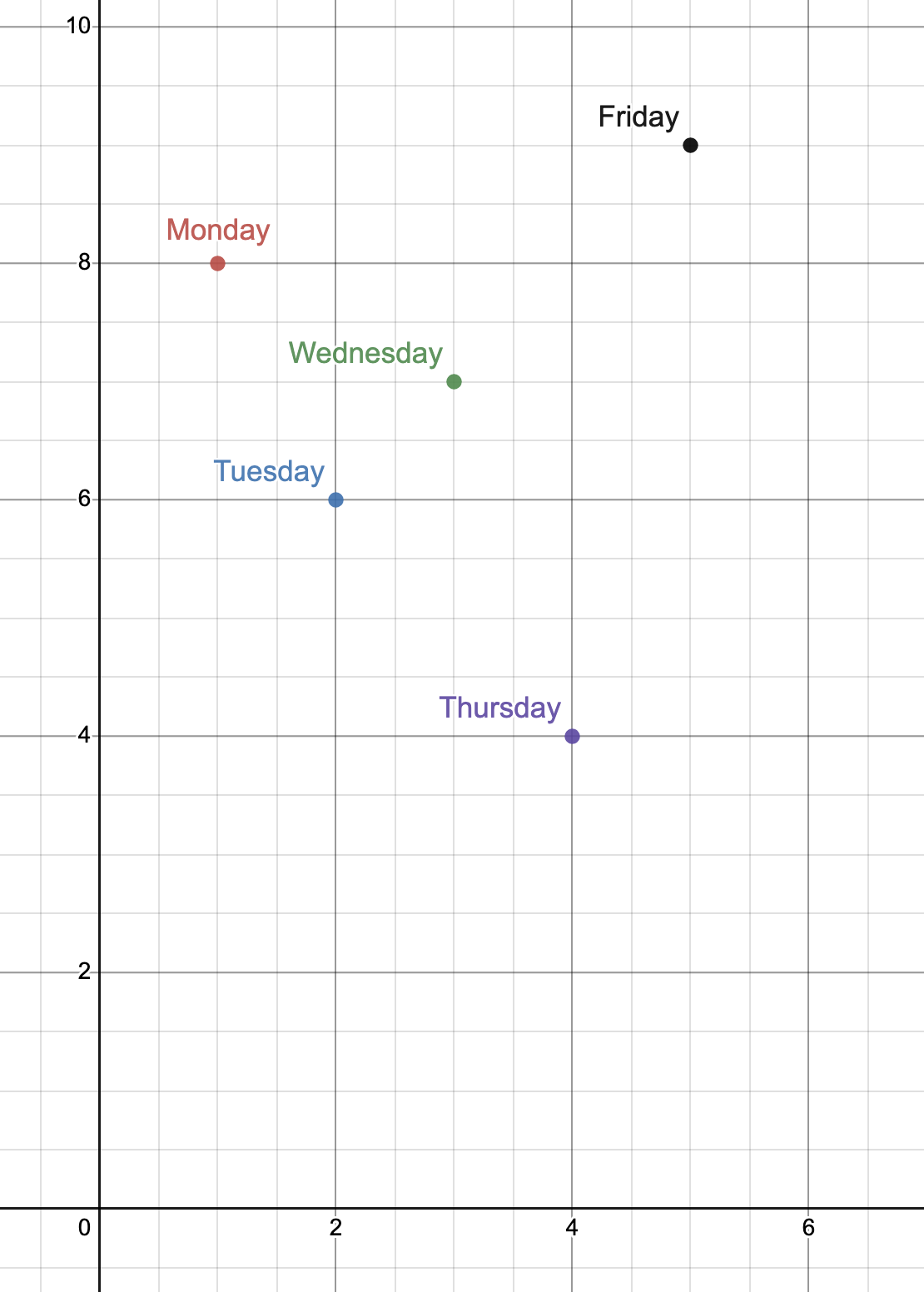
A sequence is a function from the whole numbers to the real numbers. It takes a whole number (like n) and assigns it a real number. Think of a class schedule where Monday is 1, Tuesday is 2, and so on. Each position gets one output value.
Because the inputs are only whole numbers, the graph of a sequence is a set of discrete points, not a smooth curve. For example, you could track hours of sleep each night: 8 hours on day 1, 6 hours on day 2, 7 hours on day 3, and so on. The input is the day and the output is the number of hours. Graphing this gives separate points, one per day.
Do not connect the dots like you would for a continuous function. The points stand alone.
Arithmetic Sequences
An arithmetic sequence is a sequence where the difference between any two consecutive terms is constant. That constant is the common difference, d. Because the gap between terms is always the same, an arithmetic sequence has a constant rate of change.
For example, an arithmetic sequence with a first term of 5 and a common difference of 3 looks like this: 5, 8, 11, 14, 17, 20, ... . The rate of change is 3 every step.
The sign of d tells you the direction:
- If d is positive, the terms increase.
- If d is negative, the terms decrease.
Formula and Example
The general term of an arithmetic sequence with common difference d is denoted by and given by:
Here is the initial value, and n is the term number, so you can plug in any whole number for n to find that term.
You can also write the general term relative to a known kth term:
This is useful when you know some term in the middle of the sequence instead of the starting value.
For a sequence with and :
- Using the first form: .
- Using the second form with the known term : .
Both forms give the same value. The second form just lets you start from any known term instead of the initial value.
Geometric Sequences
A geometric sequence is a sequence where the ratio of any two consecutive terms is constant. That constant is the common ratio, r, which can be a fraction or a decimal. Because the ratio between terms is always the same, a geometric sequence has a common ratio, or constant ratioal change.
For example, a geometric sequence with a first term of 2 and a common ratio of 3 looks like this: 2, 6, 18, 54, 162, ... . Each term is 3 times the one before it.
The value of r tells you the behavior:
- If r is greater than 1, the terms increase.
- If r is between 0 and 1, the terms decrease toward zero.
Formula
The general term of a geometric sequence with common ratio r is denoted by and given by:
Here is the initial value, and n is the term number.
You can also write the general term relative to a known kth term:
This works the same way as the arithmetic version: if you know one term and the common ratio, you can find any other term.
Comparing Arithmetic and Geometric Growth
The key difference is addition versus multiplication.
- Arithmetic sequences increase by the same amount each step. With a first term of 5 and d = 3, the terms 5, 8, 11, 14, 17, 20 each go up by 3.
- Geometric sequences increase by a larger amount each step (when increasing). With a first term of 2 and r = 3, the terms 2, 6, 18, 54, 162 jump by more and more each time, because each term is multiplied by 3.
This is why increasing geometric sequences eventually pull far ahead of increasing arithmetic sequences. The arithmetic pattern climbs steadily, but the geometric pattern speeds up.
How to Use This on the AP Precalculus Exam
Identify the Type First
Before using any formula, decide whether the pattern is arithmetic or geometric:
- Subtract consecutive terms. If the difference is constant, it is arithmetic.
- Divide consecutive terms. If the ratio is constant, it is geometric.
If neither the differences nor the ratios are constant, it is some other kind of sequence.
Choose the Right Formula Form
- Use or when you know the initial value.
- Use or when you only know a term in the middle and the difference or ratio.
Problem Solving
When a question gives you two terms, find d or r first, then back out the initial value if you need it. For an arithmetic sequence, set up the difference between term positions. For a geometric sequence, divide the terms to isolate r.
Write out each step. On free-response questions, answers without supporting work may not be accepted, and these formulas reward careful, step-by-step setup.
Common Trap
Pay attention to whether the problem indexes from or . The formulas here use as the initial value, so an off-by-one mistake will shift every term.
Common Misconceptions
- Misconception: A sequence graph should be connected with a continuous curve.Actually: A sequence graph is discrete points only. Do not draw a continuous curve through them.
- Misconception: A common difference means you multiply by the same number each step, and a common ratio means you add the same number each step.Actually: A common difference means you add the same number each step (arithmetic). A common ratio means you multiply by the same number each step (geometric).
- Misconception: A geometric sequence's ratio is always greater than 1.Actually: A geometric sequence can have a ratio between 0 and 1, which makes it decrease toward zero, or even a negative ratio, which makes the signs alternate.
- Misconception: is the first counted term .Actually: in these formulas is the initial term, not the first counted term . Check whether n starts at 0 or 1 before plugging in.
- Misconception: An increasing geometric sequence always beats an arithmetic sequence immediately.Actually: An increasing geometric sequence pulls ahead over time, but it can start out smaller than an arithmetic sequence depending on the initial values.
Related AP Precalculus Guides
Practice Questions for 2.1
1 of 10
The graph above displays the volume of water , in gallons, remaining in a tank after hours.
Which of the following equations represents the arithmetic sequence ?
A.
B.
C.
D.
Vocabulary
The following words are mentioned explicitly in the AP® course framework for this topic.Term | Definition |
|---|---|
arithmetic sequence | A sequence where each term after the first is found by adding a fixed number called the common difference to the previous term. |
common difference | The constant difference between successive terms in an arithmetic sequence, denoted by d. |
common ratio | The constant factor by which each term in a geometric sequence is multiplied to obtain the next term. |
constant proportional change | A relationship where successive terms change by the same multiplicative factor, characteristic of geometric sequences. |
constant rate of change | The uniform change between successive terms in an arithmetic sequence. |
general term | A formula that represents any term in a sequence based on its position, such as g_n = g_0 r^n for geometric sequences. |
geometric sequence | A sequence where each term after the first is found by multiplying the previous term by a fixed number called the common ratio. |
initial value | The starting value of a function, represented by b in linear functions and a in exponential functions. |
sequence | A function from the whole numbers to the real numbers, producing a list of ordered values. |
whole numbers | The set of non-negative integers {0, 1, 2, 3, ...} used as the domain for a sequence function. |
Frequently Asked Questions
What is a sequence in AP Precalculus?
A sequence is a function from whole numbers to real numbers. Its graph is made of discrete points because the input values are whole-number positions, not every real number.
What is an arithmetic sequence?
An arithmetic sequence changes by a constant amount each step, called the common difference. Its explicit form can be written as a_n = a_0 + dn or a_n = a_k + d(n - k).
What is a geometric sequence?
A geometric sequence changes by a constant factor each step, called the common ratio. Its explicit form can be written as g_n = g_0 r^n or g_n = g_k r^(n - k).
How do I tell arithmetic and geometric sequences apart?
Check whether terms change by adding the same amount or multiplying by the same factor. Constant difference means arithmetic; constant ratio means geometric.
How do arithmetic and geometric growth compare?
Increasing arithmetic sequences grow by equal amounts each step, while increasing geometric sequences grow by larger amounts each step because each term is multiplied by a common ratio.
How do sequences show up on the AP Precalculus exam?
Expect questions that ask you to write explicit or recursive formulas, identify common difference or common ratio, interpret context, and remember that sequence graphs are discrete.
See Fiveable more often in Google
Mark Fiveable as a preferred source and Google is more likely to show you our guides in Top Stories, with a "preferred" badge in AI Mode and AI Overviews.