4.13 Matrices as Functions

📈AP Precalculus Unit 4 Review
4.13 Matrices as Functions
📈 AP Precalculus
4.1
Parametric Functions
4.2
Parametric Functions Modeling Planar Motion
4.3
Parametric Functions and Rates of Change
4.4
Parametrically Defined Circles and Lines
4.5
Implicitly Defined Functions
4.6
Conic Sections
4.7
Parametrization of Implicitly Defined Functions
4.8
Vectors
4.9
Vector-Valued Functions
4.10
Matrices
4.11
The Inverse and Determinant of a Matrix
4.12
Linear Transformations and Matrices
4.13
Matrices as Functions
4.14
Matrices Modeling Contexts
A 2 x 2 matrix can act like a function that takes an input vector and produces an output vector. The columns of that matrix tell you where the standard unit vectors land, so once you know how the transformation moves and , you know the whole matrix.
Why This Matters for the AP Precalculus Exam
Unit 4 topics, including matrices as functions, are not assessed on the AP Precalculus exam. The exam covers Units 1, 2, and 3. Still, this topic is worth learning because it ties together vectors, matrix multiplication, determinants, and inverses into one clear idea: a matrix is a function on vectors.
The thinking you build here carries into later math and science. Connecting a rule like to a single matrix is exactly the kind of move-between-representations reasoning the course wants you to practice. If your school includes Unit 4, use technology to build matrices, multiply them, and find inverses, just as you would for other calculator-supported work.
Key Takeaways
- The linear transformation that sends to matches the matrix .
- The columns of the matrix are the images of the unit vectors and , so mapping the unit vectors gives you the matrix.
- The rotation matrix rotates every vector an angle counterclockwise about the origin.
- The absolute value of the determinant tells you how much the transformation scales the area of regions in .
- The matrix for a composition of two transformations is the product of the two matrices, and order matters.
- If and is invertible, the inverse transformation is .
Connecting Linear Transformations and Matrices
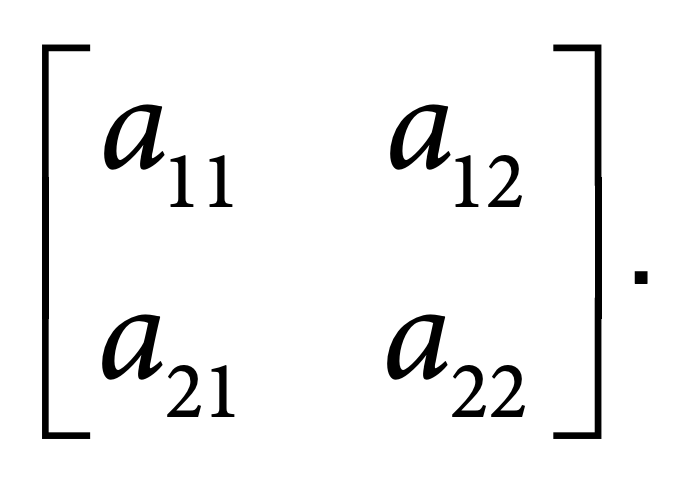
The linear transformation mapping a vector to a vector is represented by the matrix , a 2 x 2 matrix. This is called a transformation matrix, and it stores all the information about the transformation in the four coefficients , , , and .
When the vector is multiplied by the matrix , the result is the new vector . That new vector is the image of the original vector under the transformation.
Mapping the Unit Vectors
The mapping of the unit vectors gives you a fast way to find the matrix. In two dimensions, the unit vectors are and , often called the standard basis vectors. The transformation sends each unit vector to a new vector, and those new vectors are the columns of the transformation matrix.
For example, if the transformation maps to and maps to , then the transformation matrix is . Track where the unit vectors land, write those results as columns, and you have the matrix.
Rotation Matrices
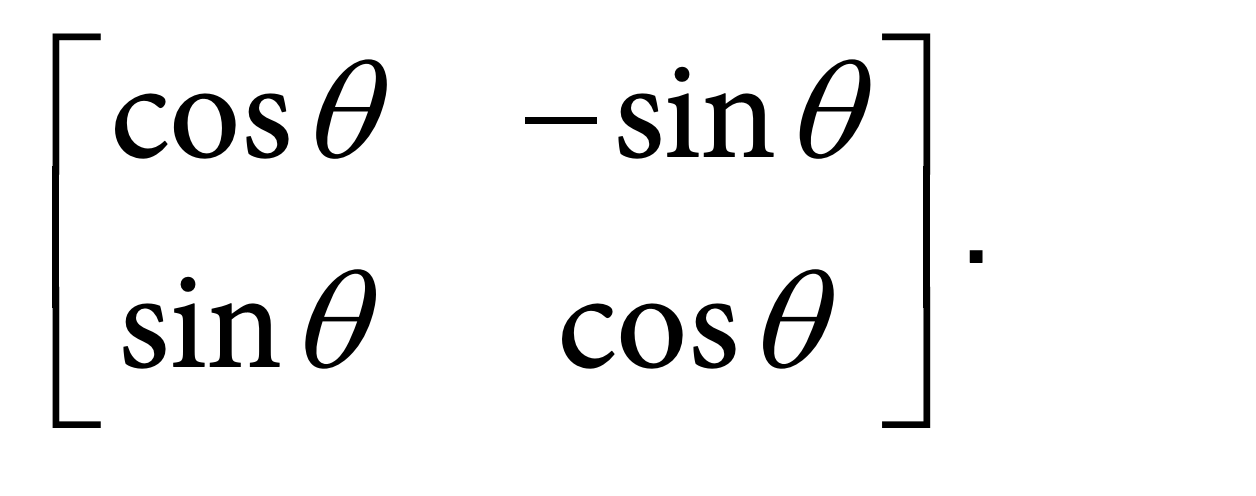
The matrix associated with rotating every vector an angle counterclockwise about the origin is the rotation matrix:
When a vector is multiplied by this matrix, the resulting vector is the image of the original vector under the rotation:
So and are the coordinates after rotating by an angle counterclockwise. The matrix stores everything about the rotation, including the angle .
To rotate clockwise instead, replace with . Because and , the clockwise rotation matrix is .
Determinants and Area Scaling
The absolute value of the determinant of a 2 x 2 transformation matrix gives the magnitude of the dilation of regions in under the transformation. For a 2 x 2 matrix, the determinant is:
The absolute value of this number is the area-scaling factor. If , the transformation doubles the area of regions. If , it cuts areas in half. The sign of the determinant tells you about orientation: a negative determinant means the transformation flips orientation, like a reflection, while still scaling area by the absolute value.
Compositions of Two Linear Transformations
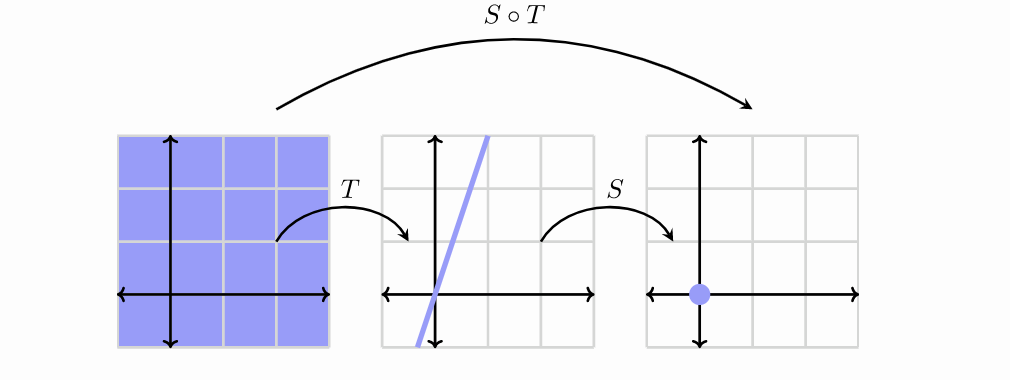
The composition of two linear transformations is itself a linear transformation. A linear transformation takes a vector as input and produces a vector as output. When you compose two of them, the output of the first becomes the input of the second.
If maps a vector to a vector , and maps to a vector , then the composition is written and it sends all the way to .
The matrix associated with the composition of two linear transformations is the product of the matrices associated with each transformation. If is the matrix for and is the matrix for , then the matrix for the composition that applies first and then is . Multiplying a vector by that product carries it through both transformations in order.
Order matters. In general , so swapping the order of the matrices usually changes the result. Keep careful track of which transformation happens first.
Inverses of Linear Transformations
Two linear transformations are inverses if their composition maps any vector back to itself. An inverse transformation undoes the effect of the original. If maps to and maps back to , then is the inverse of , written .
If a linear transformation is given by , then its inverse transformation is:
where is the inverse of the matrix . This follows directly from how matrix-vector multiplication works. The matrix encodes the transformation, and reverses it:
Here is the identity matrix, the matrix that leaves every vector unchanged. Applying to the output returns the original vector .
Not every matrix has an inverse. A 2 x 2 matrix is invertible if and only if its determinant is not zero. When , the transformation collapses the plane onto a line or a point, so there is no way to undo it.
How to Use This on the AP Precalculus Exam
Problem Solving
- To find a transformation matrix, track where and go. Write each image as a column, and you have the matrix.
- To rotate a vector counterclockwise by , multiply by . For clockwise, use .
- To find how a transformation scales area, compute . A negative determinant also flips orientation.
- To compose transformations, multiply the matrices in the right order. The transformation applied first sits on the right of the product.
- To undo a transformation , use , and remember it only exists when .
Using Technology
If your school covers Unit 4, practice building matrices, multiplying them, and finding inverses on a graphing calculator. These are the same calculator skills used elsewhere in the course, so getting comfortable with them helps your overall fluency.
Common Misconceptions
- Misconception: The rows of the matrix, not the columns, are the images of the unit vectors.Actually: The columns of the matrix, not the rows, are the images of the unit vectors. maps to the first column and maps to the second column.
- Misconception: Order does not matter when composing.Actually: Order matters when composing. The matrix for "do first, then " is , not . Matrix multiplication is generally not commutative.
- Misconception: The determinant scales length, not area.Actually: The determinant scales area, not length. tells you the area-scaling factor for regions, not how much a single vector stretches.
- Misconception: A negative determinant means the area shrinks.Actually: A negative determinant does not mean the area shrinks. The area scales by the absolute value. The negative sign signals a flip in orientation, like a reflection.
- Misconception: Every matrix is invertible.Actually: Not every matrix is invertible. If , the transformation squashes the plane to a line or point and cannot be reversed, so does not exist.
- Misconception: The rotation matrix rotates about a point other than the origin.Actually: The rotation matrix rotates about the origin. It rotates every vector around the origin by , not around some other point.
Related AP Precalculus Guides
Practice Questions for 4.13
1 of 10
Linear transformations and are defined by and , where and . The inverse transformation of their composition, , maps the vector to the vector . Use technology to evaluate the matrix relationships and determine the value of the constant .
A.
The value of the constant is exactly
B.
The value of the constant is exactly
C.
The value of the constant is exactly
D.
The value of the constant is exactly
Vocabulary
The following words are mentioned explicitly in the AP® course framework for this topic.Term | Definition |
|---|---|
composition of functions | A function operation where one function is applied to the output of another function, written as (f ∘ g)(x) = f(g(x)). |
composition of linear transformations | The result of applying one linear transformation followed by another linear transformation. |
determinant | A scalar value calculated from a square matrix that determines whether the matrix is invertible; for a 2×2 matrix [a b; c d], the determinant equals ad - bc. |
dilation | A linear transformation that scales regions by a constant factor, with the magnitude determined by the absolute value of the determinant. |
inverse transformations | Two linear transformations that are inverses if their composition maps any vector to itself, effectively undoing each other's effects. |
linear transformation | A function that maps vectors to vectors while preserving vector addition and scalar multiplication, represented by a matrix. |
matrix | A rectangular array of numbers arranged in rows and columns that represents a linear transformation. |
matrix inverse | A matrix that, when multiplied by the original matrix, produces the identity matrix; a square matrix has an inverse if and only if its determinant is nonzero. |
matrix product | The product of two matrices that represents the composition of their corresponding linear transformations. |
rotation | A linear transformation that rotates every vector by a fixed angle about the origin without changing its length. |
unit vector | A vector with a magnitude of 1, often used to indicate direction. |
vector | A mathematical object with both magnitude and direction, represented as an ordered pair of components in ℝ². |
Frequently Asked Questions
How can a matrix act like a function?
A 2 x 2 matrix can take an input vector and produce an output vector. The matrix stores the rule for a linear transformation, so multiplying the matrix by a vector gives the vector’s image.
How do you find the matrix for a linear transformation?
Track where the unit vectors <1, 0> and <0, 1> go. Write those two image vectors as the columns of the matrix.
What does the AP Precalculus rotation matrix do?
The matrix [[cos θ, -sin θ], [sin θ, cos θ]] rotates every vector θ radians or degrees counterclockwise about the origin, depending on the angle units in the problem.
What does the determinant tell you about a transformation?
The absolute value of the determinant tells you the area-scaling factor for regions in the plane. A negative determinant also means the transformation reverses orientation.
How do you compose two matrix transformations?
Multiply the matrices in the order that matches the transformations. If A happens first and B happens second, the combined matrix is BA because the rightmost matrix acts first.
When does a matrix transformation have an inverse?
A 2 x 2 matrix transformation has an inverse when its determinant is not zero. If det A = 0, the transformation collapses the plane and cannot be undone.
See Fiveable more often in Google
Mark Fiveable as a preferred source and Google is more likely to show you our guides in Top Stories, with a "preferred" badge in AI Mode and AI Overviews.