4.6 Conic Sections

📈AP Precalculus Unit 4 Review
4.6 Conic Sections
📈 AP Precalculus
4.1
Parametric Functions
4.2
Parametric Functions Modeling Planar Motion
4.3
Parametric Functions and Rates of Change
4.4
Parametrically Defined Circles and Lines
4.5
Implicitly Defined Functions
4.6
Conic Sections
4.7
Parametrization of Implicitly Defined Functions
4.8
Vectors
4.9
Vector-Valued Functions
4.10
Matrices
4.11
The Inverse and Determinant of a Matrix
4.12
Linear Transformations and Matrices
4.13
Matrices as Functions
4.14
Matrices Modeling Contexts
TLDR
Conic sections are the parabola, ellipse (with the circle as a special case), and hyperbola, and in AP Precalculus you represent each one analytically using its standard equation with center or vertex at . Once you recognize which equation matches which shape, you can pull out key features like center, vertex, radii, and asymptotes.
Why This Matters for the AP Precalculus Exam
Unit 4 topics, including conic sections, are not assessed on the AP Precalculus exam. The exam covers Units 1, 2, and 3, since those are the topics used for college credit and placement. Schools may still teach this material because it builds skills you will use in calculus and other math and science courses.
So treat this guide as preparation for the bigger picture. The thinking you practice here, recognizing a function or relation from its equation and reading off key features, is exactly the kind of reasoning the exam rewards in the units that are tested. Conic sections also connect directly to implicit equations and parametric forms, which round out your understanding of how curves in the plane can be described.
Key Takeaways
- A parabola with vertex is written as when it opens up or down, or as when it opens left or right, with .
- An ellipse centered at has the form , where is the horizontal radius and is the vertical radius.
- A circle is just an ellipse with .
- A hyperbola centered at is when it opens left and right, or when it opens up and down.
- The asymptotes of a hyperbola are .
- The sign between the squared terms tells you the shape: a plus sign means an ellipse, a minus sign means a hyperbola, and only one squared term means a parabola.
Conic Sections Overview
Conic sections are curves you get when a plane slices through a cone. The four types are the circle, ellipse, parabola, and hyperbola. In AP Precalculus you focus on conics with horizontal or vertical symmetry, meaning they are not tilted, and you represent each one with a standard equation centered or vertexed at .
The fastest way to identify a conic from its equation is to look at the squared terms:
- One variable is squared and the other is not, then it is a parabola.
- Both variables are squared and added, then it is an ellipse (a circle if the radii are equal).
- Both variables are squared and subtracted, then it is a hyperbola.
Parabola
A parabola is the set of all points equidistant from a fixed point called the focus and a fixed line called the directrix. The vertex is the turning point of the curve.
With vertex and a nonzero constant , a parabola is represented as:
- if it opens up or down.
- if it opens left or right.
The sign of tells you direction. For an up or down parabola, positive opens up and negative opens down. For a left or right parabola, positive opens right and negative opens left.
Ellipse and Circle
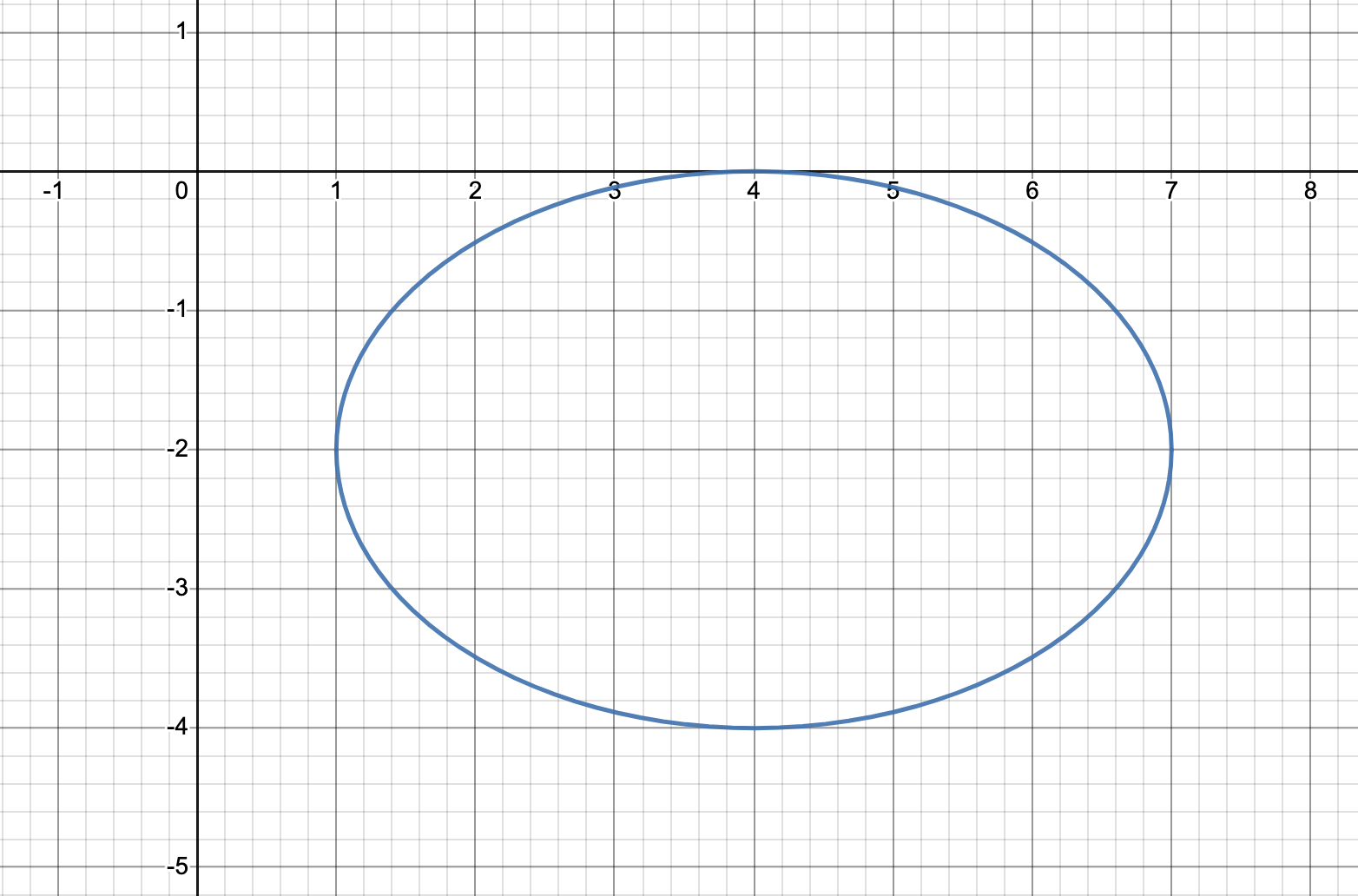
An ellipse is defined by the property that the sum of the distances from any point on the curve to two fixed points (the foci) is constant. An ellipse centered at is:
Here is the horizontal radius and is the vertical radius. The center is , and the curve stretches units left and right and units up and down from the center.
A circle is the special case where . With radius , a circle centered at can be written as:
The foci of an ellipse lie on the longer axis, and the focal length satisfies (using the larger of the two radii as ). This focus relationship is useful background, but the standard equation above is what you build directly from the center and radii.
Hyperbola
A hyperbola centered at with horizontal and vertical lines of symmetry is represented as:
- if it opens left and right.
- if it opens up and down.
The center is , and the asymptotes are:
The asymptotes are the diagonal lines the branches approach but never touch. The term that comes first and is positive tells you which direction the hyperbola opens.
How to Use This on the AP Precalculus Exam
Even though Unit 4 is not tested, the recognition and feature-reading skills here carry over to graded units. Practice these moves so they become automatic.
Identifying the Conic
Look at the squared terms first.
- Only one squared term means parabola.
- Two squared terms added means ellipse or circle.
- Two squared terms subtracted means hyperbola.
Then check signs and coefficients to find orientation and key features.
Reading Off Key Features
Once you match the equation to its shape, pull out features directly:
- Center or vertex: read from the equation. Remember the signs flip, so gives .
- Ellipse radii: is the horizontal radius and is the vertical radius.
- Hyperbola asymptotes: use .
Common Trap
The orientation of a hyperbola depends on which squared term is positive, not which letter sits under it. For , the term is positive, so it opens up and down.
Common Misconceptions
- Misconception: Added squared terms give a hyperbola, and subtracted squared terms give an ellipse.Actually: Added squared terms give an ellipse, and subtracted squared terms give a hyperbola. The operation between the terms decides the shape.
- Misconception: In , the center coordinate is .Actually: In , the center coordinate is , not . So means .
- Misconception: In an ellipse, is always bigger than .Actually: In the standard form used here, is the horizontal radius and is the vertical radius, so either one can be larger depending on the shape.
- Misconception: A parabola needs both variables squared.Actually: A parabola has exactly one squared variable. If both are squared, it is an ellipse or hyperbola.
- Misconception: The variable that appears first determines a hyperbola's opening direction.Actually: The positive squared term determines the opening direction, not the variable that appears first by habit.
- Misconception: A circle is separate from the ellipse.Actually: A circle is just an ellipse with equal radii, .
Practice Problems
-
What type of conic section is represented by the equation ? a) Circle b) Ellipse c) Parabola d) Hyperbola
-
What type of conic section is represented by the equation ? a) Circle b) Ellipse c) Parabola d) Hyperbola
Answers
#1 d) Hyperbola
The equation has two squared terms that are subtracted and set equal to 1, which is the standard form of a hyperbola. The center is , and since the term is positive, it opens left and right.
#2 b) Ellipse
The equation has two squared terms that are added and set equal to 1, which is the standard form of an ellipse. The center is , with a horizontal radius of 3 and a vertical radius of 2. Since the horizontal radius is larger, the ellipse is stretched horizontally.
Related AP Precalculus Guides
Practice Questions for 4.6
1 of 10
A comet travels in a hyperbolic path around a star. On a coordinate grid where unit equals astronomical unit (AU), the center of the hyperbola is at , and the path opens left and right. The shortest distance from the center to the comet's path (the vertex) is AU. If the equations of the asymptotes for the comet's trajectory are , which equation models the comet's path?
A.
The comet's trajectory is represented by .
B.
The comet's trajectory is represented by .
C.
The comet's trajectory is represented by .
D.
The comet's trajectory is represented by .
Vocabulary
The following words are mentioned explicitly in the AP® course framework for this topic.Term | Definition |
|---|---|
asymptote | Lines that a graph approaches but never reaches, indicating behavior at infinity or at points of discontinuity. |
circle | A special case of an ellipse where the horizontal and vertical radii are equal (a = b). |
conic sections | Curves formed by the intersection of a plane with a cone, including parabolas, ellipses, circles, and hyperbolas. |
ellipse | A conic section formed when a plane intersects a cone at an angle, or the set of points where the sum of distances to two foci is constant. |
horizontal radius | The distance from the center of an ellipse to its edge along the horizontal axis, represented by the value a. |
hyperbola | A conic section formed when a plane intersects both nappes of a cone, or the set of points where the difference of distances to two foci is constant. |
parabola | A conic section formed when a plane intersects a cone parallel to its side, or the set of points equidistant from a focus and directrix. |
vertex | The point (h, k) that represents the center or turning point of a parabola. |
vertical radius | The distance from the center of an ellipse to its edge along the vertical axis, represented by the value b. |
Frequently Asked Questions
What are the four types of conic sections?
The four main conic sections are circles, ellipses, parabolas, and hyperbolas. AP Precalculus focuses on representing these curves analytically when they have horizontal or vertical symmetry.
How do you identify a conic from its equation?
A parabola has one squared variable, an ellipse or circle has two squared variables added, and a hyperbola has two squared variables subtracted. A circle is a special ellipse with equal radii.
What is the standard form of an ellipse?
An ellipse centered at (h, k) can be written as (x - h)^2/a^2 + (y - k)^2/b^2 = 1. The values a and b describe the horizontal and vertical radii.
What is the standard form of a parabola?
A parabola with vertical symmetry can be written as y - k = a(x - h)^2. A parabola with horizontal symmetry can be written as x - h = a(y - k)^2, where (h, k) is the vertex.
What is the standard form of a hyperbola?
A hyperbola centered at (h, k) can be written as (x - h)^2/a^2 - (y - k)^2/b^2 = 1 or (y - k)^2/b^2 - (x - h)^2/a^2 = 1. Its asymptotes help show the curve's direction and shape.
Are conic sections tested on the AP Precalculus exam?
Conic sections are in AP Precalculus Unit 4, and Unit 4 is not assessed on the AP Precalculus Exam. They still matter for the course and for later math because they build equation analysis and graph interpretation skills.
See Fiveable more often in Google
Mark Fiveable as a preferred source and Google is more likely to show you our guides in Top Stories, with a "preferred" badge in AI Mode and AI Overviews.