1.10 Rational Functions and Holes

📈AP Precalculus Unit 1 Review
1.10 Rational Functions and Holes
📈 AP Precalculus
1.1
Change in Tandem
1.2
Rates of Change
1.3
Rates of Change in Linear and Quadratic Functions
1.4
Polynomial Functions and Rates of Change
1.5
Polynomial Functions and Complex Zeros
1.6
Polynomial Functions and End Behavior
1.7
Rational Functions and End Behavior
1.8
Rational Functions and Zeros
1.9
Rational Functions and Vertical Asymptotes
1.10
Rational Functions and Holes
1.11
Equivalent Representations of Polynomial and Rational Expressions
1.12
Transformations of Functions
1.13
Function Model Selection and Assumption Articulation
1.14
Function Model Construction and Application
A hole in a rational function shows up when the same factor appears in both the numerator and the denominator and cancels out. The function is undefined at , but the graph approaches a single finite value there, so you draw an open circle instead of a vertical asymptote.
Why This Matters for the AP Precalculus Exam
Holes test whether you can tell the difference between two kinds of breaks in a rational function: a removable one (a hole) and a non-removable one (a vertical asymptote). On the AP Precalculus exam, you may need to factor a rational expression, decide where the graph has a hole versus an asymptote, and describe the value the function approaches near the hole. This connects directly to reading graphs, choosing the right procedure, and explaining your reasoning clearly, which all matter across multiple-choice and free-response work.
Key Takeaways
- A hole appears at x = c when (x - c) is a factor of both the numerator and the denominator.
- If the multiplicity of a real zero in the numerator is greater than or equal to its multiplicity in the denominator, the graph has a hole at that input value.
- Equal multiplicity of a common factor in the numerator and denominator creates a removable discontinuity, which is a hole, after you cancel.
- To find the hole's y-value, cancel the common factor, then evaluate the simplified function at x = c.
- The hole sits at the point (c, L), where L is the value the function approaches near c.
- A factor only in the denominator gives a vertical asymptote, not a hole. Keep these two cases separate.
How Holes Form
A real number c can be a zero of the polynomial on top, the polynomial on the bottom, or both. When c is a zero of both, the factor (x - c) shows up in the numerator and the denominator, so it cancels. The original function is still undefined at x = c, but after canceling you get a simpler function that behaves normally there. That gap in the graph is the hole.
The rule for whether you get a hole comes from comparing multiplicities. Multiplicity is how many times a factor appears in a polynomial's factorization. If the multiplicity of a real zero in the numerator is greater than or equal to its multiplicity in the denominator, the graph has a hole at that input value. If the factor appears more times in the denominator than in the numerator, you get a vertical asymptote instead.
The simplest and most common case is equal multiplicity: one (x - c) on top and one (x - c) on the bottom. They cancel completely, leaving a removable discontinuity, which is just another name for a hole.
Worked Example
Consider the rational function:
Factor the numerator:
The factor (x - 3) appears once on top and once on the bottom, so the multiplicities are equal. That means the graph has a hole at x = 3, not a vertical asymptote.
Cancel the common factor:
Now evaluate the simplified function at x = 3:
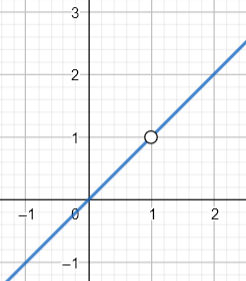
The graph has a hole at the point (3, 6). On the graph you would draw the line y = x + 3 with an open circle at (3, 6) to show the function is undefined there.
Describing the Value Near a Hole
If a rational function r has a hole at x = c, you can find its location by looking at the output values for input values very close to c. As the inputs get close to c from both sides, the outputs settle near a single finite value L. The hole sits at (c, L).
This is the key contrast with a vertical asymptote. Near an asymptote the outputs blow up without bound. Near a hole the outputs approach a normal, finite number, and the function would be perfectly continuous there if you simply filled in the missing point. The x-coordinate of the hole is the value c that made the original denominator zero, and the y-coordinate is the value the simplified function gives at c.
How to Use This on the AP Precalculus Exam
Problem Solving
- Always factor the numerator and denominator fully before deciding what kind of break you have.
- Compare the multiplicity of each shared factor in the numerator and denominator. Numerator multiplicity greater than or equal to denominator multiplicity means a hole; denominator multiplicity greater means a vertical asymptote.
- After canceling the shared factor, plug c into the simplified function to get the hole's y-value.
- Write the hole as an ordered pair (c, L), not just an x-value.
MCQ
- Watch for answer choices that list x = c as a vertical asymptote when it is actually a hole. Factoring first prevents this mistake.
- Remember the canceled factor still restricts the domain, so x = c is excluded even though the simplified function looks defined there.
Common Trap
- Do not forget to keep the domain restriction x ≠ c after you cancel. The simplified expression equals the original everywhere except at the hole.
Common Misconceptions
- Misconception: A hole is the same as a vertical asymptote.Actually: A hole is not the same as a vertical asymptote. A shared factor that cancels gives a hole; a factor left only in the denominator gives an asymptote.
- Misconception: Canceling the factor makes the function defined at x = c.Actually: Canceling the factor does not make the function defined at x = c. The original function is still undefined there, which is why you draw an open circle.
- Misconception: The hole's y-value is always zero.Actually: The hole's y-value is not always zero. You find it by evaluating the simplified function at c, and it can be any number.
- Misconception: A hole is found by setting the numerator equal to zero by itself.Actually: A hole is not found by setting the numerator equal to zero by itself. It comes from a factor shared by both the numerator and denominator.
- Misconception: Equal multiplicity creates an asymptote.Actually: Equal multiplicity does not create an asymptote. When the shared factor appears the same number of times on top and bottom, it fully cancels and leaves a hole.
Related AP Precalculus Guides
Practice Questions for 1.10
1 of 10
The table shows values of the rational function for inputs near . Which statement best explains the behavior shown in the table?
| x | 1.9 | 1.99 | 1.999 | 2 | 2.001 | 2.01 | 2.1 |
|---|---|---|---|---|---|---|---|
| r(x) | -0.9 | -0.99 | -0.999 | undefined | -1.001 | -1.01 | -1.1 |
A.
The function is continuous at with value because the table entries are all close to .
B.
The function has a vertical asymptote at because the denominator equals zero at this point.
C.
The function has a hole at because the factor cancels from numerator and denominator.
D.
The function has a hole at because both numerator and denominator equal zero when .
Vocabulary
The following words are mentioned explicitly in the AP® course framework for this topic.Term | Definition |
|---|---|
denominator | The polynomial expression in the bottom part of a rational function. |
holes | Points where a rational function is undefined due to common factors in the numerator and denominator that cancel out, creating a gap in the graph. |
limit | The value that a function approaches as the input approaches a specific value. |
multiplicity | The number of times a linear factor appears in the complete factorization of a polynomial; determines how the graph behaves at that zero. |
numerator | The polynomial expression in the top part of a rational function. |
rational function | A function expressed as the ratio of two polynomials, where the denominator is not equal to zero. |
real zero | A real number value that makes a polynomial function equal to zero, corresponding to an x-intercept on the graph. |
Frequently Asked Questions
How do I find holes in rational functions?
Factor the numerator and denominator completely, cancel any shared factor, and keep the excluded input value. If the shared factor is x - c, evaluate the simplified function at x = c to get the hole at (c, L).
What creates a hole in a rational function?
A hole happens when a real zero appears in both the numerator and denominator with numerator multiplicity greater than or equal to denominator multiplicity. After the common factor cancels, the original function is still undefined at that input.
How do I find the coordinates of a hole?
The x-coordinate is the excluded value c from the canceled factor. To find the y-coordinate, plug c into the simplified function, or use the finite value L that the original function approaches as x gets close to c.
What is the difference between a hole and a vertical asymptote?
A shared factor that cancels creates a hole. A factor left in the denominator after simplification creates a vertical asymptote. Holes approach a finite y-value, while vertical asymptotes do not.
Does canceling a factor make the rational function defined there?
No. Canceling helps you see the graph behavior, but the original denominator still made the function undefined at that input. The simplified expression matches the original everywhere except the hole.
How does AP Precalculus 1.10 test rational functions and holes?
AP Precalculus 1.10 asks you to determine holes in graphs of rational functions. Be ready to factor, compare multiplicities, identify excluded input values, find hole coordinates, and explain why the break is removable.
See Fiveable more often in Google
Mark Fiveable as a preferred source and Google is more likely to show you our guides in Top Stories, with a "preferred" badge in AI Mode and AI Overviews.