2.12 Logarithmic Function Manipulation

📈AP Precalculus Unit 2 Review
2.12 Logarithmic Function Manipulation
📈 AP Precalculus
2.1
Change in Arithmetic and Geometric Sequences
2.2
Change in Linear and Exponential Functions
2.3
Exponential Functions
2.4
Exponential Function Manipulation
2.5
Exponential Function Context and Data Modeling
2.6
Competing Function Model Validation
2.7
Composition of Functions
2.8
Inverse Functions
2.9
Logarithmic Expressions
2.10
Inverses of Exponential Functions
2.11
Logarithmic Functions
2.12
Logarithmic Function Manipulation
2.13
Exponential and Logarithmic Equations and Inequalities
2.14
Logarithmic Function Context and Data Modeling
2.15
Semi-log Plots
What is logarithmic function manipulation in AP Precalculus?
Logarithmic function manipulation means using the product, power, and change of base properties to rewrite log expressions in equivalent forms. These same properties also have graphical meaning: a horizontal dilation can equal a vertical translation, and raising the input to a power gives a vertical dilation. The natural log, ln x, is just a logarithm with base e (about 2.71828).
Why This Matters for the AP Precalculus Exam
Logarithmic properties show up across Unit 2, which carries a large share of the AP Precalculus exam. You will use them to rewrite and condense log expressions, switch bases so a calculator can evaluate a log, and connect algebraic moves to graph transformations. These skills feed directly into solving exponential and logarithmic equations and into modeling with logarithmic functions later in the unit. Because logarithmic work needs precision, showing each step clearly is important for clear exam work on free-response questions, where answers without supporting steps may not support a stronger score.
Key Takeaways
- Product property: , which turns a horizontal dilation into a vertical translation where .
- Power property: , which turns into a vertical dilation .
- Change of base: for and , which shows all log functions are vertical dilations of each other.
- The natural log is , with .
- Every log function has domain and a vertical asymptote at .
- Properties only combine logs that share the same base.
Properties of Logarithmic Functions
Logarithmic functions are inverses of exponential functions, so they can be rewritten in equivalent forms much like exponential expressions can. Each rewrite is a "property" you can use to simplify, solve, or model. If the exponent rules feel shaky, review 2.4 Exponential Function Manipulation before going further.
Product Property
The product property for logarithms says the logarithm of a product equals the sum of the logarithms:
where is the base.
Graphically, this property means a horizontal dilation of a logarithmic function, , is the same as a vertical translation:
So stretching or compressing the x-values horizontally is equivalent to shifting the graph up or down. The horizontal dilation is set by , and the vertical shift is .
For example, becomes when you multiply by 2. That horizontal change is the same as adding to every output, which is a vertical translation.
Power Property
The power property for logarithms states that for positive real numbers , , and :
This follows from the definition of logarithms as exponents. Raising the input to a power scales the exponent, so the power comes out front as a multiplier.
Graphically, raising the input to a power, , produces a vertical dilation:
The factor controls the amount of dilation. If , the graph stretches vertically by a factor of 2. If , it compresses vertically by a factor of 0.5.
For example, because . Using the power property, , which confirms that the log of a power equals the exponent times the log of the base.
This property also helps when solving logarithmic equations. If , the power property rewrites it as , which you can then solve for .
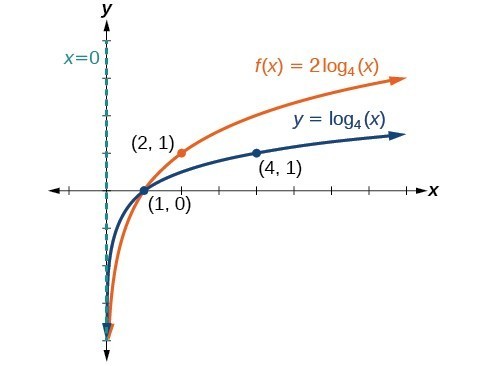
The power property only combines logs that share the same base. This matches the product property: works because every term uses base 2.
Change of Base Property
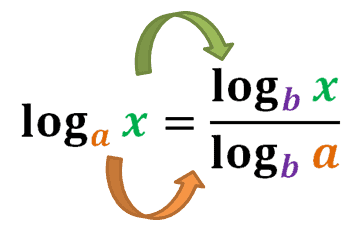
The change of base property lets you rewrite a log in terms of a different base. For bases and with and :
This is what makes a calculator useful: most calculators only do base 10 or base , so you convert any log into one of those bases to evaluate it.
This property also implies that all logarithmic functions are vertical dilations of each other. Changing the base just multiplies the whole function by a constant, so different bases give graphs that are stretched or compressed versions of one another.
Natural Logs and e
The natural logarithm, written , is the logarithm of with base , where is approximately 2.71828:
So is the exponent to which must be raised to equal , which makes the inverse of .
The natural log shows up often when modeling real-world situations involving proportional growth and decay. The natural log function has domain all positive real numbers and range all real numbers, just like any logarithmic function in general form.
How to Use This on the AP Precalculus Exam
MCQ
- Recognize which property to apply. A product inside a log expands to a sum, a quotient to a difference, and a power comes out front as a coefficient.
- Watch for base agreement. Properties only combine logs with the same base, so do not merge and .
- For graph questions, connect the algebra to the transformation: is a vertical shift, and is a vertical dilation.
Free Response
- Show each rewrite step. With logs it is easy to introduce errors by skipping steps, so write out the property you used.
- When you need a numerical answer, use change of base to convert to or before evaluating.
- After solving a logarithmic equation, check that your solution keeps every input positive, since logs are only defined for .
Problem Solving
- To condense an expression, run the properties in reverse: a coefficient becomes a power, a sum becomes a product, and a difference becomes a quotient.
- Use and to simplify quickly.
- Convert between exponential and logarithmic form with when an equation is easier to handle one way.
Common Misconceptions
- Misconception: .Actually: is not . The product property applies to , a product inside the log, not a sum.
- Misconception: is the same as .Actually: is not the same as . Change of base is a quotient of two logs, not a difference.
- Misconception: is .Actually: is not . The power property needs the exponent inside the log, as in .
- Misconception: You can combine logs with different bases using the product or power properties.Actually: You cannot combine logs with different bases using the product or power properties. Convert to a common base first.
- Misconception: is a brand new function.Actually: is not a brand new function. It is just , a logarithm with base .
- Misconception: Logs are defined for zero and negative inputs.Actually: Logs are undefined for zero and negative inputs, so always confirm the argument stays positive.
Related AP Precalculus Guides
Practice Questions for 2.12
1 of 10
The discrete points shown above lie on the graph of .
Which of the following is an equivalent expression for ?
A.
B.
C.
D.
Vocabulary
The following words are mentioned explicitly in the AP® course framework for this topic.Term | Definition |
|---|---|
change of base property | The logarithmic property stating that log_b x = (log_a x)/(log_a b), which allows conversion between logarithms of different bases. |
horizontal dilation | A transformation that stretches or compresses the graph of a function horizontally by multiplying the input by a constant factor b, written as g(x) = f(bx). |
logarithmic expressions | Mathematical expressions involving logarithms that can be rewritten in different equivalent forms. |
natural logarithm | The logarithmic function with base e, denoted ln(x), that is particularly useful for modeling real-world phenomena. |
power property for logarithms | The logarithmic property stating that log_b x^n = n log_b x, which allows exponents inside a logarithm to be written as coefficients. |
product property for logarithms | The logarithmic property stating that log_b(xy) = log_b x + log_b y, which allows products inside a logarithm to be written as sums. |
vertical dilation | A transformation that stretches or compresses the graph of a function vertically by multiplying the function by a constant factor a, written as g(x) = af(x). |
vertical translation | A transformation that shifts the graph of a function up or down by adding a constant k to the function, written as g(x) = f(x) + k. |
Frequently Asked Questions
What is logarithmic function manipulation in AP Precalculus?
Logarithmic function manipulation means rewriting logarithmic expressions in equivalent forms using the product, power, and change of base properties. These rewrites also explain graph transformations.
What is the product property for logarithms?
The product property says log_b(xy) = log_b x + log_b y. In graph terms, f(x) = log_b(kx) can be rewritten as log_b k + log_b x, so a horizontal dilation can appear as a vertical translation.
What is the power property for logarithms?
The power property says log_b(x^n) = n log_b x. For graphs, f(x) = log_b(x^k) becomes k log_b x, which is a vertical dilation.
What is the change of base property?
The change of base property rewrites log_b x as (log_a x)/(log_a b), where a > 0 and a is not 1. It lets you evaluate logs with calculators and compare logarithmic functions with different bases.
What is natural log?
The natural log, written ln x, is the logarithm with base e. In other words, ln x = log_e x, where e is approximately 2.71828.
What is the common mistake with log properties?
Do not apply log properties to sums inside the argument. log_b(x + y) is not log_b x + log_b y; the product property applies to multiplication inside the logarithm.
See Fiveable more often in Google
Mark Fiveable as a preferred source and Google is more likely to show you our guides in Top Stories, with a "preferred" badge in AI Mode and AI Overviews.