2.10 Inverses of Exponential Functions

📈AP Precalculus Unit 2 Review
2.10 Inverses of Exponential Functions
📈 AP Precalculus
2.1
Change in Arithmetic and Geometric Sequences
2.2
Change in Linear and Exponential Functions
2.3
Exponential Functions
2.4
Exponential Function Manipulation
2.5
Exponential Function Context and Data Modeling
2.6
Competing Function Model Validation
2.7
Composition of Functions
2.8
Inverse Functions
2.9
Logarithmic Expressions
2.10
Inverses of Exponential Functions
2.11
Logarithmic Functions
2.12
Logarithmic Function Manipulation
2.13
Exponential and Logarithmic Equations and Inequalities
2.14
Logarithmic Function Context and Data Modeling
2.15
Semi-log Plots
Exponential functions and logarithmic functions are inverses of each other: if , then undoes it, so . Their graphs are reflections across the line , which means every point on becomes the point on .
Why This Matters for the AP Precalculus Exam
This topic ties together two function families you will use constantly in Unit 2, which carries a large share of the exam. Recognizing that is the inverse of lets you switch between exponential and logarithmic forms, read graphs as reflections across , and swap input-output pairs without redoing all the work. You will see these ideas in both multiple-choice and free-response questions, often asking you to move between graphical, numerical, and analytical representations of the same relationship. Clear notation and steps are important for clear exam work, especially when you show why two functions are inverses.
Key Takeaways
- The general form of a logarithmic function is , where , , and .
- and are inverse functions, so .
- The graph of is the reflection of the graph of across the identity line .
- If is a point on , then is a point on .
- Exponential growth means output changes multiplicatively as input changes additively; logarithmic growth means output changes additively as input changes multiplicatively.
- Domain and range swap: has range , and has domain .
Connecting Exponential and Logarithmic Functions
This builds directly on inverse functions from Topic 2.8 and logarithmic expressions from Topic 2.9. A logarithmic function is defined as , where is the base of the logarithm and is the coefficient. The base must be greater than 0 and not equal to 1, and the coefficient must not be 0.
You can see the inverse relationship between input and output values by comparing the general forms. The general form of an exponential function is , where is the coefficient and is the base. As the input value increases in equal-length intervals, the output value increases proportionately.
For a logarithmic function , the relationship flips. As the output value increases in equal-length intervals, the input value increases proportionately. That flip is the whole point of an inverse.
How Inverse Growth Works
Exponential growth is characterized by output values changing multiplicatively as input values change additively. Logarithmic growth is the reverse: output values change additively as input values change multiplicatively. This happens because in exponential functions the input value is the exponent, while in logarithmic functions the input value is the argument of the logarithm.
Reflections and the Identity Function
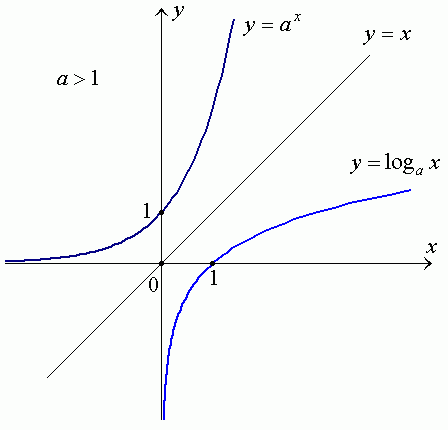
The graph of the logarithmic function , where and , is a reflection of the graph of the exponential function , where and , across the graph of the identity function . This comes straight from the inverse relationship between the two functions.
The exponential function has a curve that rises quickly as increases when . Its graph has a horizontal asymptote at and no vertical asymptote.
The logarithmic function has a curve that rises slowly as increases when . Its graph has a vertical asymptote at and no horizontal asymptote.
The identity function is a straight line with slope 1 and y-intercept 0, and it has no asymptotes. When you reflect the graph of across , you get the graph of , with the x- and y-coordinates switched. That switch is exactly what an inverse does to every point.
Applying the Relationship: Ordered Pairs
If is an ordered pair of the exponential function , where and , then is an ordered pair of the logarithmic function , where and .
The exponential function takes input and raises the base to that power, giving output . So .
The logarithmic function takes input and finds the exponent the base must be raised to in order to equal , giving output . So .
Because the two functions are inverses, the same numbers and describe both equations. The statements and are just two ways of writing the same fact, which is why you can swap an ordered pair from one function to get a point on the other.
How to Use This on the AP Precalculus Exam
MCQ
- When a question gives you a point on , swap the coordinates to get the matching point on , and vice versa.
- If you see a graph reflected across , expect an exponential and logarithmic pair with the same base.
- Use if and only if to rewrite an equation in the form that is easier to evaluate.
Free Response
- To show two functions are inverses, demonstrate that .
- When building or sketching a graph, label the asymptotes: for and for .
- Show each step when you convert between exponential and logarithmic form so your reasoning is clear.
Common Trap
- The domain and range trade places between the two functions, so do not assume a logarithm accepts negative or zero inputs.
Common Misconceptions
- Misconception: The exponential and logarithm have the same asymptote.Actually: The asymptotes are not the same for both functions. The exponential has a horizontal asymptote at , while the logarithm has a vertical asymptote at .
- Misconception: Reflecting across is the same as reflecting across the x-axis or y-axis.Actually: Reflecting across is not the same as reflecting across the x-axis or y-axis. Only reflection across the identity line produces the inverse.
- Misconception: To find an inverse, you only swap the sign or change one coordinate.Actually: An ordered pair swap gives from . Students sometimes only swap the sign or change one coordinate, which breaks the inverse relationship.
- Misconception: The logarithm is defined for zero or negative inputs.Actually: is only defined for . The output of is always positive, so its inverse cannot take in zero or negative numbers.
- Misconception: A logarithmic function is the reciprocal of an exponential function.Actually: A logarithmic function is not the reciprocal of an exponential function. Inverse means undoing the mapping, not dividing 1 by the function.
Related AP Precalculus Guides
Practice Questions for 2.10
1 of 10
The figure above shows discrete points that lie on the graph of a logarithmic function .
If is the inverse function of , which of the following is the expression for ?
A.
B.
C.
D.
Vocabulary
The following words are mentioned explicitly in the AP® course framework for this topic.Term | Definition |
|---|---|
base | The number b in exponential functions b^x or logarithmic functions log_b x, where b > 0 and b ≠ 1. |
exponential function | A function of the form f(x) = ab^x where a ≠ 0 is the initial value and b > 0, b ≠ 1 is the base. |
exponential growth | A pattern of change where output values increase multiplicatively as input values increase additively. |
identity function | The function h(x) = x, which serves as the line of reflection between inverse exponential and logarithmic functions. |
inverse function | A function that reverses the mapping of another function, such that if f(x) = y, then f⁻¹(y) = x. |
inverse relationship | A relationship between two functions where the input and output values are reversed, such that one function undoes the other. |
logarithmic function | A function of the form f(x) = a log_b x where b > 0, b ≠ 1, and a ≠ 0, characterized by output values changing additively as input values change multiplicatively. |
logarithmic growth | A pattern of change where output values increase additively as input values increase multiplicatively. |
ordered pair | A pair of values (x, y) representing a point on a graph or a relationship between input and output values. |
reflection | A transformation that flips a graph over a line, such as the line y = x. |
Frequently Asked Questions
How do you find the inverse of an exponential function?
To find the inverse of an exponential function, swap x and y, then solve for y using logarithms. For example, if y = b^x, swapping gives x = b^y, so y = log_b x. That means the inverse of g(x) = b^x is f(x) = log_b x when b > 0 and b is not 1.
Why is a logarithm the inverse of an exponential function?
A logarithm is the inverse of an exponential function because it answers the reverse question. The exponential equation t = b^s says b raised to the s power equals t. The logarithmic equation s = log_b t asks which exponent on b gives t. They describe the same relationship with input and output reversed.
What happens to the graph when an exponential function is inverted?
The graph of f(x) = log_b x is the reflection of g(x) = b^x across the line y = x. Points swap coordinates, so a point (s, t) on the exponential graph becomes (t, s) on the logarithmic graph. The exponential horizontal asymptote y = 0 becomes the logarithm vertical asymptote x = 0.
How do domain and range change for exponential and logarithmic inverses?
Domain and range switch when you take an inverse. For g(x) = b^x, the domain is all real numbers and the range is (0, infinity). For f(x) = log_b x, the domain is (0, infinity) and the range is all real numbers. That is why logarithms cannot take zero or negative inputs in this topic.
How do you solve an exponential equation with a variable exponent?
Rewrite the equation in logarithmic form. If b^x = a, then x = log_b a. If your calculator does not have base b, use change of base: log_b a = ln(a) / ln(b). On AP Precalculus questions, also check that the logarithm input is positive.
What should I know for AP Precalculus Topic 2.10?
For Topic 2.10, know that f(x) = log_b x and g(x) = b^x are inverses, their compositions give x, their graphs reflect across y = x, and their ordered pairs swap. You should also be able to connect exponential growth with logarithmic growth and explain why the logarithm domain is positive real numbers.
See Fiveable more often in Google
Mark Fiveable as a preferred source and Google is more likely to show you our guides in Top Stories, with a "preferred" badge in AI Mode and AI Overviews.