1.4 Polynomial Functions and Rates of Change

📈AP Precalculus Unit 1 Review
1.4 Polynomial Functions and Rates of Change
📈 AP Precalculus
1.1
Change in Tandem
1.2
Rates of Change
1.3
Rates of Change in Linear and Quadratic Functions
1.4
Polynomial Functions and Rates of Change
1.5
Polynomial Functions and Complex Zeros
1.6
Polynomial Functions and End Behavior
1.7
Rational Functions and End Behavior
1.8
Rational Functions and Zeros
1.9
Rational Functions and Vertical Asymptotes
1.10
Rational Functions and Holes
1.11
Equivalent Representations of Polynomial and Rational Expressions
1.12
Transformations of Functions
1.13
Function Model Selection and Assumption Articulation
1.14
Function Model Construction and Application
A polynomial function is a sum of terms like , where the highest power is the degree and is the leading coefficient. In AP Precalculus, you connect that structure to rates of change, end behavior, and how the graph changes over intervals.
Why This Matters for the AP Precalculus Exam
This topic builds the vocabulary and reasoning you use to describe how polynomial functions behave. On the AP Precalculus exam, you analyze functions across graphs, tables, and equations, so being able to name and locate local extrema, global extrema, and points of inflection helps you answer both calculator and non-calculator questions.
These ideas also feed directly into later Unit 1 topics like end behavior, zeros, and model building. Free-response questions ask you to explain and justify conclusions, not just give an answer, so being precise about increasing/decreasing intervals and concavity is important for clear exam work. When a problem is set in context, describing extrema and rates of change with correct units shows you understand what the function actually represents.
Key Takeaways
- A nonconstant polynomial has the form with positive integer degree and nonzero leading coefficient ; a nonzero constant counts as degree zero.
- A local (relative) maximum or minimum happens where the function switches between increasing and decreasing, or at an included endpoint of a restricted domain.
- The global (absolute) maximum is the greatest of all local maxima, and the global minimum is the least of all local minima.
- Between any two distinct real zeros, there is at least one local maximum or local minimum.
- Even-degree polynomials have either a global maximum or a global minimum; for a quadratic, that global extremum occurs at the vertex.
- A point of inflection is where the function changes from concave up to concave down or the reverse, which is where the rate of change switches between increasing and decreasing.
A Refresher on Polynomial Functions
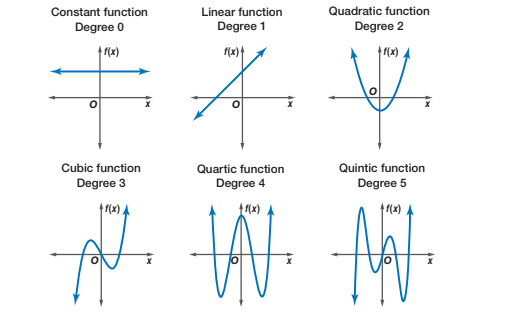
A polynomial function is a sum of terms, where each term is a constant coefficient times a variable raised to a non-negative integer power. The degree is the highest power of the variable.
A nonconstant polynomial function of x has the general form
where is a positive integer, each is a real number, and is nonzero. The leading term is and the leading coefficient is . A nonzero constant function is also a polynomial function, with degree zero.
Local and Global Maxima and Minima
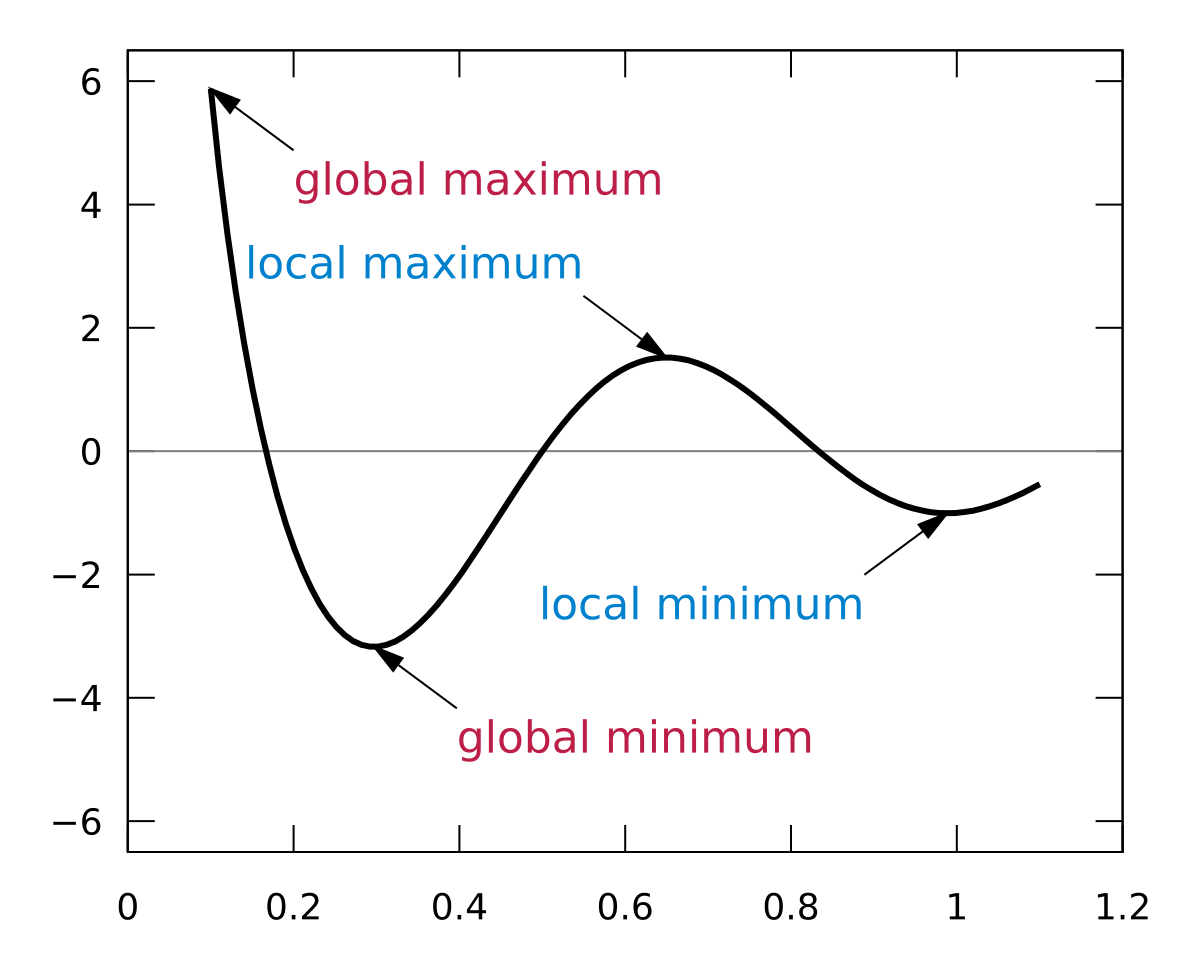
A switching point is where the function changes from increasing to decreasing or from decreasing to increasing. At these points the function has a local, or relative, maximum or minimum output value, which is the highest or lowest point in the immediate area.
If a polynomial has a restricted domain, the included endpoint of that range can also be a local maximum or minimum. These endpoints can hold the highest or lowest output values the function reaches within its domain.
If a local maximum is greater than all other output values, it is the global (absolute) maximum. If a local minimum is less than all other output values, it is the global (absolute) minimum. These describe the highest and lowest points on the whole function.
Zeros, Extrema, and Points of Inflection
The zeros of a polynomial are the input values that make the output zero. Between every two distinct real zeros, there must be at least one input value with a local maximum or local minimum. The function changes direction somewhere between the zeros, so a turning point has to appear in that interval.
A point of inflection occurs where the rate of change of the function switches from increasing to decreasing or from decreasing to increasing. Graphically, this is where the curve changes concavity:
- When a polynomial changes from concave up to concave down, the function was increasing at an increasing rate and then starts increasing at a decreasing rate.
- When a polynomial changes from concave down to concave up, the function was decreasing at a decreasing rate and then starts decreasing at an increasing rate.
So a point of inflection marks where the rate of change reaches its largest or smallest value before turning around.
Even-Degree Polynomials
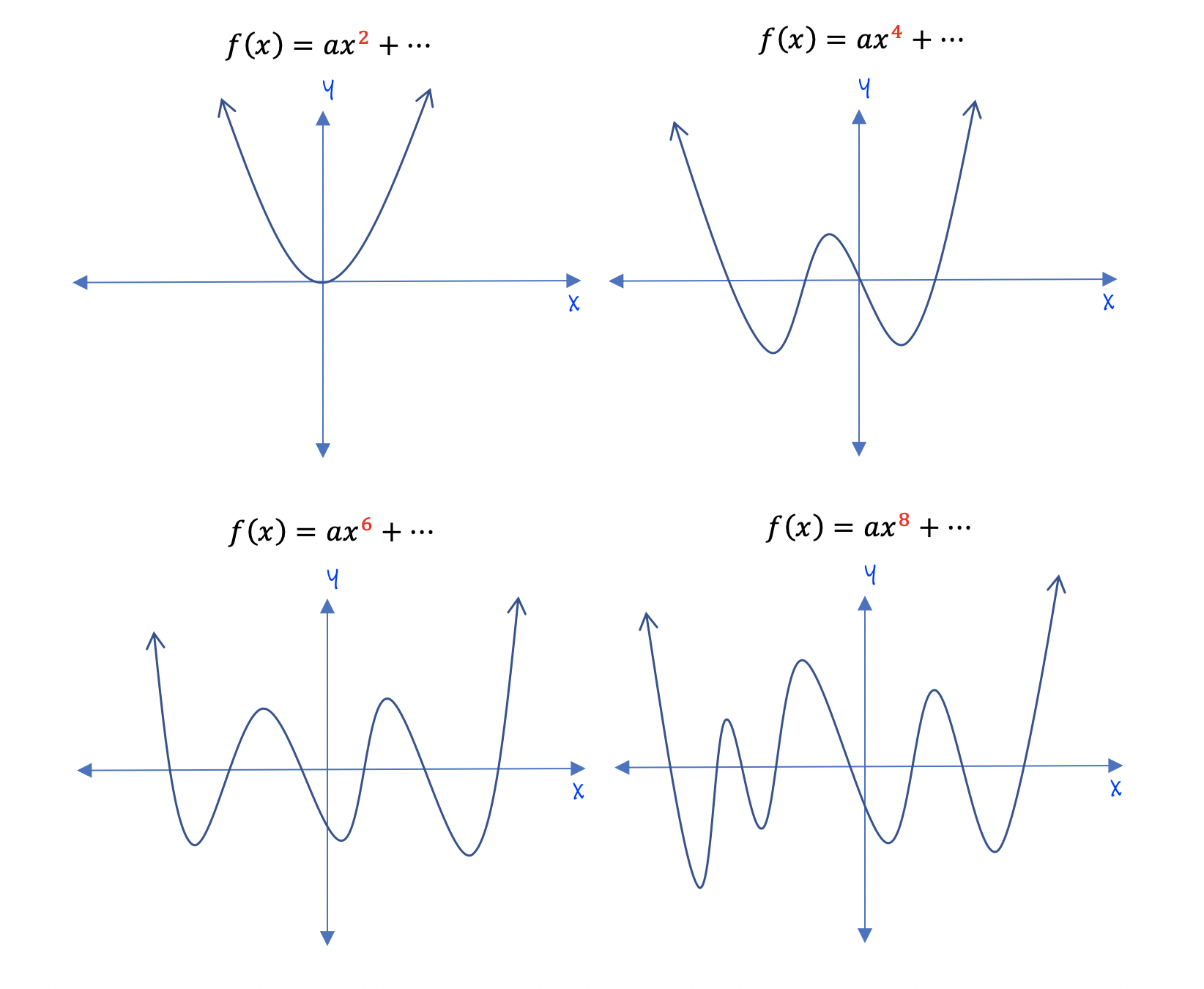
Polynomial functions of even degree will have either a global maximum or a global minimum. The leading coefficient tells you which one:
- If the leading coefficient of an even-degree polynomial is positive, the function has a global minimum.
- If the leading coefficient is negative, the function has a global maximum.
This happens because an even-degree polynomial heads toward the same infinity on both ends. Since the graph is continuous, it has to reach a lowest point (positive leading coefficient) or a highest point (negative leading coefficient) somewhere in between.
How to Use This on the AP Precalculus Exam
MCQ
- Read a graph or equation and identify local maxima, local minima, and the global extremum. Watch for restricted domains, since an endpoint can be the answer.
- Use the even-degree rule as a quick check: positive leading coefficient means a global minimum, negative means a global maximum.
- Spot points of inflection as the places where concavity flips, not where the function crosses the x-axis.
Free Response
- When you justify an answer, point to the behavior: name the interval where the function increases or decreases, or state where concavity changes.
- If two distinct real zeros are given, you can argue there is a local max or min between them.
- In a context problem, describe extrema and rates of change using the situation's units so your answer connects to what the function models.
Common Trap
- Do not confuse a point of inflection (concavity change) with a zero (output equals zero). They are different features and often occur at different x-values.
Common Misconceptions
- Misconception: A zero is the same as an extremum.Actually: A zero is not the same as an extremum. A zero is where the output is zero; a local max or min is where the function switches direction. They can happen at different inputs.
- Misconception: A change in concavity means the function switched between increasing and decreasing.Actually: Concavity changing does not mean the function switched between increasing and decreasing. At a point of inflection the function can still be increasing the whole time; what changes is whether the rate of change is growing or shrinking.
- Misconception: An even-degree polynomial has both a global maximum and a global minimum.Actually: Even degree does not mean the polynomial has both a global maximum and a global minimum. It has exactly one of the two, decided by the sign of the leading coefficient.
- Misconception: The leading coefficient is the same thing as the degree.Actually: The leading coefficient affects end behavior and which global extremum exists, but it is not the same thing as the degree. Check both.
- Misconception: An endpoint cannot be a local maximum or minimum unless the function turns around there.Actually: A restricted domain matters. An endpoint that is included in the domain can be a local maximum or minimum even if the function is not turning around there.
Related AP Precalculus Guides
Practice Questions for 1.4
1 of 10
A polynomial of degree 3 has the form where are distinct real zeros and . Which statement correctly verifies the number of local extrema?
A.
Exactly three local extrema must exist because the polynomial has three distinct zeros.
B.
The number of local extrema depends on the value of and cannot be determined from the zeros alone.
C.
Exactly two local extrema must exist: one between and , and one between and .
D.
At most one local extremum can exist because the polynomial has odd degree.
Vocabulary
The following words are mentioned explicitly in the AP® course framework for this topic.Term | Definition |
|---|---|
concave down | A characteristic of a graph where the rate of change is decreasing, creating a curve that opens downward. |
concave up | A characteristic of a graph where the rate of change is increasing, creating a curve that opens upward. |
decreasing | A characteristic of a function where output values fall as input values increase over an interval. |
degree | The highest power of the variable in a polynomial function, which determines the number of differences needed to reach a constant value. |
even degree | A polynomial function where the highest power of the variable is an even number. |
global maximum | The greatest of all local maximum values of a polynomial function. |
global minimum | The least of all local minimum values of a polynomial function. |
increasing | A characteristic of a function where output values rise as input values increase over an interval. |
leading coefficient | The coefficient a_n of the leading term in a polynomial function. |
leading term | The term in a polynomial with the highest degree, which dominates the function's behavior as input values increase or decrease without bound. |
local maximum | A point where a polynomial function switches from increasing to decreasing, producing a relative highest output value in that region. |
local minimum | A point where a polynomial function switches from decreasing to increasing, producing a relative lowest output value in that region. |
point of inflection | A point on the graph of a polynomial where the concavity changes from concave up to concave down or vice versa, occurring where the rate of change changes from increasing to decreasing or decreasing to increasing. |
polynomial function | A function that can be expressed in the form p(x) = a_n x^n + a_{n-1} x^{n-1} + ... + a_1 x + a_0, where n is a positive integer and a_n is nonzero. |
rate of change | The measure of how quickly a function's output changes relative to changes in its input. |
real zero | A real number value that makes a polynomial function equal to zero, corresponding to an x-intercept on the graph. |
Frequently Asked Questions
What is a polynomial function in AP Precalculus?
A polynomial function is a sum of terms with real coefficients and nonnegative integer powers of x. The highest power gives the degree, and its term is the leading term.
How do you find the degree of a polynomial?
The degree is the highest exponent of x in the polynomial after it is written in standard form. A nonzero constant function is a polynomial of degree zero.
What is a local maximum or minimum of a polynomial?
A local maximum or minimum happens where the polynomial switches between increasing and decreasing, or at an included endpoint when the polynomial has a restricted domain.
What is a global maximum or minimum of a polynomial?
A global maximum is the greatest output value on the whole domain, and a global minimum is the least output value. Even-degree polynomials have either a global maximum or a global minimum.
What is a point of inflection?
A point of inflection is where the rate of change switches from increasing to decreasing or from decreasing to increasing. On the graph, this is where concavity changes from up to down or down to up.
What happens between two real zeros of a polynomial?
Between every two distinct real zeros of a nonconstant polynomial, there must be at least one input value where the polynomial has a local maximum or local minimum.
See Fiveable more often in Google
Mark Fiveable as a preferred source and Google is more likely to show you our guides in Top Stories, with a "preferred" badge in AI Mode and AI Overviews.