1.11 Equivalent Representations of Polynomial and Rational Expressions

📈AP Precalculus Unit 1 Review
1.11 Equivalent Representations of Polynomial and Rational Expressions
📈 AP Precalculus
1.1
Change in Tandem
1.2
Rates of Change
1.3
Rates of Change in Linear and Quadratic Functions
1.4
Polynomial Functions and Rates of Change
1.5
Polynomial Functions and Complex Zeros
1.6
Polynomial Functions and End Behavior
1.7
Rational Functions and End Behavior
1.8
Rational Functions and Zeros
1.9
Rational Functions and Vertical Asymptotes
1.10
Rational Functions and Holes
1.11
Equivalent Representations of Polynomial and Rational Expressions
1.12
Transformations of Functions
1.13
Function Model Selection and Assumption Articulation
1.14
Function Model Construction and Application
The same polynomial or rational function can be written in different forms, and each form shows you something different. Factored form makes zeros, x-intercepts, holes, and asymptotes easier to read, while standard form makes end behavior clearer.
Why This Matters for the AP Precalculus Exam
This topic is about flexibility. The AP Precalculus exam expects you to switch between equivalent forms of a function and pull the right information from each one. If a question asks for zeros or holes, you want factored form. If it asks about end behavior, you reason from standard form and the leading term.
Polynomial long division shows up when you need a slant asymptote or want to rewrite a rational function as a polynomial plus a remainder. The binomial theorem gives you a fast, reliable way to expand powers of binomials without multiplying everything out by hand. Both calculator-active and non-calculator questions can use these skills, so being comfortable moving between forms helps you choose the most efficient path on each problem.
Key Takeaways
- Factored form reveals real zeros, x-intercepts, holes, domain restrictions, and asymptote locations.
- Standard form reveals end behavior through the degree and the sign of the leading coefficient.
- Different forms of the same function answer different questions, so pick the form that matches what is asked.
- Polynomial long division rewrites , where the degree of is less than the degree of , and helps you find slant asymptotes.
- The binomial theorem uses one row of Pascal's Triangle to expand and powers like .
Equivalent Forms of Polynomial and Rational Expressions
Factored Form
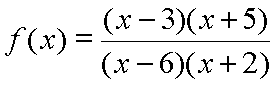
The factored form of a polynomial or rational function gives you fast access to its real zeros. From those zeros, you can read off x-intercepts and identify domain restrictions.
For rational functions, factored form also helps you locate vertical asymptotes and holes. When a factor in the denominator does not cancel, it points to a vertical asymptote. When a factor cancels between numerator and denominator, it points to a hole. Looking at the factors and their powers tells you how the function behaves near those points, which also gives insight into the range.
Standard Form
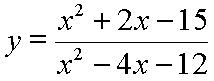
The standard form (terms written in descending powers) is the best form for end behavior.
For polynomials, the degree and the sign of the leading coefficient determine end behavior:
- Even degree, positive leading coefficient: the output increases without bound as input values go toward positive or negative infinity.
- Even degree, negative leading coefficient: the output decreases without bound in both directions.
- Odd degree: the two ends go opposite directions. A positive leading coefficient rises to the right; a negative leading coefficient falls to the right.
For rational functions, compare the degrees of the numerator and denominator:
- Numerator degree less than denominator degree: a horizontal asymptote at .
- Degrees equal: a horizontal asymptote at the ratio of the leading coefficients.
- Numerator degree greater than denominator degree: the function grows without bound, and if the numerator degree is exactly one more than the denominator degree, the graph has a slant asymptote.
Using Multiple Forms Together
Different analytic forms of the same function answer different questions. Factored form handles zeros, holes, and intercepts. Standard form handles end behavior. Switching between them lets you extract exactly the information a problem asks for and apply it in context.
Quotients of Two Polynomial Functions
Polynomial long division divides one polynomial by another, much like numerical long division but with polynomials.
To divide, you divide the highest-degree term of the dividend by the highest-degree term of the divisor to get the first term of the quotient. Multiply the divisor by that term, subtract, and repeat with the new dividend until its degree is less than the degree of the divisor.
The result can be written as:
where is the quotient and is the remainder. The degree of is always less than the degree of the divisor .
This is especially useful for slant asymptotes. When you divide a rational function and the quotient is linear, that linear quotient is the equation of the slant asymptote.
The Binomial Theorem
The binomial theorem lets you expand expressions of the form without multiplying everything out term by term. It uses a single row of Pascal's Triangle, where each entry is the sum of the two entries above it.
You can use it to expand polynomial functions of the form , where is a constant and is a non-negative integer. The expansion has terms, and each term is a binomial coefficient times a power of and a power of .
The binomial coefficients come from the th row of Pascal's Triangle and can also be found with the "n choose k" formula, where is the power and is the index of the term. Expanding this way is a quick way to rewrite a binomial power in standard form.
How to Use This on the AP Precalculus Exam
Multiple Choice
- When a question asks for zeros, x-intercepts, holes, or domain, rewrite in factored form first.
- When a question asks about end behavior or horizontal asymptotes, look at the leading terms in standard form.
- For a slant asymptote, expect to use polynomial long division and read the linear quotient.
Free Response
- Show your division steps clearly so the quotient and remainder are easy to follow. Clear setup makes your reasoning easier to score.
- When you state a slant asymptote, write it as an equation like , not just the quotient terms.
- Keep your final form matched to the question. If the prompt wants end behavior, explain it from the leading term; if it wants holes, justify them from the cancelled factor.
Common Trap
- A cancelled factor creates a hole, not a vertical asymptote. A non-cancelled denominator factor creates a vertical asymptote. Mixing these up is a frequent error.
Common Misconceptions
- Misconception: Equal numerator and denominator degrees always give a horizontal asymptote at .Actually: Equal numerator and denominator degrees do not always give a horizontal asymptote at . The asymptote is at the ratio of the leading coefficients.
- Misconception: A slant asymptote appears whenever the numerator degree is larger than the denominator degree.Actually: A slant asymptote only appears when the numerator degree is exactly one more than the denominator degree, not whenever the numerator degree is larger.
- Misconception: A factor that cancels signals a vertical asymptote, while a denominator factor that does not cancel signals a hole.Actually: A factor that cancels signals a hole, while a denominator factor that does not cancel signals a vertical asymptote. They are not the same feature.
- Misconception: A remainder can have a degree equal to or greater than the divisor after polynomial division is finished.Actually: The remainder in polynomial long division must have a lower degree than the divisor. If it does not, the division is not finished.
- Misconception: The numbers in Pascal's Triangle are exponents.Actually: The numbers in Pascal's Triangle are the binomial coefficients themselves, not exponents. Match each coefficient with the correct powers of and .
Related AP Precalculus Guides
Practice Questions for 1.11
1 of 10
The graph above models the population of a species in a restricted environment years after introduction.
Which of the following equivalent forms of best reveals the carrying capacity (the long-term population limit as ) of the environment?
A.
B.
C.
D.
Vocabulary
The following words are mentioned explicitly in the AP® course framework for this topic.Term | Definition |
|---|---|
analytic representations | Different mathematical forms or expressions used to represent the same function, such as factored form or standard form. |
asymptote | Lines that a graph approaches but never reaches, indicating behavior at infinity or at points of discontinuity. |
binomial | A polynomial expression consisting of exactly two terms, such as (a + b). |
binomial coefficients | The numerical coefficients that appear in the expansion of (a + b)^n, found in the rows of Pascal's Triangle. |
binomial theorem | A mathematical theorem that provides a formula for expanding expressions of the form (a + b)^n using binomial coefficients. |
domain | The set of all possible input values for which a function is defined. |
end behavior | The behavior of a function as the input values approach positive or negative infinity. |
equivalent forms | Different ways of writing the same mathematical expression that have equal values for all valid inputs. |
factored form | A representation of a polynomial or rational expression written as a product of its factors, which reveals the real zeros and x-intercepts. |
holes | Points where a rational function is undefined due to common factors in the numerator and denominator that cancel out, creating a gap in the graph. |
Pascal's Triangle | A triangular array of numbers where each row contains the binomial coefficients used in the binomial expansion of (a + b)^n. |
polynomial expressions | Mathematical expressions consisting of variables and coefficients combined using addition, subtraction, and multiplication, where variables have non-negative integer exponents. |
polynomial long division | An algebraic process similar to numerical long division used to divide one polynomial by another, producing a quotient and remainder. |
quotient | The result obtained when one polynomial is divided by another polynomial in polynomial long division. |
range | The set of all possible output values that a function can produce. |
rational expressions | Mathematical expressions that represent the ratio of two polynomials, written as a fraction with a polynomial numerator and polynomial denominator. |
rational function | A function expressed as the ratio of two polynomials, where the denominator is not equal to zero. |
real zero | A real number value that makes a polynomial function equal to zero, corresponding to an x-intercept on the graph. |
remainder | The polynomial left over after polynomial long division, which has a degree less than the divisor polynomial. |
slant asymptote | A linear asymptote that occurs when the numerator polynomial of a rational function has a degree one greater than the denominator polynomial. |
standard form | A representation of a polynomial or rational expression in expanded form, which reveals information about end behavior. |
x-intercept | The point where a graph crosses or touches the x-axis, occurring at (a, 0) when a is a real zero of the function. |
Frequently Asked Questions
How do you find the roots of a polynomial in AP Precalculus?
Rewrite the polynomial in factored form when possible. Each real factor equal to zero gives a real root and an x-intercept of the graph.
Why is factored form useful for polynomial and rational functions?
Factored form makes zeros, x-intercepts, holes, vertical asymptotes, domain restrictions, and some range information easier to identify.
What does standard form reveal about a polynomial?
Standard form reveals end behavior through the degree of the polynomial and the sign of the leading coefficient.
How do you find a slant or oblique asymptote?
Use polynomial long division. When the numerator degree is exactly one more than the denominator degree, the quotient gives the slant or oblique asymptote.
How does the binomial theorem help in AP Precalculus?
The binomial theorem expands expressions like (a + b)^n using coefficients from Pascal's Triangle, which is faster than repeated multiplication.
What is the difference between a hole and a vertical asymptote?
A cancelled denominator factor creates a hole. A denominator factor that does not cancel creates a vertical asymptote.
See Fiveable more often in Google
Mark Fiveable as a preferred source and Google is more likely to show you our guides in Top Stories, with a "preferred" badge in AI Mode and AI Overviews.