4.11 The Inverse and Determinant of a Matrix

📈AP Precalculus Unit 4 Review
4.11 The Inverse and Determinant of a Matrix
📈 AP Precalculus
4.1
Parametric Functions
4.2
Parametric Functions Modeling Planar Motion
4.3
Parametric Functions and Rates of Change
4.4
Parametrically Defined Circles and Lines
4.5
Implicitly Defined Functions
4.6
Conic Sections
4.7
Parametrization of Implicitly Defined Functions
4.8
Vectors
4.9
Vector-Valued Functions
4.10
Matrices
4.11
The Inverse and Determinant of a Matrix
4.12
Linear Transformations and Matrices
4.13
Matrices as Functions
4.14
Matrices Modeling Contexts
Matrix Inverses and Determinants
For AP Precalculus, the inverse of a 2 x 2 matrix exists exactly when its determinant is not zero. The determinant of is , and that value tells you whether the matrix is invertible, whether two row or column vectors are parallel, and the area of the parallelogram those vectors span.
The identity matrix is the matrix version of multiplying by 1. If exists, then .
Identity Matrix and Inverses
The identity matrix, denoted as I, is a special type of square matrix that has the property that when it is multiplied by any other matrix of the same size, the resulting matrix is equal to the original matrix.
The identity matrix has the size of n x n, where n is the number of rows and columns. The identity matrix has ones on the diagonal from the top left to bottom right, and zeros everywhere else. This diagonal of ones is often referred to as the main diagonal. The identity matrix is also known as the unit matrix.
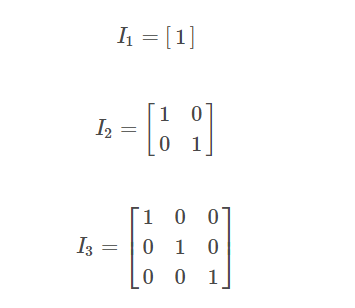
The product of a square matrix and its inverse, when it exists, is the identity matrix of the same size. This means that if is a square matrix and is the inverse of , then , where is the identity matrix of the same size as .
The inverse of a 2 x 2 matrix, when it exists, can be calculated both with and without technology.
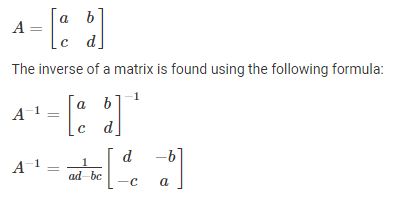
One way to calculate the inverse of a 2 x 2 matrix is to use the formula:
If , then , where .
Determinants

The determinant of a matrix is a scalar value that can be calculated for square matrices, and it is denoted as . The determinant of a matrix A is a measure of its invertibility and it can be used to find the inverse of a matrix, when it exists.
For a 2 x 2 matrix A (see image above), the determinant is calculated as the scalar value . This is a simple calculation that can be done by hand or with the help of a calculator.
The determinant of a 2×2 matrix can be calculated with or without technology (e.g., on a calculator).
Optional/Not required for AP Precalculus: Determinants of larger matrices (e.g., 3×3) exist but are not assessed in this unit.
Relating Determinants and Parallel Vectors
If a 2 x 2 matrix consists of two column vectors and from R2, then , and this absolute value equals the area of the parallelogram spanned by and . If , the vectors are parallel. (The sign of indicates orientation, depending on the order of .)
It's worth noting that the same holds true for a 2 x 2 matrix if the matrix consists of two row vectors and from R2: the area is and if the determinant equals 0, then the vectors are parallel.
Invertibility Condition
The square matrix A has an inverse if and only if its determinant, denoted as , is not equal to 0 []. This means that a square matrix A is invertible if and only if its determinant is non-zero. This is often referred to as the invertibility condition of a matrix.
Practice Questions for 4.11
1 of 10
An engineer models a system's input and output using the matrix equation , where . Which expression correctly isolates the input matrix ?
A.
B.
C.
D.
Vocabulary
The following words are mentioned explicitly in the AP® course framework for this topic.Term | Definition |
|---|---|
2 × 2 matrix | A square matrix with 2 rows and 2 columns. |
column vector | Vectors represented as columns in a matrix; when two column vectors form a 2×2 matrix, the absolute value of the determinant gives the area of the parallelogram they span. |
determinant | A scalar value calculated from a square matrix that determines whether the matrix is invertible; for a 2×2 matrix [a b; c d], the determinant equals ad - bc. |
identity matrix | A square matrix with 1s on the main diagonal (from top left to bottom right) and 0s everywhere else. |
invertibility | The property of a square matrix that has an inverse; a matrix is invertible if and only if its determinant is nonzero. |
matrix inverse | A matrix that, when multiplied by the original matrix, produces the identity matrix; a square matrix has an inverse if and only if its determinant is nonzero. |
parallel vectors | Vectors that have the same or opposite direction, resulting from scalar multiplication of a vector by a constant. |
parallelogram | A quadrilateral formed by two vectors; the area of the parallelogram spanned by two vectors equals the absolute value of the determinant of the matrix formed by those vectors. |
row vector | Vectors represented as rows in a matrix; when two row vectors form a 2×2 matrix, the absolute value of the determinant gives the area of the parallelogram they span. |
square matrix | A matrix with the same number of rows and columns; only square matrices can have determinants and inverses. |
Frequently Asked Questions
What is the determinant of a 2x2 matrix?
For a 2 x 2 matrix A = [a b; c d], the determinant is det(A) = ad - bc.
How do you find the inverse of a 2x2 matrix?
If det(A) is not zero, swap a and d, change the signs of b and c, and multiply the resulting matrix by 1/det(A).
What does det(A) = 0 mean?
If det(A) = 0, the matrix is singular and does not have an inverse. In vector terms, the row or column vectors are parallel.
What is the identity matrix I2?
I2 is the 2 x 2 identity matrix with 1s on the main diagonal and 0s elsewhere. Multiplying a 2 x 2 matrix by I2 gives the original matrix.
What does singular matrix mean?
A singular matrix is a square matrix with determinant 0. It cannot be inverted because its rows or columns do not span the full space.
See Fiveable more often in Google
Mark Fiveable as a preferred source and Google is more likely to show you our guides in Top Stories, with a "preferred" badge in AI Mode and AI Overviews.