AP Chemistry Unit 4 Cheatsheet: Chemical Reactions

AP Chemistry Unit 4 Cheatsheet: Chemical Reactions

Start with the first 3 sections of the Unit 4 one-page cheatsheet below. The full sheet is a PDF you can print.

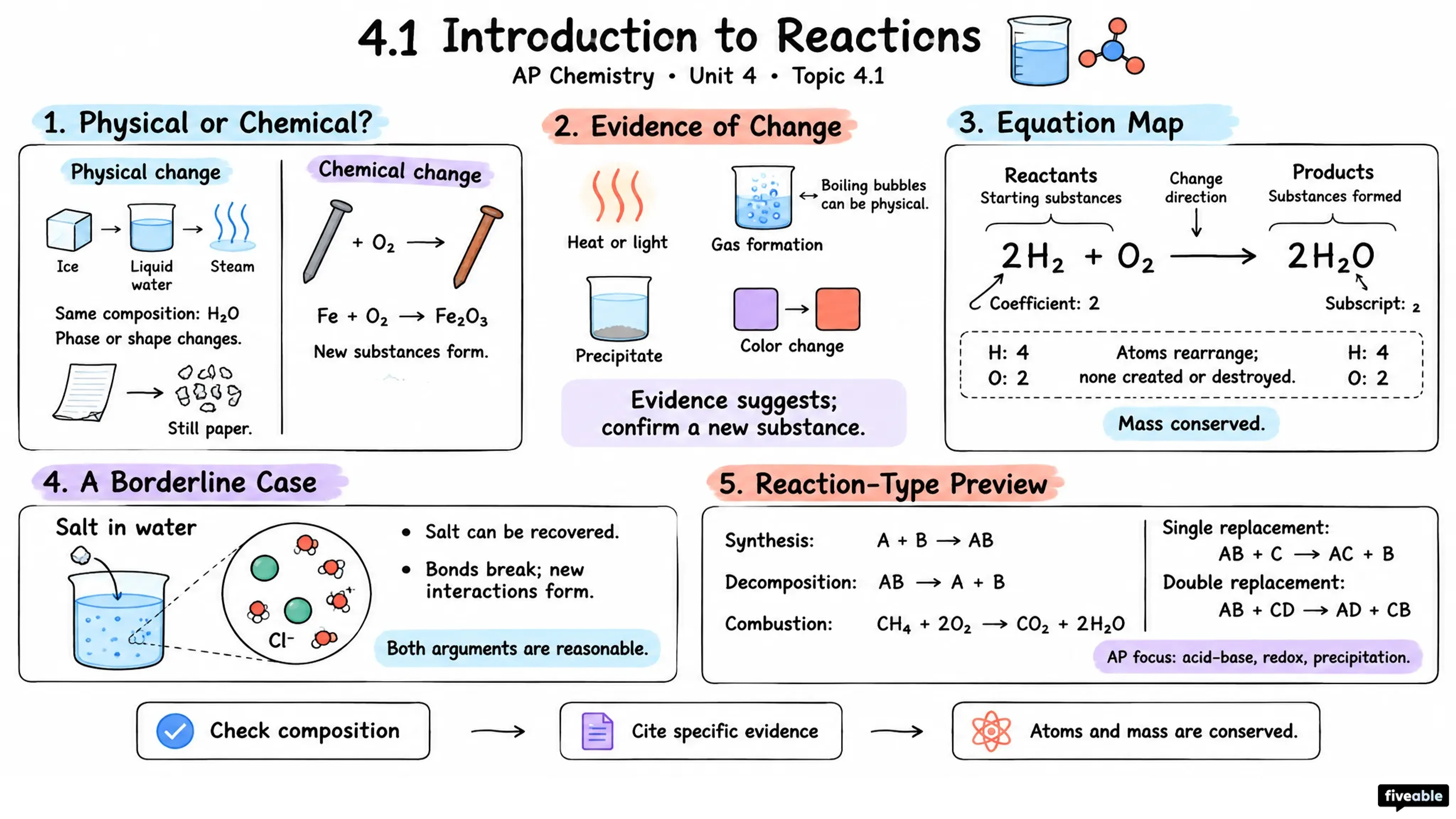
Physical vs. Chemical Changes

Physical ChangeChemical Change
Substance properties change, but composition stays the sameNew substances form with different composition
Phase changes (solid ↔ liquid ↔ gas)Atoms rearrange into new combinations
Mixture formation/separationEvidence: heat/light, gas formation, precipitate, color change
In a physical change, only interparticle attractions (IMFs, ion–ion lattice attractions) are broken and/or formed — no covalent bonds within the substance's particles are made or broken.Chemical bonds break and/or form

Gray area: Salt dissolving in water involves breaking ionic bonds but may be classified as physical or chemical depending on context.
Equation Forms & When to Use

  • Molecular equation: Shows all compounds as written formulas. Use for general representation.
  • Complete ionic equation: Shows all ions and molecules separately. Reveals what's actually in solution.
  • Net ionic equation: Removes spectator ions (ions that don't participate). Shows only the actual reaction occurring.

All three forms must be balanced for atoms AND charge. Mass and charge are conserved in every reaction.

Brønsted-Lowry Acid-Base Pairs

  • Acid: Proton (H⁺) donor
  • Base: Proton (H⁺) acceptor
  • Conjugate acid-base pair: Two species differing by one H⁺

Example: HCl + H₂O → H₃O⁺ + Cl⁻
HCl is acid; Cl⁻ is conjugate base.
H⁺ + H₂O ⇌ H₃O⁺
H₂O is base; H₃O⁺ is conjugate acid.

Water is amphoteric—it can donate or accept protons depending on what it reacts with.

The rest of the Unit 4 sheet

6 more sections are on the one-page PDF:

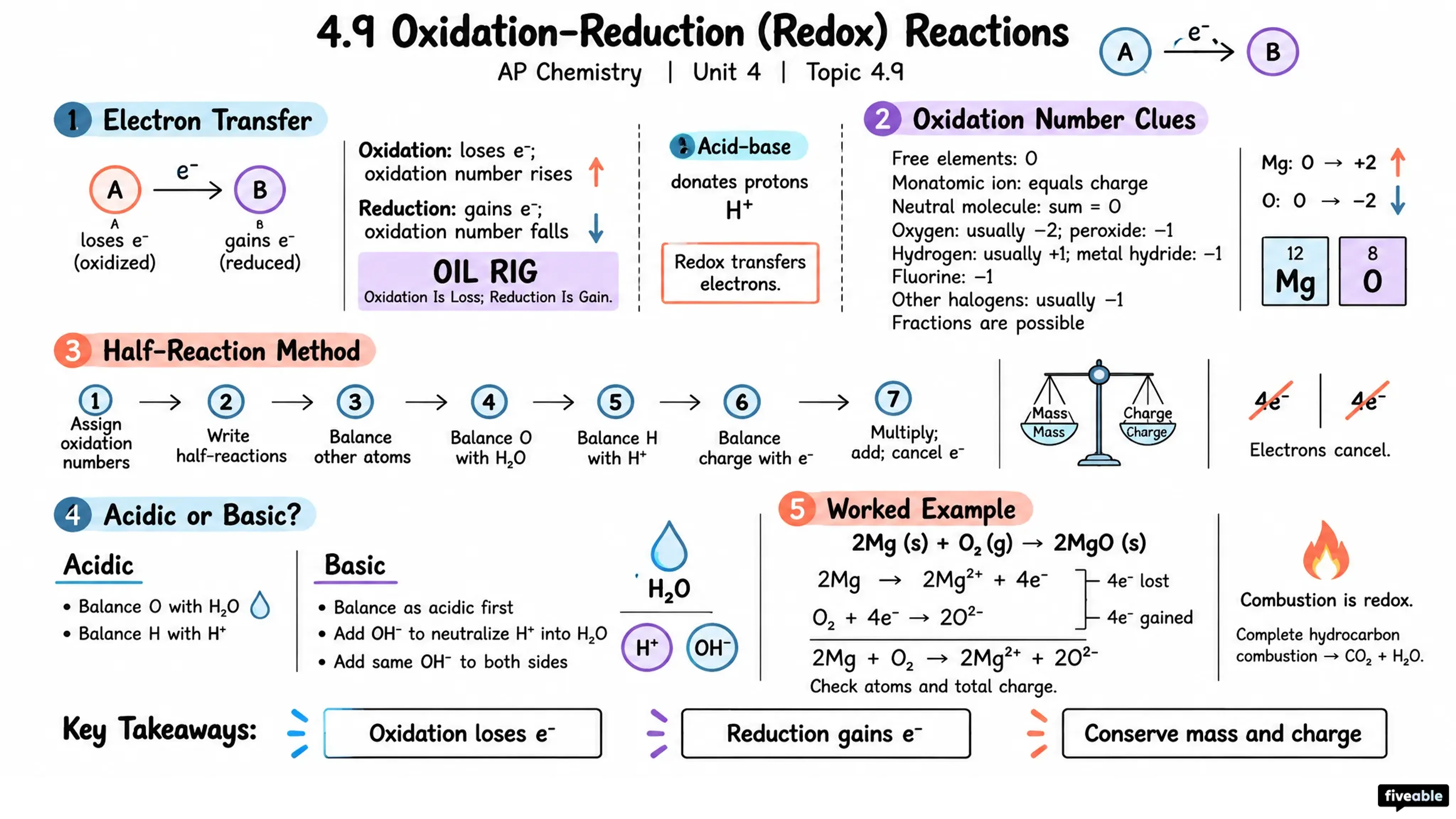
  • Balancing Redox with Half-Reactions

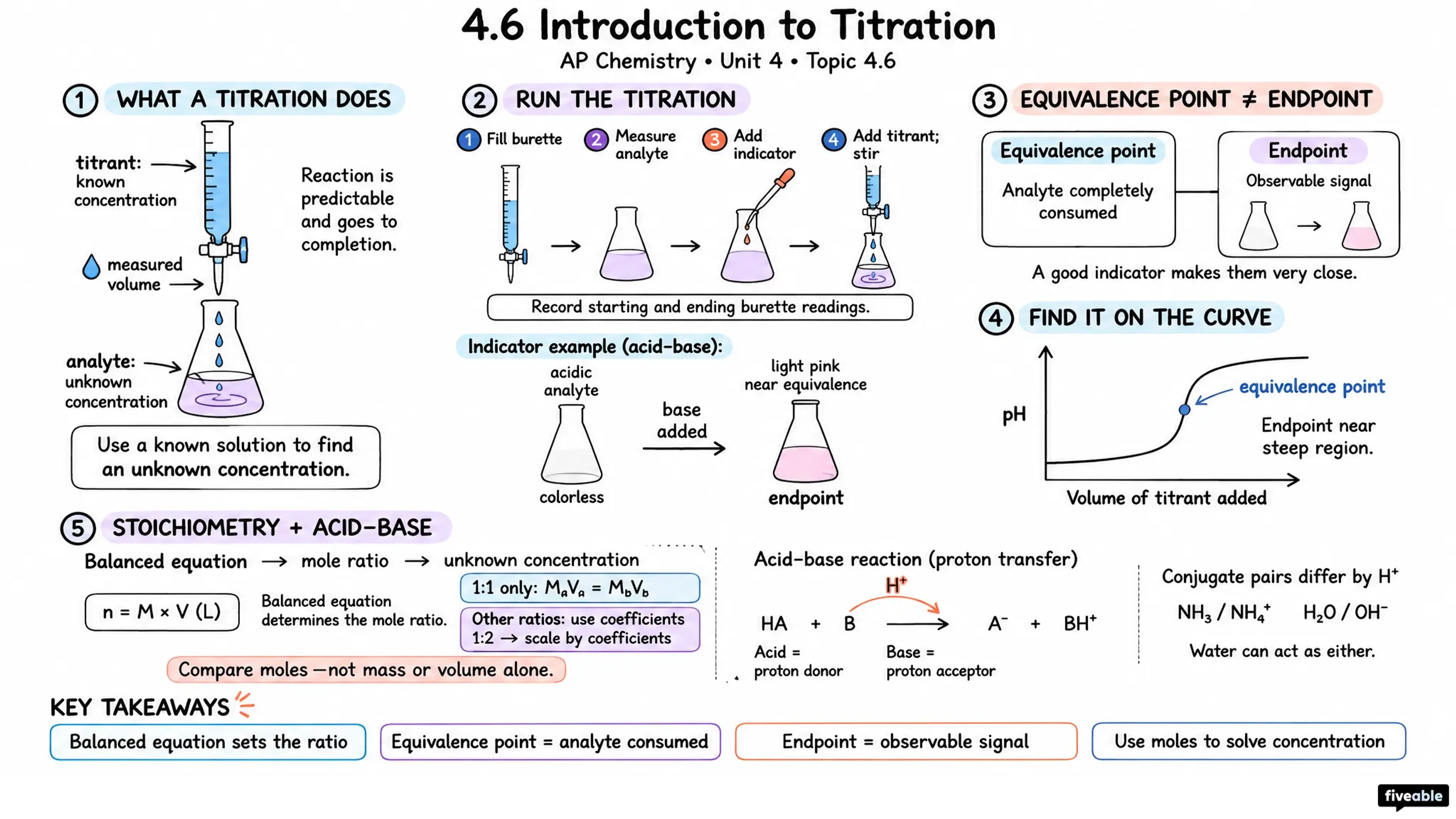
  • Titration: Equivalence Point & Endpoint

  • Oxidation Numbers & Redox Identification

  • Identifying Reaction Types

  • Stoichiometry: Mole Ratios & Calculations

  • Particulate-Level Representation

Made by you

Visual Cheatsheets

Pick a Unit 4 topic and a format: flowchart, comparison chart, vocab sheet, Cornell notes and more. Ready in about a minute.

Printable PDF · from the Fiveable shop

AP Chemistry Unit 4 Cheatsheet

1 page · Chemical Reactions · PDF

Visual Cheatsheets

One topic, the format you pick, ready in about a minute

Format

Topic

Takes 30–60 seconds

Preview: Standard

Unit 4: Chemical Reactions, topic by topic

Each topic has a full study guide. See the whole unit.