AP exam review verified for 2027

AP African American Studies Themes Review

AP African American Studies organizes its content around four recurring themes that run through every unit, from early African societies to the present. Learning to recognize and apply these themes is the core analytical skill the course tests.

Use the topic guides for each theme to trace how the same big idea shows up across different time periods and contexts.

What are the AP African American Studies themes?

Themes in AP African American Studies work differently from units. Units move chronologically and topically. Themes cut across all four units like threads, so you are expected to recognize the same pattern in a slave ship revolt, a Harlem Renaissance poem, a Great Migration photograph, and a civil rights sit-in. The exam rewards students who can connect examples across time using thematic language.

There are four official themes. Each one recurs across all four units of the course. You are expected to use them as analytical tools, not just as labels.

Themes are connective tissue, not chapter headings

A single event can illustrate multiple themes at once. The Great Migration, for example, is a Migration and the African Diaspora example, but it also involves Intersections of Identity because class, region, and gender shaped who migrated and how, and Resistance and Resilience because moving north was itself an act of agency against Jim Crow conditions.
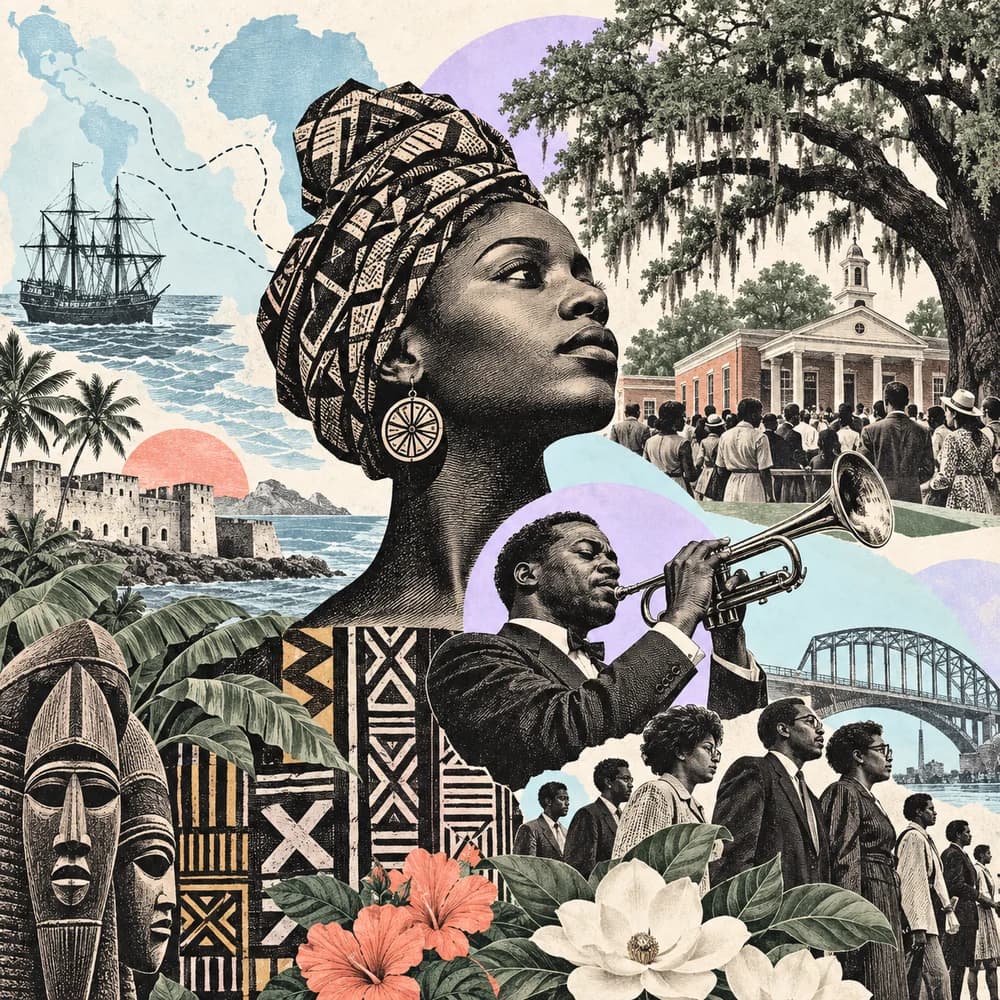
Themes spiral across units

You will encounter each theme in Unit 1 through Unit 4. Resistance looks like maroon communities in Unit 2, the Harlem Renaissance in Unit 3, and the Black Power movement in Unit 4. Recognizing that spiral is what the course calls thematic analysis.

Creativity and expression are evidence, not decoration

Theme 3 asks you to treat Black art, music, literature, and performance as primary sources. The blues, the slave narrative, the protest poem, and the mural are all arguments about identity, justice, and survival. Analyzing them as evidence is a distinct exam skill.

Why themes matter on the exam

The AP exam asks you to analyze sources and construct arguments. Themes give you the vocabulary and framework to do that. When a prompt asks you to explain how African Americans responded to oppression, you are being asked to apply Resistance and Resilience. When it asks how identity shaped experience, you are applying Intersections of Identity. Knowing the themes by name and by example lets you answer those prompts with precision.

Thematic study guides

1

Migration and the African Diaspora

Traces forced and voluntary movement of African-descended people from the transatlantic slave trade through the Great Migration. Asks you to analyze how displacement and migration shaped culture, identity, and community across time and geography.

open guide
2

Intersections of Identity

Examines how race, gender, class, region, religion, and other identity categories overlap and produce distinct experiences. Uses intersectionality as a framework to complicate single-axis analysis of historical and contemporary events.

open guide
3

Creativity, Expression, and the Arts

Treats Black artistic and literary production as primary evidence. Covers slave narratives, the Harlem Renaissance, blues and jazz, and the Black Arts Movement as arguments about identity, justice, and culture rather than as background decoration.

open guide
4

Resistance and Resilience

Documents how African Americans resisted oppression through armed revolt, legal challenge, cultural production, institution-building, and mass mobilization across all four units. Distinguishes between dramatic confrontation and everyday forms of resistance.

open guide

Themes review notes

Theme 1

Migration and the African Diaspora

This theme tracks how the movement of people, both forced and voluntary, built and reshaped African diaspora communities across time. It asks you to hold two ideas at once: displacement as violence and migration as agency. Forced migration includes the transatlantic slave trade. Voluntary migration includes the Great Migration north and west in the twentieth century.

  • Transatlantic slave trade: Forced migration of millions of Africans to the Americas that created the African diaspora and is the foundational event of the course.
  • African diaspora: The global dispersal of people of African descent and the cultural, political, and social connections they maintained across national boundaries.
  • Great Migration: The movement of approximately six million Black Americans from the rural South to northern and western cities between roughly 1910 and 1970, driven by Jim Crow violence and economic opportunity.
  • Push and pull factors: Forces that drive people away from a place (push) or attract them to a new one (pull); used to analyze both forced and voluntary migration patterns.
Can you name one example of forced migration and one example of voluntary migration from different units and explain what each reveals about African diaspora experience?
Migration typeExampleUnit contextWhat it shows
ForcedTransatlantic slave tradeUnit 2Displacement as systemic violence; creation of diaspora
VoluntaryGreat MigrationUnit 3 and 4Agency and resistance; reshaping of Black urban culture
Forced internalDomestic slave tradeUnit 2Continued displacement within the Americas after 1808
Voluntary transnationalPan-African movementUnit 3 and 4Diaspora solidarity across national borders
Theme 2

Intersections of Identity

This theme keeps you thinking about how multiple categories of identity operate simultaneously rather than in isolation. Race, ethnicity, class, nationality, gender, region, religion, and ability all overlap and shape how people live, what they fight for, and how others treat them. The course uses this theme to complicate any single-axis analysis.

  • Intersectionality: A framework, developed by scholar Kimberle Crenshaw, for understanding how overlapping systems of identity and oppression interact to produce distinct experiences.
  • Double consciousness: W.E.B. Du Bois's concept describing the tension of being both Black and American, always seeing oneself through the eyes of a society that devalues Blackness.
  • Gender and race: The course examines how Black women faced compounded forms of discrimination and how their leadership in movements was often minimized despite being central.
  • Class stratification: Economic position within Black communities shaped access to education, political power, and geographic mobility, and intersected with race to produce varied experiences.
Pick one historical figure from the course and identify at least three identity categories that shaped their experience or their political work.
Identity axisHow it intersects with raceCourse example
GenderBlack women faced both racial and gender-based exclusion from rights and leadership recognitionIda B. Wells, Fannie Lou Hamer, Black feminist organizing
ClassEconomic position shaped access to education, migration options, and political voiceTalented Tenth debate, sharecropping, Black middle class formation
RegionSouthern and northern Black experiences differed sharply in legal status, culture, and opportunityJim Crow South vs. Harlem Renaissance North
ReligionChurch institutions served as political organizing spaces and shaped community identityBlack church in civil rights movement
Theme 3

Creativity, Expression, and the Arts

This theme treats Black art, music, literature, and performance as primary sources and analytical evidence. Creative works are arguments about identity, justice, survival, and culture. The theme runs across every unit and asks you to read a blues song, a slave narrative, a protest poem, or a mural the same way you would read a political document.

  • Slave narrative: First-person accounts of enslaved life, such as those by Frederick Douglass and Harriet Jacobs, that served as abolitionist evidence and assertions of humanity.
  • Harlem Renaissance: A flowering of Black artistic, literary, and intellectual production centered in Harlem in the 1920s and 1930s that used culture to assert dignity and challenge racism.
  • Blues and jazz: Musical forms rooted in African American experience that expressed suffering, resilience, and joy and became foundational to American and global culture.
  • Black Arts Movement: A 1960s and 1970s cultural movement that linked artistic production explicitly to Black political liberation and community self-determination.
Choose one creative work from the course and explain what argument it makes about Black identity or justice, using specific evidence from the work itself.
Art formUnit contextWhat it argues or expresses
Slave narrativeUnit 2Asserts humanity and exposes the brutality of slavery as a political act
Harlem Renaissance literature and visual artUnit 3Claims cultural citizenship and challenges racist stereotypes
Blues and jazzUnit 3 and 4Expresses collective memory, grief, and resilience; shapes American cultural identity
Black Arts Movement poetry and theaterUnit 4Links aesthetic production directly to political liberation
Theme 4

Resistance and Resilience

This theme shows how African Americans innovated methods to resist oppression and assert agency across every period of the course. Resistance is not only dramatic confrontation. It includes everyday acts, cultural production, legal challenges, institution-building, and armed revolt. Resilience refers to the capacity to sustain community and identity under conditions designed to destroy both.

  • Maroon communities: Self-liberated communities of formerly enslaved people in the Americas who established independent settlements and resisted recapture, representing organized resistance to slavery.
  • Abolitionism: The organized movement to end slavery, involving both Black and white activists, that used moral argument, legal pressure, and direct action.
  • Civil disobedience: Nonviolent refusal to comply with unjust laws, used extensively in the civil rights movement through sit-ins, freedom rides, and marches.
  • Black Power: A political movement of the 1960s and 1970s that emphasized Black self-determination, cultural pride, and community control as forms of resistance beyond legal integration.
Identify one example of resistance from each of the four units and explain how the method of resistance reflects the specific conditions of that period.
UnitForm of resistanceExampleConditions it responded to
Unit 1Cultural and spiritual retentionPreservation of African religious and cultural practicesForced assimilation and cultural erasure
Unit 2Armed revolt and escapeNat Turner's rebellion, Underground RailroadChattel slavery and legal dehumanization
Unit 3Legal and cultural challengeNAACP litigation, Harlem RenaissanceJim Crow segregation and racial terror
Unit 4Mass mobilization and Black PowerCivil rights movement, Black Panther PartyOngoing structural racism and police violence

Common mistakes

Treating themes as separate from units

Themes are not a fifth unit or a separate section to memorize. They run through all four units simultaneously. If you are studying Unit 3 and only thinking about chronology, you are missing the thematic layer the exam tests.

Using only one theme when multiple apply

Most major events, figures, and texts in the course illustrate more than one theme. Applying only one theme to the Great Migration or the civil rights movement produces a thinner analysis than the exam rewards. Practice identifying the second and third theme in any example.

Describing creative works instead of analyzing them

For Theme 3, students often summarize what a poem, song, or painting is about rather than explaining what argument it makes. The exam wants analysis: what does this work claim about Black identity, justice, or experience, and how does it make that claim?

Limiting resistance to dramatic events only

Students often list only revolts, marches, and legal cases as examples of resistance. The course also counts cultural production, institution-building, migration, and everyday acts of refusal as resistance. Narrowing your examples weakens thematic analysis.

Ignoring intersectionality within examples

When applying Theme 2, students often focus only on race and ignore how gender, class, or region shaped the same event differently for different people. Ida B. Wells's experience of both racial and gender-based exclusion is a stronger intersectionality example than race alone.

How this theme shows up on the AP exam

How themes appear in source-based analysis

When the exam presents a primary source, such as a speech, image, song lyric, or document, and asks you to analyze it, you are expected to connect it to at least one course theme. Naming the theme and explaining how the source illustrates it is the move that elevates a response from description to analysis. Practice identifying which theme a source belongs to before you write.

How themes appear in argument and comparison tasks

Prompts that ask you to explain how African Americans responded to a specific condition, or to compare responses across time periods, are asking you to apply Resistance and Resilience or Migration and the African Diaspora as organizing frameworks. Using thematic vocabulary precisely, rather than just listing events, is what produces a strong analytical response.

How themes appear in cross-unit connections

The exam rewards students who can connect examples from different units using a shared theme. If a prompt gives you a Unit 2 example and asks you to explain a broader pattern, you should be able to bring in a Unit 3 or Unit 4 example that illustrates the same theme. This cross-unit fluency is built by studying themes as threads rather than as unit-specific content.

Review checklist

  • Name and define all four themesYou should be able to state each theme's name and write a one-sentence definition of what it tracks or asks you to analyze. If you cannot do this without looking, review the topic guides.
  • Match at least two examples per theme per unitFor each of the four themes, identify at least two concrete examples from different units. This cross-unit fluency is what the exam tests. A single-unit example is not enough to demonstrate thematic analysis.
  • Practice applying multiple themes to one eventTake one event, such as the Great Migration or the Harlem Renaissance, and write a paragraph explaining how it illustrates at least two different themes. This is the core analytical move the course rewards.
  • Know the vocabulary specific to each themeTerms like intersectionality, double consciousness, diaspora, maroon communities, and Black Arts Movement are not interchangeable. Know which theme each term belongs to and how to use it precisely in an analytical sentence.
  • Treat creative works as evidence, not backgroundFor Theme 3, practice writing sentences that analyze what a specific work argues rather than just describing what it is. The difference between describing the Harlem Renaissance and analyzing what Langston Hughes's poetry argues about Black identity is the difference between summary and analysis.
  • Distinguish forms of resistance by period and contextFor Theme 4, be able to explain why a particular form of resistance emerged in a particular period. Maroon communities reflect the conditions of chattel slavery. Sit-ins reflect the conditions of Jim Crow. The method is always a response to specific conditions.

How to study themes

Start with the topic guidesFour topic guides are available, one for each theme. Read each one to understand what the theme tracks, what vocabulary it uses, and where it appears across units. This gives you the framework before you try to apply it.
Build a theme-by-example chartCreate a four-column chart, one column per theme. For each unit you have studied, add at least two examples to each column. By the time you finish, you should have eight or more examples per theme drawn from across the course.
Practice multi-theme analysis in writingChoose one event or figure and write a short paragraph applying two themes at once. Explain how the same example illustrates both Migration and the African Diaspora and Resistance and Resilience, for instance. This is the analytical move the exam rewards most.
Use the score calculator to set a targetThe score calculator available for this course can help you estimate what score your current preparation level might produce and identify where thematic analysis is costing you points. Use it to set a realistic study target before your exam date.
Review creative works as primary sourcesPick three creative works from the course, one from Unit 2, one from Unit 3, and one from Unit 4. For each one, write one sentence explaining what argument it makes about Black identity or justice. This builds the Theme 3 analytical skill the exam tests.

More ways to review

Topic study guides

Open the individual guides for Themes when you want a closer review of one topic.

browse guides

FRQ practice

Practice free-response reasoning and compare your answer with scoring guidance.

practice FRQs

Cheatsheets

Use unit cheatsheets for a quick visual review after you work through the notes.

open cheatsheets

Score calculator

Estimate your broader AP score goal after you review the course and exam format.

open calculator
Ready to review Themes?Start with the notes, check the topic cards, and use the practice or resource links when they are available for this course.