5.2 Understanding Molecular and Formula Weights

👩🏽🔬Honors Chemistry Unit 5 Review
5.2 Understanding Molecular and Formula Weights
👩🏽🔬 Honors Chemistry
continue practicing 5.2
Multiple choice
Understanding Molecular and Formula Weights
Molecular and formula weights let you connect a compound's chemical formula to its actual mass, which is the foundation for nearly every calculation in stoichiometry. Building on the mole concept from the previous guide, you'll learn here how to calculate these weights and use them in practice.
📐 Calculating Molecular and Formula Weights
From Chemical Formulas to Weights
Every chemical formula tells you exactly which atoms are present and how many of each. To find the molecular weight (for covalent compounds) or formula weight (for ionic compounds), you just add up the atomic masses of all the atoms in the formula.
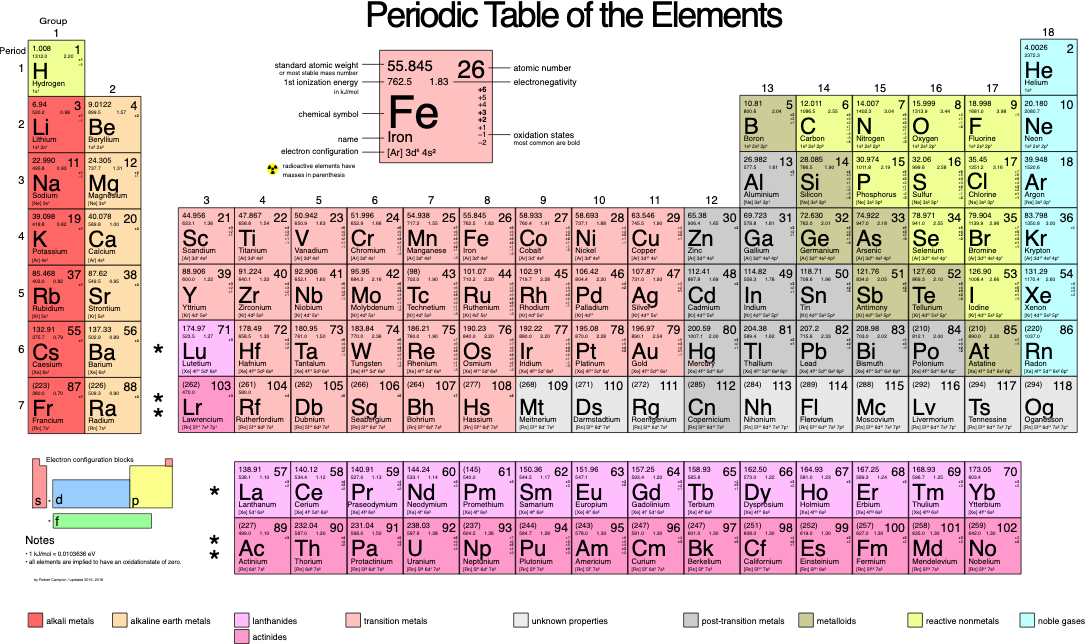
A color-coded periodic table showing element types.
Image courtesy of Wikimedia Commons

Here's the process:
- Identify the atomic weight of each element from the periodic table. For example, F has an atomic weight of about 19 amu, while Xe is about 131 amu.
- Count the atoms using the subscripts in the chemical formula. A compound like has 3 C atoms, 8 H atoms, and 1 O atom.
- Multiply and add. Multiply each element's atomic weight by the number of that atom, then sum everything up. The result is the molecular weight (or formula weight).
Example: Finding the molecular weight of 6 molecules
- Atomic weights: H ≈ 1 amu, O ≈ 16 amu
- Atom count: Six molecules contain 12 H atoms and 6 O atoms total.
- Math:
Example: Formula weight of NaCl
The same process works for ionic compounds. For NaCl:
- Atomic weights: Na ≈ 23 amu, Cl ≈ 35.5 amu
- Atom count: 1 Na and 1 Cl per formula unit.
- Math:
💡 The key idea: identify each element's atomic weight, count the atoms from the chemical formula, then multiply and add.
Applications in Stoichiometry
Empirical formulas show the simplest whole-number ratio between elements in a compound, while molecular formulas give the exact number of each type of atom.
For example, , , and all share the same empirical formula (), but their molecular formulas differ. You need the molecular weight to determine which molecular formula is correct.
❓ Practice Question:
Calculate the empirical formula for a compound that is 40% carbon, 6.7% hydrogen, and 53.3% oxygen by mass.
To solve this, assume a 100 g sample so the percentages become grams directly. Then convert each to moles by dividing by the element's molar mass:
Now divide each by the smallest value (3.33 mol) to get the ratio:
- C: 3.33 / 3.33 = 1
- H: 6.7 / 3.33 ≈ 2
- O: 3.33 / 3.33 = 1
The empirical formula is . (The molecular formula from the raw mole numbers, , reduces to this same simplest ratio.)
Another application is verifying balanced chemical equations. While you'd normally balance by counting atoms on each side, you can also confirm balance by checking that total mass is equal on both sides.
❓ Practice Question:
Is this equation balanced: ?
- Atomic weights: N = 14 amu, H = 1 amu
- Atom count: Reactant side has 4 N and 4 H. Product side has 1 N and 3 H. Already you can see the atoms don't match, but the mass calculation confirms it:
- Math:
Not balanced. (The correctly balanced equation is .)
🌐 Molar Mass, Formula Weight, and Atomic Weight Relationships
Molar Mass vs. Atomic Weight
These terms come up constantly, so it's worth being precise about the difference:
- Atomic weight is the mass of a single atom of an element, measured in atomic mass units (amu). You read it directly off the periodic table.
- Molar mass is the mass of one mole of a substance, expressed in grams per mole (g/mol).
The convenient connection: the atomic weight in amu and the molar mass in g/mol are numerically the same. Carbon has an atomic weight of ~12 amu, and one mole of carbon atoms has a mass of ~12 g. This relationship is what makes the mole so useful as a bridge between the atomic scale and the lab scale.
Why Do Molar Masses Matter?
Molar masses are the conversion factor between grams (what you measure on a balance) and moles (what you use in chemical equations). Specifically, they let you:
- Prepare solutions with precise concentrations
- Determine empirical formulas from experimental mass data
- Perform stoichiometric calculations to predict how much product a reaction will yield
💡 Guided Practice Questions
❓ Question #1: Calculate the Molecular Weight
What is the molecular weight of glucose ()?
Atomic weights: C ≈ 12 amu, H ≈ 1 amu, O ≈ 16 amu
Glucose has 6 C, 12 H, and 6 O:
So glucose has a molecular weight of 180 amu (and a molar mass of 180 g/mol).
❓ Question #2: Converting Grams to Moles
How many moles are in 36 grams of water?
From the atomic weights of H (≈1 amu) and O (≈16 amu), the molecular weight of is:
That means water's molar mass is 18 g/mol. Using dimensional analysis:
There are 2 moles of water in 36 grams. This conversion factor works in both directions: you can just as easily go from moles to grams by multiplying by the molar mass instead of dividing.
⭐ Wrapping Up Molecular and Formula Weights
The previous guide established what a mole is for counting particles. This guide connected that concept to real, measurable masses through atomic weights, molecular weights, and molar masses.
The core skill here is straightforward: look up atomic weights, count atoms from the formula, multiply and add. But that simple process unlocks your ability to interconvert between moles, grams, and number of particles (via Avogadro's number), which you'll rely on for virtually every stoichiometry problem going forward.
See Fiveable more often in Google
Mark Fiveable as a preferred source and Google is more likely to show you our guides in Top Stories, with a "preferred" badge in AI Mode and AI Overviews.