1.1 Chemistry’s Role in Science

👩🏽🔬Honors Chemistry Unit 1 Review
1.1 Chemistry’s Role in Science
👩🏽🔬 Honors Chemistry
continue practicing 1.1
Multiple choice
Chemistry's Role in Science
Chemistry is the study of matter, its properties, and the changes matter undergoes. It's called the "central science" because it connects physics, biology, geology, and other natural sciences, making it essential for understanding how the physical world works at a molecular level.
Understanding the Definition and Scope of Chemistry
Matter is anything that has mass and takes up space. Chemistry focuses on understanding matter by examining:
- The properties of substances (how they look, behave, and measure)
- The composition and structure of substances (what they're made of and how atoms are arranged)
- How substances interact with one another in chemical reactions
- The energy changes that accompany those reactions
Because matter is everywhere, chemistry shows up in virtually every other science. That's why it earns the "central science" label: you can't fully understand biology without knowing how molecules behave, and you can't fully understand physics without knowing how atoms bond.
Interdisciplinary Nature of Chemistry
Chemistry's reach extends into fields you might not immediately expect:
- Medicine & Healthcare — Drug development depends on understanding how molecules interact with biological systems. Techniques like MRI contrast agents and blood chemistry panels rely directly on chemical principles.
- Environmental Science — Chemists develop cleaner industrial processes, study pollutants like ozone-depleting CFCs, and design methods for hazardous waste treatment.
- Engineering & Materials Science — Creating stronger steel alloys, lighter carbon-fiber composites, and nanoscale materials for electronics all require chemistry at their core.
- Food Science — Chemical analysis methods like chromatography test for contaminants, and an understanding of reaction kinetics helps food scientists optimize preservation without sacrificing nutrition.
- Forensic Science — Crime scene investigators use techniques like mass spectrometry and chemical reagent tests to identify trace substances and link evidence to suspects.
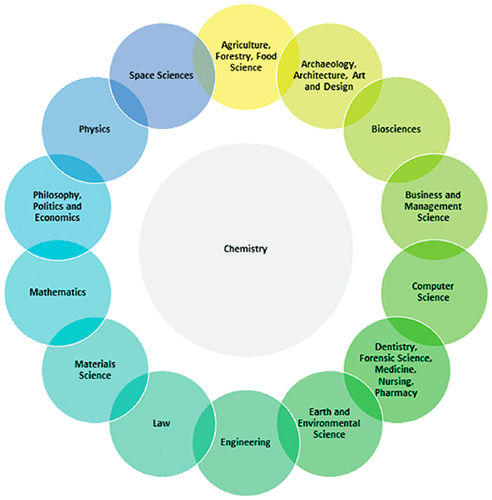
Chemistry and its application in other fields.
Image Courtesy of ACS Publications.
Historical Development in Chemistry
Modern chemistry didn't appear overnight. It grew out of centuries of trial, error, and a few major breakthroughs:
- Antoine Lavoisier (late 1700s) — Often called the "father of modern chemistry," Lavoisier demonstrated the law of conservation of mass: matter is neither created nor destroyed in a chemical reaction. This shifted chemistry from the guesswork of alchemy to a quantitative, measurement-based science.
- John Dalton (early 1800s) — Dalton proposed that each element consists of its own type of indivisible atom, and that atoms combine in fixed ratios to form compounds. His atomic theory gave chemistry a concrete framework for explaining why reactions happen in predictable proportions.
- Dmitri Mendeleev (1869) — Mendeleev organized the known elements by atomic mass and recurring properties, creating an early periodic table. His table was powerful enough to predict the properties of elements that hadn't even been discovered yet (like gallium and germanium).
- Quantum Chemistry (early 1900s) — Physicists like Erwin Schrödinger applied quantum mechanics to atomic structure, explaining why electrons behave the way they do. This gave chemists a deeper understanding of bonding, reactivity, and molecular shape.
Each of these milestones built on the last. Lavoisier made chemistry measurable, Dalton explained what was being measured, Mendeleev organized it, and quantum theory explained the underlying "why."
Chemistry's Impact on Society & Environment
Chemistry drives both major advances and serious challenges in the modern world. Understanding both sides is part of thinking like a scientist.
Positive Impacts
- Medical breakthroughs — Vaccines, antibiotics, and cancer treatments all depend on chemical research. The development of penicillin, for example, revolutionized medicine in the 20th century.
- Synthetic materials — Polymers like nylon, polyester, and silicone have transformed clothing, construction, and consumer products.
- Renewable energy — Advances in photovoltaic cell chemistry (solar panels) and biofuel production are helping reduce dependence on fossil fuels.
Challenges & Responsibilities
- Hazardous waste — Industrial processes often produce toxic byproducts. Chemists bear responsibility for developing safer disposal and treatment methods.
- Unintended consequences — Substances designed to solve one problem can create others. DDT, for instance, was an effective pesticide but caused widespread ecological damage before it was banned in many countries. Ethical evaluation of new chemicals is a constant obligation.
Green Chemistry
Green chemistry is a set of design principles aimed at reducing or eliminating hazardous substances in chemical processes. The goal is to make reactions more efficient, use less toxic reagents, and generate less waste. This approach aligns chemistry with broader sustainability goals and addresses many of the challenges listed above at the design stage rather than after the fact.
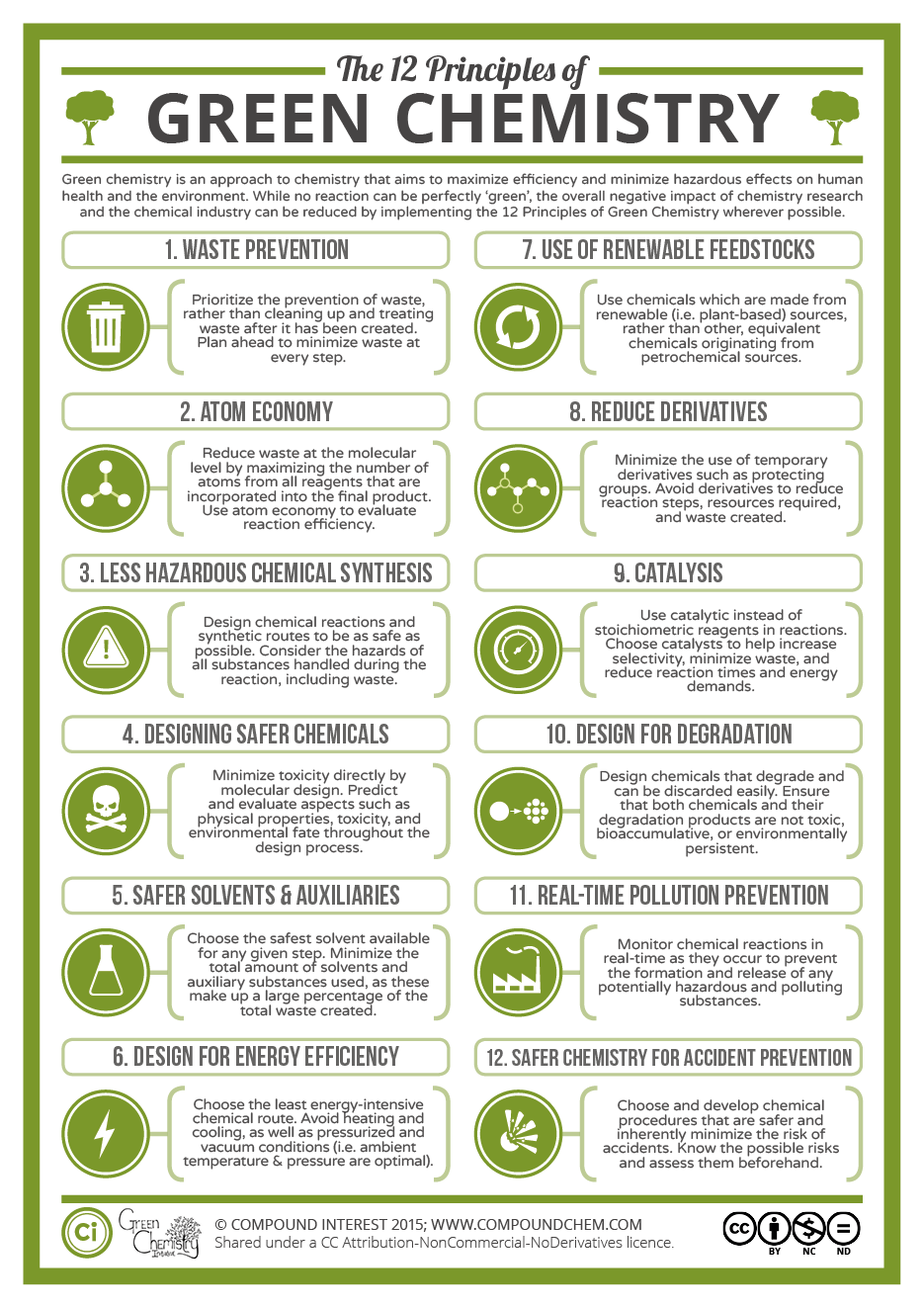
A graphic displaying the 12 principles of green chemistry.
Image Courtesy of Compound Interest.
See Fiveable more often in Google
Mark Fiveable as a preferred source and Google is more likely to show you our guides in Top Stories, with a "preferred" badge in AI Mode and AI Overviews.