2.3 Significant Figures and Measurement

👩🏽🔬Honors Chemistry Unit 2 Review
2.3 Significant Figures and Measurement
👩🏽🔬 Honors Chemistry
continue practicing 2.3
Multiple choice
Significant Figures and Measurement
Significant figures are the foundation of reliable data in chemistry. Every measurement you take has a limit to its precision, and sig figs are how you communicate that limit. Mastering these rules now will save you from losing points on nearly every calculation for the rest of the course.
🧐 Identifying Significant Figures
Significant figures are all the digits in a measurement that are known with certainty, plus one estimated digit. There are four rules to memorize:
- Non-zero digits are always significant. No exceptions.
- Captive zeros (zeros between non-zero digits) are always significant. For example, 509 has three significant figures.
- Leading zeros (zeros at the beginning of a number) are never significant. They're just placeholders. In 0.0025, only the 2 and 5 count, giving two significant figures.
- Trailing zeros (zeros at the end of a number) are significant only if a decimal point is present. So 50.00 has four significant figures, but 500 has only one. If you see 500., that decimal point makes all three digits significant.
A quick way to remember leading vs. trailing zeros: leading zeros show you where the decimal is, not how precise the measurement is. Trailing zeros after a decimal show that someone actually measured to that level of precision.
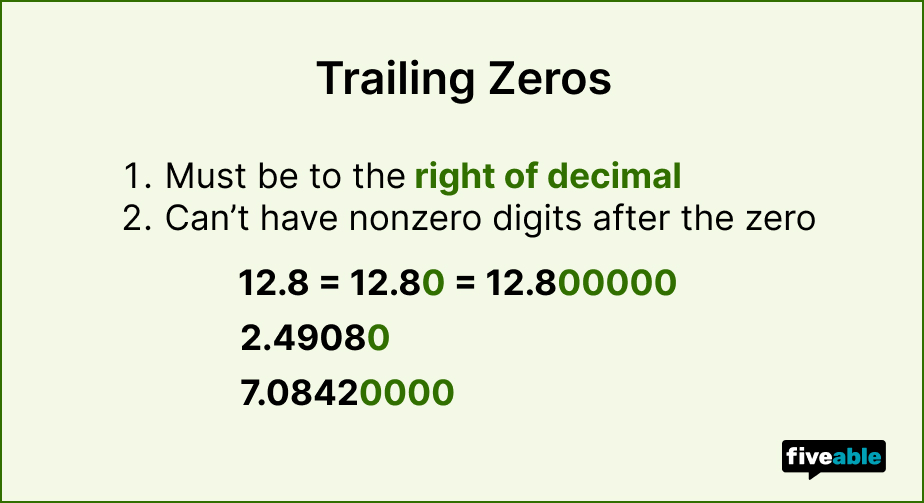
Examples of trailing zeros.
Image Credit to [Fiveable]
🔢 Calculations with Significant Figures
Your final answer can never be more precise than your least precise measurement. The rules differ depending on the operation.
Addition and Subtraction
The result should have the same number of decimal places as the measurement with the fewest decimal places. You're looking at decimal places here, not total sig figs.
For example: on your calculator, but 18.0 has only one decimal place, so you round to .
Multiplication and Division
The result should have the same number of significant figures as the measurement with the fewest significant figures.
For example: on your calculator, but 4.2 has only two sig figs, so you round to .
Rounding Rules
- If the digit being removed is greater than 5, round up.
- If the digit being removed is less than 5, round down (leave the last digit as is).
- If the digit being removed is exactly 5 followed by nonzero digits, round up.
- If the digit being removed is exactly 5 followed by nothing (or only zeros), round to the nearest even number. This is called the "round half to even" rule, and it prevents a systematic rounding bias over many calculations.
Scientific Notation
Scientific notation makes sig figs much clearer because it strips away ambiguous placeholder zeros. Only the digits in the coefficient count as significant. For example, has three significant figures. Compare that to writing 32000, where the sig fig count is ambiguous.
🌡️ Measurements in Chemistry
Every measurement in chemistry falls into one of a few categories, and each has its own set of tools.
Length
Used for measuring dimensions of solids. Common tools include rulers, meter sticks, and micrometers (for very small measurements).
Volume
Graduated cylinders work for routine measurements. For higher precision, use pipettes or volumetric flasks, which are calibrated to deliver or contain a specific volume.
Mass
Analytical balances measure to and are used when high precision matters. Top-loading balances are faster but less sensitive, typically reading to .
Temperature
Measured with thermometers (glass or digital). Temperature control is critical for reactions where rate or equilibrium depends on it.
Pressure
Relevant in gas experiments. Manometers measure the pressure of a gas sample directly, while barometers measure atmospheric pressure.
These measurements support both qualitative analysis (describing properties like color or phase) and quantitative analysis (collecting numerical data like mass or volume).
🛠️ Tools & Techniques for Precise Measurements
Calibration
Instruments drift over time. Regular calibration against known standards ensures your readings stay accurate.
Choosing Tools
Match the tool to the task. Consider the precision you need, the type of measurement (mass, volume, temperature), and the sample size. You wouldn't use a 1 L graduated cylinder to measure 2.00 mL of solution.
Digital vs. Analog Instruments
Digital instruments display a direct numerical readout, making them faster to use and easier to read. Analog instruments (like a mercury thermometer or a mechanical balance) may require more skill to read but don't depend on batteries or electricity and can be very reliable when well-maintained.
Both types can be highly precise. In practice, digital instruments are often preferred for sensitive analytical work because they reduce human reading error.
Minimizing Errors
- Systematic errors (consistent bias in one direction) can be reduced by calibrating instruments, using fresh reagents, and following proper technique.
- Random errors (unpredictable fluctuations) can be reduced by running multiple trials and averaging results.
- Always double-check calculations and record units with every measurement.
Safety Practices
Follow lab protocols: wear goggles and gloves, handle chemicals carefully, and know where safety equipment is located before you start measuring.
Data Recording
Record every measurement with its correct units and the appropriate number of significant figures. Your recorded precision should reflect the actual capability of the instrument you used.
💡 Practice Problems
-
Determine how many significant figures there are in each of these numbers:
a)
b)
c)
-
Perform each calculation adhering to rules about significant figures:
a) Add:
b) Subtract:
c) Multiply:
d) Divide:
-
Express these values in scientific notation with proper use of significant figures:
a)
b)
-
Choose whether to use digital or analog instruments based on specific scenarios presented:
a) You need quick results during multiple trials.
b) Precision is paramount while working on highly sensitive chemical analysis.
Try each problem on your own before checking the solutions below.
⭐️ Solutions to Practice Problems
✏️ Practice Problem 1 Solution
a) has 4 significant figures.
The significant digits are 7, 0, 8, and the final 0. The two zeros before the 7 are leading zeros (not significant). The zero between 7 and 8 is a captive zero (significant). The trailing zero after 8 is significant because it comes after the decimal point.
b) has 3 significant figures.
The significant digits are 2, 0, and 7. The zero between 2 and 7 is captive (significant). The two trailing zeros are not significant because there's no decimal point.
c) has 5 significant figures.
Don't let the scientific notation distract you. The coefficient contains all the significant digits. The zero between 2 and 7 is captive, and the trailing zero after 9 is significant because a decimal point is present. If you expanded this to 2,079,000, the three trailing zeros would not be significant, which is exactly why scientific notation is useful for removing that ambiguity.
✏️ Practice Problem 2 Solution
a)
The limiting measurement is 18.0 (one decimal place), so round to one decimal place. The answer has 3 significant figures.
b)
The limiting measurement is 60, which is precise only to the tens place. So round 1991 to the tens place: . This gives 3 significant figures (the trailing zero in the tens place is not significant since there's no decimal).
c) (or )
For multiplication, match the fewest sig figs. has 3 sig figs and has 2 sig figs, so your answer gets 2 significant figures. Writing it as removes any ambiguity about those trailing zeros.
d)
Both 9 and 3 have 1 significant figure, so the answer has 1 significant figure.
✏️ Practice Problem 3 Solution
a)
Move the decimal three places to the right. All four digits (7, 5, 4, 2) are significant.
b)
As written without a decimal point, 150000 has 2 significant figures, so the coefficient is 1.5.
✏️ Practice Problem 4 Solution
a) You need quick results during multiple trials → Digital. Digital instruments give fast, direct readouts with no interpretation needed, which speeds up repeated measurements.
b) Precision is paramount for highly sensitive chemical analysis → Digital. Modern analytical instruments (like analytical balances) are digital and offer the highest precision available. The original answer of "analog" is outdated. In a real lab, the most precise instruments for sensitive work are almost always digital.
See Fiveable more often in Google
Mark Fiveable as a preferred source and Google is more likely to show you our guides in Top Stories, with a "preferred" badge in AI Mode and AI Overviews.