2.5 Dimensional Analysis

👩🏽🔬Honors Chemistry Unit 2 Review
2.5 Dimensional Analysis
👩🏽🔬 Honors Chemistry
continue practicing 2.5
Multiple choice
Dimensional Analysis
Dimensional analysis is a method for converting between units by multiplying a given quantity by one or more conversion factors. It's one of the most frequently used skills in chemistry, and you'll rely on it in nearly every unit going forward.
Why Dimensional Analysis Matters in Chemistry
- Accuracy: Getting the right units is just as important as getting the right number. A calculation with the wrong units can be off by orders of magnitude.
- Standardization: Science uses the SI system so that measurements mean the same thing everywhere. Dimensional analysis is how you move between SI units and other systems.
- Error checking: If your units don't cancel correctly, you know something went wrong in your setup before you even touch a calculator.
Fundamental Concepts
Units of Measurement
- Base units are the fundamental building blocks of measurement: the meter (m) for length, the kilogram (kg) for mass, the second (s) for time, and so on.
- Derived units are combinations of base units that describe more complex quantities. For example, speed is measured in meters per second (), and density is measured in grams per cubic centimeter ().
The International System of Units (SI)
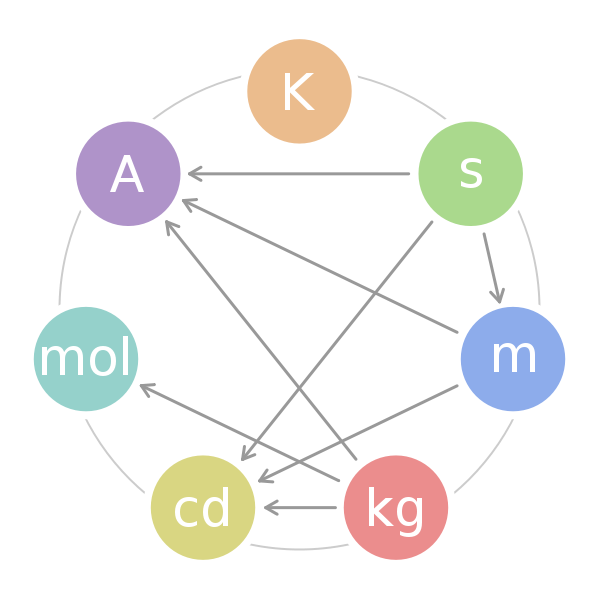
The SI system is the standard measurement system used across all sciences. Here are the seven SI base quantities and their units:
| Quantity | Symbol | Base Unit | Unit Symbol |
|---|---|---|---|
| Time | second | s | |
| Length | meter | m | |
| Mass | kilogram | kg | |
| Electric Current | ampere | A | |
| Temperature | kelvin | K | |
| Amount of Substance | mole | mol | |
| Luminous Intensity | candela | cd |
Conversion Factors
A conversion factor is a fraction built from two equivalent quantities expressed in different units. For example, since 1 inch = 2.54 cm, you can write the conversion factor as:
or
You choose whichever version causes the old unit to cancel out. The conversion factor equals 1 (since the top and bottom are the same amount), so multiplying by it changes the units without changing the actual quantity.
Applying Dimensional Analysis
Basic Unit Conversion
Follow these steps for any single-step conversion:
- Write down the quantity you're starting with, including its units.
- Identify the conversion factor that relates your starting unit to your target unit.
- Set up the multiplication so the starting unit appears in the denominator of the conversion factor. This way it cancels, leaving only the target unit.
- Multiply across and simplify.
Practice Problem: Convert 12 inches to centimeters (1 inch = 2.54 cm).
Solution:
Notice how "inches" cancels because it appears in both the numerator and the denominator.
Chemical Calculations Using Dimensional Analysis
-
Grams to Moles (using Molar Mass): The molar mass of a substance acts as a conversion factor between grams and moles. To find molar mass, add up the atomic masses of every atom in the formula using the periodic table. Example: Calculate the moles in 18 g of water ().
First, find the molar mass of :
Then convert:
The general pattern: multiply your given grams by .
-
Empirical and Molecular Formulas: You'll convert percent composition data to moles, then find the simplest whole-number ratio of atoms. Dimensional analysis keeps the units straight through each step.
-
Stoichiometry: In balanced equations, the coefficients give you mole-to-mole ratios. A typical stoichiometry problem chains together multiple conversion factors: grams → moles → moles of another substance → grams (or volume).

Multi-Step Conversions
Sometimes no single conversion factor gets you from your starting unit to your target unit. In that case, chain multiple conversion factors together.
- Identify all the intermediate units you'll pass through.
- Line up conversion factors so each intermediate unit cancels, leaving only the final target unit.
- Multiply everything across in one expression.
Practice Problem: Convert 50 miles per hour to meters per second (1 mile = 1609.34 m; 1 hour = 3600 s).
Solution:
Both "miles" and "hr" cancel, leaving .
Advanced Applications of Dimensional Analysis
As you move into later units, dimensional analysis will show up in:
- Reaction rates, where you might convert between moles per liter per second and other rate units.
- Energy calculations, where you'll convert between joules and calories or kilojoules.
- Solution concentrations, such as converting between molarity, parts per million (ppm), and mass percent.
The technique stays exactly the same: identify your starting quantity, set up conversion factors so unwanted units cancel, and multiply through.
Practice Problems
Try these on your own before checking the solutions below.
- Convert 500 grams to pounds (1 lb = 453.592 g).
- Calculate the mass of 2 moles of carbon dioxide ().
- A wire measures 12 feet long. Convert this length to meters (1 ft = 12 in; 1 in = 0.0254 m).
Solutions
1. 500 grams to pounds:
500 grams is approximately 1.10 pounds.
2. Mass of 2 moles of :
First, find the molar mass:
Then convert moles to grams:
Two moles of has a mass of 88.02 grams.
3. 12 feet to meters (two-step conversion):
12 feet is approximately 3.66 meters. You could also use the single conversion factor 1 ft = 0.3048 m to do this in one step.
Key Takeaways
- Dimensional analysis works by multiplying a quantity by conversion factors (fractions equal to 1) until you reach the desired units.
- Always write out your units and make sure they cancel properly. If they don't cancel, your setup is wrong.
- This same technique applies whether you're converting inches to centimeters or grams to moles to molecules. The method never changes; only the conversion factors do.
See Fiveable more often in Google
Mark Fiveable as a preferred source and Google is more likely to show you our guides in Top Stories, with a "preferred" badge in AI Mode and AI Overviews.