5.1 Mole Fundamentals

👩🏽🔬Honors Chemistry Unit 5 Review
5.1 Mole Fundamentals
👩🏽🔬 Honors Chemistry
continue practicing 5.1
Multiple choice
Mole Fundamentals
In daily life, certain words already imply a specific count. A basketball team has five players on the court; a dozen donuts means 12; a "strike" in bowling means all 10 pins went down.
Chemistry works the same way. You're constantly dealing with atoms, molecules, and ions, and the numbers involved are astronomically large. Rather than saying "602 billion trillion atoms," chemists use a single word: the mole. This guide covers what a mole is, how to convert between moles and particles, and how molar mass connects moles to grams.
The Mole: Bridging the Microscopic and Macroscopic Worlds
Definition and Importance of the Mole
Here's the formal definition:
"One mole is the amount of substance that contains the same number of particles () as there are atoms in exactly 12 g of the isotope."
That's a mouthful. The simplified version:
A mole is particles. This number is called Avogadro's number ().
That's the core idea. Just like "dozen" means 12, "mole" means . The difference is just scale: a mole is a counting unit sized for atoms and molecules, which are far too small and numerous to count one by one.
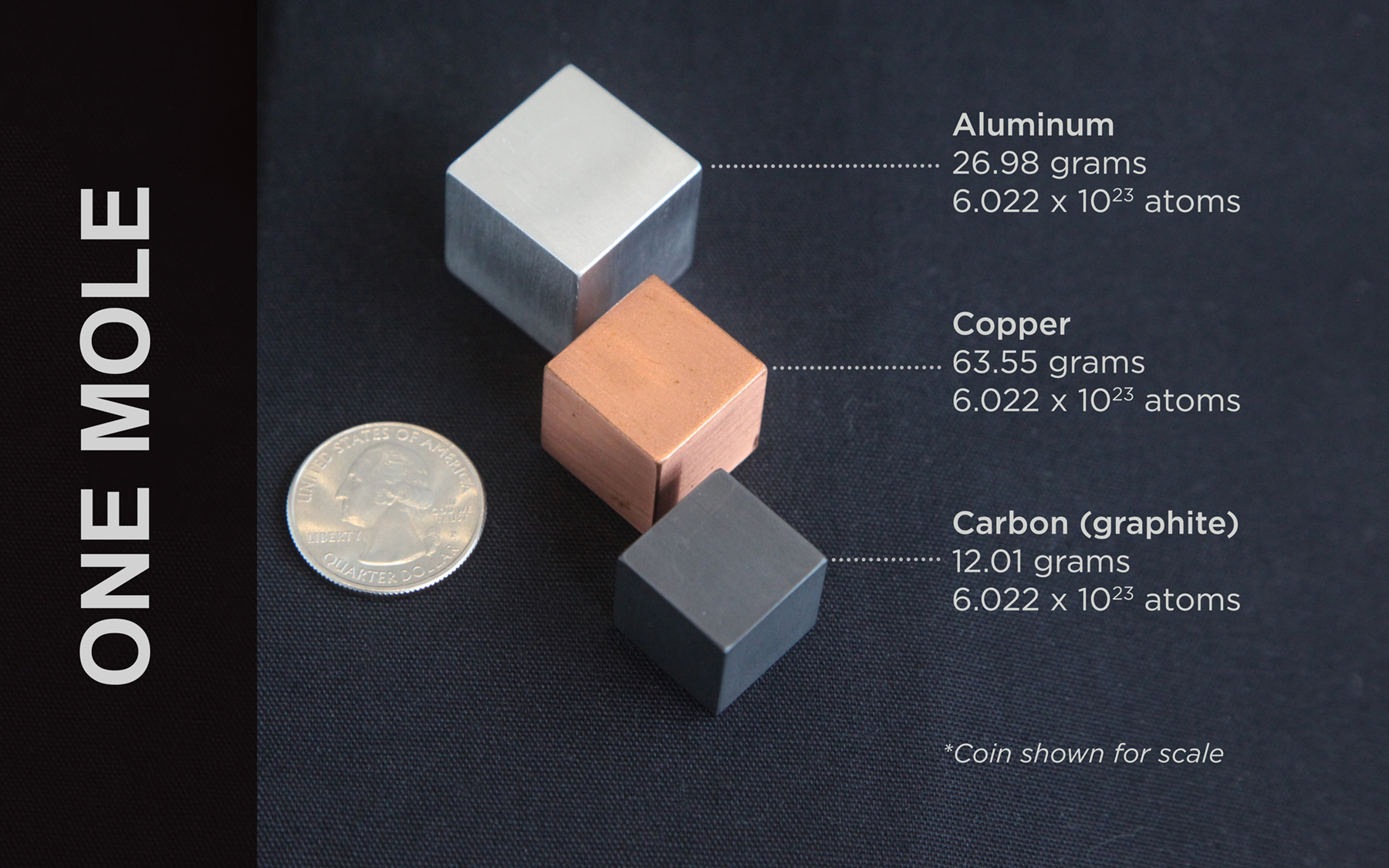
A diagram showing one mole of various substances (e.g., a mole of aluminum, a mole of copper), highlighting that regardless of the substance, one mole always contains the same number of particles.
Image Courtesy of National Institute of Standards & Technology
Learning to Convert Between Moles and Particles
Those particles can be anything: atoms, molecules, ions, or electrons. The mole connects what you can physically measure (grams, liters) to the particle-level world you can't see. Notice the pattern:
- One mole of electrons = electrons
- One mole of = water molecules
- One mole of bananas = bananas (you'd need a bigger kitchen)
Here are the two conversion setups you'll use constantly:
- Moles → Particles: Multiply by Avogadro's number.
- Particles → Moles: Divide by Avogadro's number.
Notice how the units are arranged so the unit you're converting from cancels out, leaving only the unit you want. This strategy is called dimensional analysis, and it's your best friend for any unit conversion in chemistry.
For more on this technique, check out the study guide on Dimensional Analysis here.
Practice Question
How many atoms are in 3 moles of helium?
Set up dimensional analysis so "moles" cancels and "atoms" remains:
Mastering Molar Mass
Molar mass is the mass of one mole of a substance, expressed in grams per mole (g/mol). You find it directly from the atomic mass listed on the periodic table.
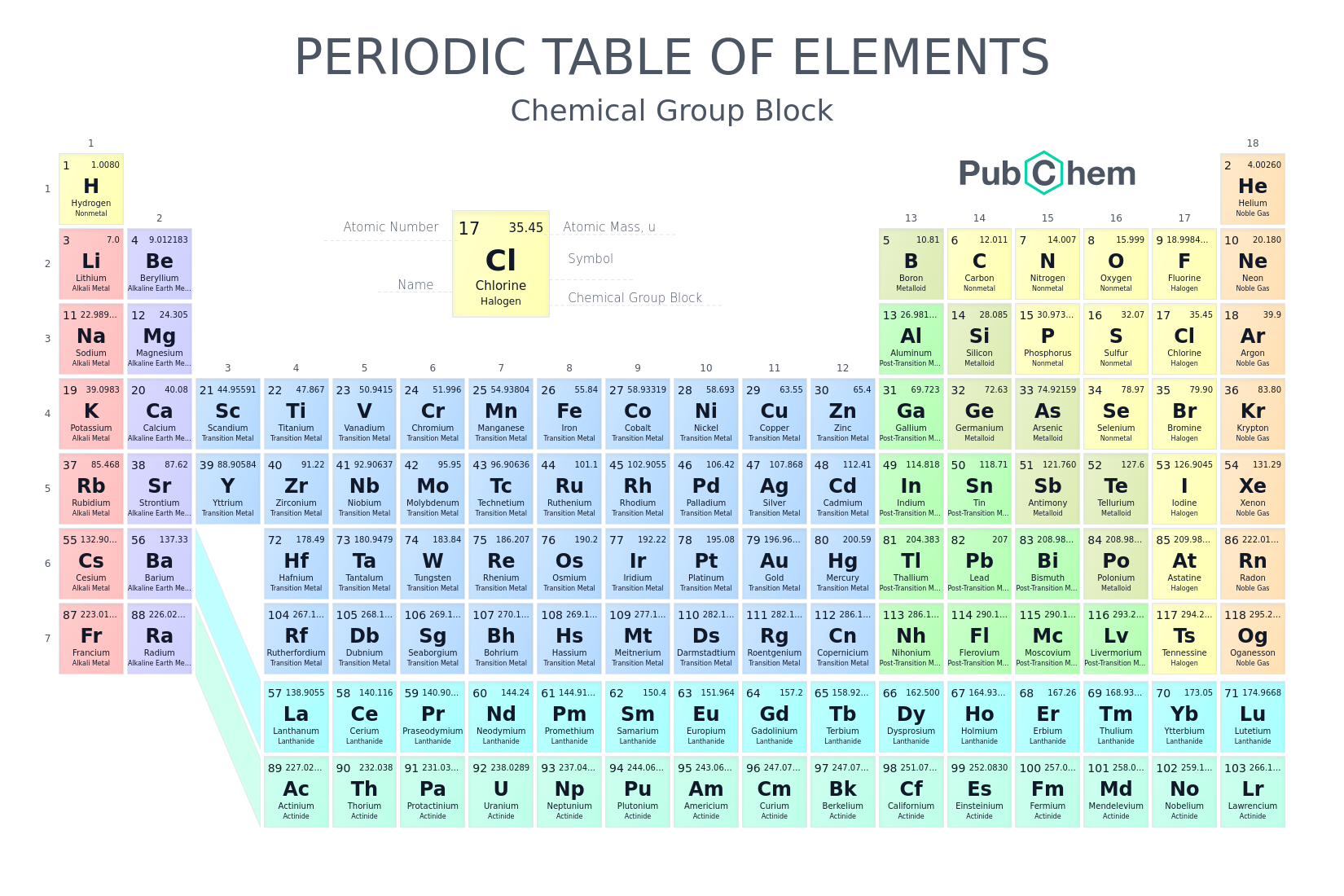
Periodic table
Image courtesy of PubChem
For individual elements, just read the number off the table:
- Oxygen (O, element #8): 15.999 g/mol
- Magnesium (Mg, #12): 24.305 g/mol
- Lead (Pb, #82): 207.2 g/mol
For compounds, you calculate the formula mass by adding up the molar masses of each element, multiplied by how many atoms of that element appear in the formula.
Molar Mass Practice Question
What is the mass in grams of one mole of water ()?
So one mole of water has a mass of approximately 18.02 grams. Using more precise atomic masses (1.008 for H, 15.999 for O) is good practice for honors-level work, though rounding to 18 g/mol is fine for quick calculations.
Going Beyond Basic Understanding of Moles
You don't need to master these topics yet, but the mole shows up everywhere in later units. Here's a preview of where it's headed.
Stoichiometry
Stoichiometry uses balanced chemical equations to calculate quantities of reactants and products based on their mole ratios. Dimensional analysis is central here too.
Stoichiometry Practice Question
If you react two moles of hydrogen gas with one mole of oxygen gas, how many moles of water are produced?
First, write the balanced equation:
The coefficients tell you the mole ratio: 2 mol and 1 mol produce 2 mol . So starting with 2 mol , you get 2 mol .
Note: The original unbalanced equation has only 1 water molecule on the right, which doesn't balance the hydrogens. Always check that atoms are equal on both sides.
Concentration and Molarity
Molarity (M) measures how concentrated a solution is, defined as moles of solute per liter of solution. A solution with 5 mol of solute in 1 L is more concentrated than one with 3 mol in 1 L.
Molarity Practice Question
You dissolve 5 moles of solute in 2 liters of solution. What is the molarity?
Ideal Gases and Moles
An ideal gas is a simplified model where gas particles have no volume and no intermolecular forces. Real gases approximate ideal behavior at high temperatures and low pressures.
The Ideal Gas Law relates pressure, volume, temperature, and moles:
where is the gas constant.
Gas Laws Practice Question
What volume does one mole of an ideal gas occupy at STP (273.15 K, 1 atm)?
This value, 22.4 L/mol at STP, comes up frequently and is worth remembering.
Wrapping Up
The mole is the central counting unit in chemistry. It connects the particle scale (atoms, molecules) to the lab scale (grams, liters) through Avogadro's number and molar mass. You'll rely on it in stoichiometry, solution chemistry, gas laws, and nearly every calculation going forward. The best way to get comfortable with mole conversions is to practice dimensional analysis setups until the unit cancellation feels automatic.
See Fiveable more often in Google
Mark Fiveable as a preferred source and Google is more likely to show you our guides in Top Stories, with a "preferred" badge in AI Mode and AI Overviews.