
🧪AP Chemistry Unit 2 Review
2.3 Structure of Ionic Solids
2.3 Structure of Ionic Solids
Unit & Topic Study Guides
Unit 1 – Atomic Structure & Properties
Unit 2 – Compound Structure and Properties
Unit 3 – Properties of Substances and Mixtures
Unit 4 – Chemical Reactions
Unit 5 – Kinetics
Unit 6 – Thermochemistry
Unit 7 – Equilibrium
Unit 8 – Acids & Bases
Unit 9 – Thermodynamics and Electrochemistry
AP Chemistry Exam
Science Practices
Required Labs

TLDR
Ionic solids are made of cations and anions locked in a repeating 3-D lattice that maximizes attractions between opposite charges and minimizes repulsions between like charges. Coulomb's law explains the whole thing: stronger charges and smaller ions mean stronger attractions, which lead to higher lattice energy, higher melting points, and harder solids. For AP Chemistry, you need to draw a particulate model of an ionic solid and use it to explain properties.

Why This Matters for the AP Chemistry Exam
This topic asks you to represent an ionic solid with a particulate model and connect that model to the properties you can measure in the lab, like melting point and conductivity. The core skill is explaining the link between what happens at the particle level and what you observe at the macroscopic level.
You will use Coulomb's law reasoning to compare ionic compounds and justify claims. That kind of comparison shows up in multiple-choice questions and in free-response questions where you justify which compound has the stronger attractions or higher lattice energy. You do not need to memorize specific crystal structures; those will not be tested.
Key Takeaways
- Ionic solids form when a metal transfers electrons to a nonmetal, creating positive cations and negative anions held in a repeating 3-D lattice.
- The lattice arrangement maximizes attractions between opposite charges and minimizes repulsions between like charges.
- Coulomb's law drives everything: attraction gets stronger with larger ion charges and smaller distances between ion centers.
- Higher charge plus smaller ion size means higher lattice energy and a higher melting point.
- Ionic solids are hard, brittle, have high melting points, conduct poorly as solids, but conduct when melted or dissolved because the ions can move.
- Draw ionic substances as a network of alternating positive and negative ions, not as separate molecules.
What Makes an Ionic Solid
Ionic solids are built from a positive cation and a negative anion. Ionic bonding usually happens when a metal's valence electron transfers to a nonmetal. The metal loses a negative electron and becomes a cation, while the nonmetal gains that electron and becomes an anion.
The cation and anion attract each other because of their opposite charges. How strong that attraction is depends on Coulomb's law, which is the central idea for this whole topic.
Word choice matters here. On a free-response answer, mixing up "cation" and "anion" or saying "molecule" when you mean an ionic network can cost you points, so use the precise terms.
The Lattice Structure
Ionic interactions produce brittle, hard solids with high melting points. This happens because the ions are held in a repeating 3-D array called a crystal lattice.

Ions are attracted to their opposites, so negative ions surround positive ones and positive ions surround negative ones. Think of this arrangement as a setup that maximizes attractive forces between cations and anions while minimizing repulsive forces between ions of the same charge.
Ion size also fits into this picture. When metals ionize, they lose electrons and shrink. When nonmetals ionize, they gain electrons and grow. You can see this periodic trend with sodium and chlorine: the small cations (Na+) fit between the larger anions (Cl-). This does not happen for every ionic solid, but it affects how strongly the ions attract.
Note for the exam: you are not expected to know the names of specific crystal structures. The point is being able to draw and explain a particulate model that follows Coulomb's law.
Drawing Ionic Solids
Particle diagrams for ionic substances look different from those for molecular substances that have covalent bonds. Covalent substances get drawn as discrete molecules (such as H2O). Ionic substances get drawn as a repeating network of alternating positive and negative ions.

When you draw an ionic solid, show a grid of alternating charges, not separate paired-up units. There are no individual "molecules" in an ionic solid; the whole crystal is one extended network.
How Coulomb's Law Explains the Lattice
The lattice holds together because of strong electrostatic forces between cations and anions. Coulomb's law describes these forces: the electrostatic attraction between a cation and an anion is directly proportional to the size of their charges and inversely proportional to the distance between their centers.
You do not need to memorize the formula for this topic. If you want a refresher, check the study guide on atomic structure and electron configuration.
Two factors control the strength of these forces:
- Magnitude of charge: Greater charges on the cation and anion mean a stronger attraction.
- Distance between ion nuclei: A smaller distance between the cation and anion means a stronger attraction.
This is why ion size matters. If small Na+ cations fit closely between Cl- anions, the distance between their nuclei is smaller, so Coulomb's law predicts a stronger attraction. Remember the big idea: attractions between opposite charges are maximized in the lattice while repulsions between like charges are minimized.
Properties of Ionic Substances
Ionic substances are usually solids at room temperature with very high melting and boiling points. Here is why their common properties show up:
- 🌡️ High melting and boiling points: The strong electrostatic forces require a lot of energy to overcome, so it takes a lot of heat to melt or boil an ionic substance.
- 🚫🔌 Poor conductors as solids: In the lattice, the ions are locked in place and cannot move, so there is nothing to carry an electric current.
- ⚡ Good conductors when liquid or dissolved: When an ionic solid melts or dissolves, the ions are free to move, so they can carry electric current.
- 💎 Hard and brittle: The strong electrostatic forces make ionic solids difficult to deform, but shifting the layers can line up like charges and cause the crystal to crack.
Lattice Energy
Lattice energy is the energy released when ions come together to form an ionic solid. It depends on the same two ideas from Coulomb's law: charge and distance.
The shortcut to remember:
Smaller ion size and higher charge mean higher lattice energy. Higher lattice energy generally means a higher melting point.
Comparing Lattice Energies
Try these comparisons:
- NaF or NaCl: Charges are the same (+1/-1), so look at size. F- is smaller than Cl-, so it sits closer to Na+. NaF has the higher lattice energy.
- MgO or NaF: Mg and O carry +2/-2 charges, while Na and F carry +1/-1. The larger charges win, so MgO has the much higher lattice energy.
- NaF or KCl: Same charges, so compare size. K+ and Cl- are larger than Na+ and F-, so NaF has the higher lattice energy.
- LiCl or NaCl: Same charges. Li+ is smaller than Na+, so LiCl has the higher lattice energy.
How to Use This on the AP Chemistry Exam
MCQ
Expect comparison questions: which compound has stronger attractions, higher lattice energy, or a higher melting point. Check charges first, since a jump from +1/-1 to +2/-2 usually outweighs size differences. If charges are equal, compare ion sizes using periodic trends, where smaller ions sit closer and attract more strongly.
Free Response
You may be asked to draw a particulate model of an ionic solid. Show a repeating grid of alternating positive and negative ions, with opposite charges next to each other. When you justify a claim, name the two Coulomb's law factors (charge magnitude and distance between ion centers) and connect them to the property in question.
A justification that earns points usually sounds like: "Because the charges are the same, the smaller ion sits closer, the attraction is stronger by Coulomb's law, so the lattice energy and melting point are higher."
Worked Example
Answer the following questions related to Mg and Sr.
- Write the complete ground state configuration for the ions Mg2+ and Sr2+.
- Do you predict that the ionic radius of Sr2+ is larger or smaller than the ionic radius of Mg2+? Justify your answer in terms of atomic structure and electron configuration.
- The lattice energy of MgCl2(s) is 2300 kJ/mol. Do you predict the lattice energy of SrCl2(s) to be less than or greater than 2300 kJ/mol? Justify your answer using Coulomb's law.
Sample responses:
(1) Start with the electron configurations of Mg and Sr, then remove two valence electrons to get the configurations of the 2+ ions.
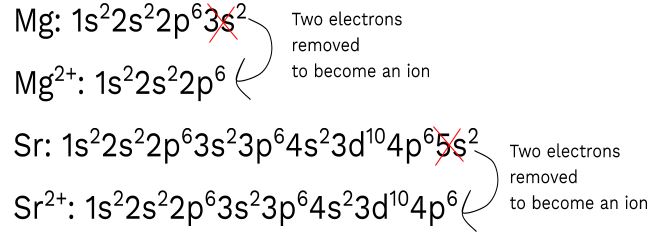
Do not leave the neutral-atom configurations as your final answer. Write the configuration for the ions they actually asked about.
(2) Sr2+ has a larger ionic radius than Mg2+ because it has more occupied electron shells. The valence electrons in Sr2+ are in the 4th energy level, while those in Mg2+ are in the 2nd energy level. Electrons farther from the nucleus make the ion larger.
(3) Coulomb's law states that higher charges and smaller distances between ions give stronger attractions and higher lattice energy. The charges of Mg2+ and Sr2+ are the same, but Sr2+ is larger because it has more occupied energy shells. Since Sr2+ is larger, the distance between it and the chloride ions is greater than for Mg2+. So the lattice energy of SrCl2(s) is less than 2300 kJ/mol.
Worked example adapted from official Advanced Placement materials.
Common Misconceptions
- "Ionic solids contain molecules." They do not. An ionic solid is one continuous lattice of alternating ions. A formula like NaCl gives the ratio of ions, not a separate molecule.
- "Bigger charge and smaller size both always increase attraction, so they're tied." When charges differ, the charge effect usually outweighs the size effect. Compare charges first, then size.
- "Ionic solids conduct electricity." They conduct only when melted or dissolved, because the ions need to move freely. As solids, the ions are locked in place.
- "Lattice energy and melting point are the same thing." They are closely related but not identical. Higher lattice energy generally lines up with a higher melting point, but lattice energy is a specific energy value released when the lattice forms.
- "Ionic solids are soft because they're crystals." They are hard but brittle. Strong electrostatic forces resist deformation, but if layers shift so like charges line up, the crystal cracks.
- "You need to memorize crystal structures." You do not. Focus on drawing a correct particulate model and explaining it with Coulomb's law.
Related AP Chemistry Guides
Vocabulary
The following words are mentioned explicitly in the AP® course framework for this topic.Term | Definition |
|---|---|
anion | A negatively charged ion formed when an atom gains one or more electrons. |
attractive forces | Electrostatic forces between oppositely charged ions that hold them together in an ionic solid. |
cation | A positively charged ion formed when an atom loses one or more electrons. |
Coulomb's law | The principle that the electrostatic force between charged particles is proportional to the product of their charges and inversely proportional to the square of the distance between them. |
ionic crystal | A solid structure in which cations and anions are arranged in a repeating three-dimensional pattern. |
ionic solid | A crystalline compound composed of cations and anions held together by electrostatic forces. |
particulate model | A representation of matter showing individual atoms, molecules, or ions and their interactions to describe chemical processes at the molecular level. |
repulsive forces | Electrostatic forces between ions of the same charge that push them apart in an ionic solid. |
Frequently Asked Questions
What is an ionic solid in AP Chemistry?
An ionic solid is a repeating three-dimensional array of cations and anions. The arrangement maximizes attractions between opposite charges and minimizes repulsions between like charges.
How does Coulomb's law explain ionic solids?
Coulomb's law says electrostatic attraction gets stronger with larger ion charges and smaller distances between ion centers. That is why charge and ion size affect lattice energy, melting point, and other properties.
Do I need to memorize specific crystal structures for AP Chemistry?
No. The CED exclusion says knowledge of specific crystal structures is not required. Focus on representing an ionic solid with a particulate model that is consistent with Coulomb's law.
How should I draw a particulate model of an ionic solid?
Draw a repeating lattice of alternating positive and negative ions. Do not draw separate molecules or isolated ion pairs; an ionic solid is an extended network.
Why do ionic solids have high melting points?
Ionic solids have strong electrostatic attractions between cations and anions throughout the lattice. More energy is needed to overcome those attractions, so melting points are usually high.
When do ionic solids conduct electricity?
Ionic solids conduct poorly as solids because the ions are locked in place. They conduct when melted or dissolved because ions can move and carry charge.