AP African American Studies Unit 1 Cheatsheet: Origins of the African Diaspora

AP African American Studies Unit 1 Cheatsheet: Origins of the African Diaspora

Start with the first 3 sections of the Unit 1 one-page cheatsheet below. The full sheet is a PDF you can print.

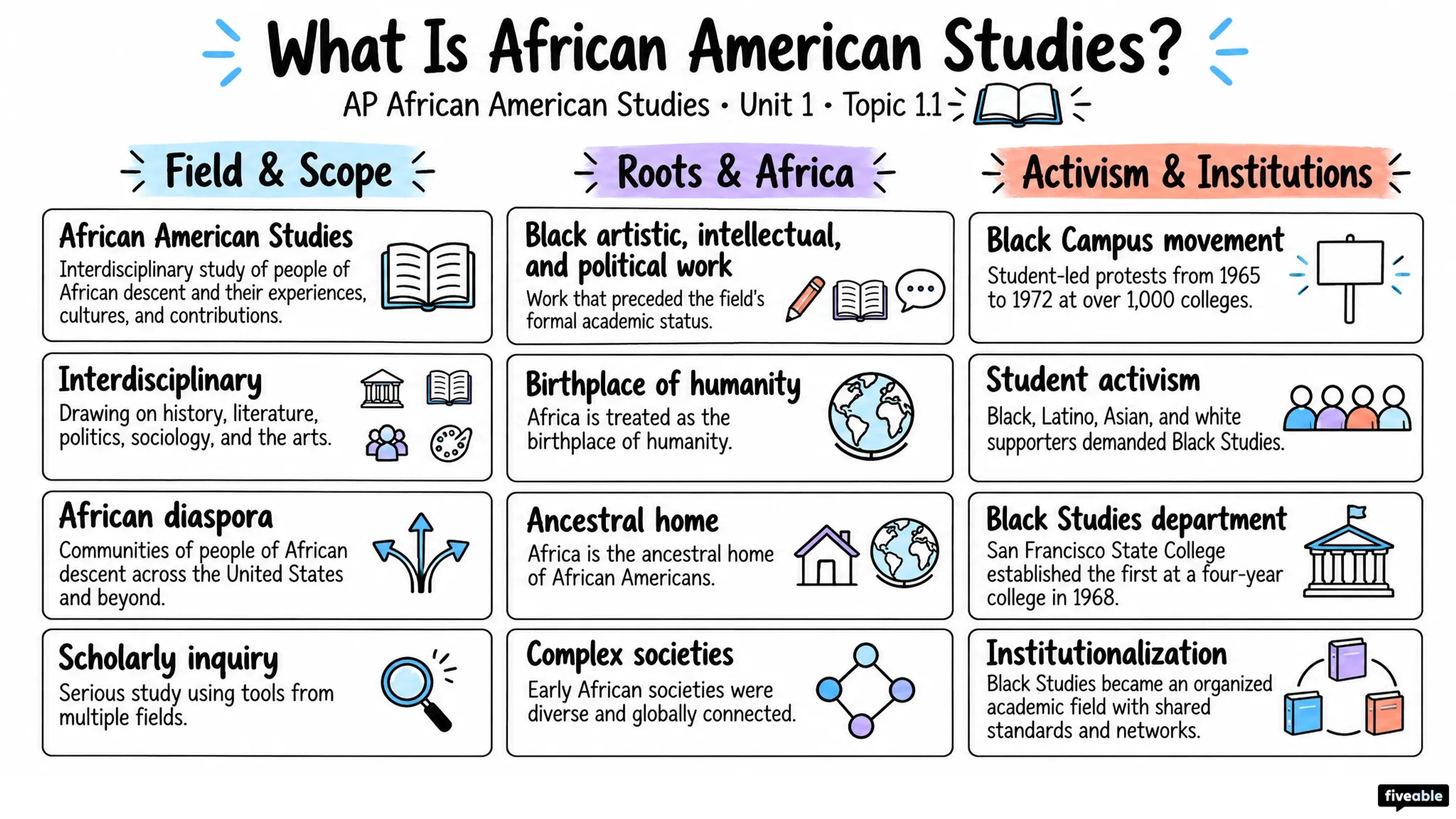
What Is African American Studies?

Definition: Interdisciplinary field combining scholarly rigor to analyze history, culture, and contributions of people of African descent in the US and African diaspora.

  • Origins: Emerged from Black artistic, intellectual, and political endeavors before formal institutionalization
  • Formalization (1960s–1970s): Black Campus movement (1965–1972) led by hundreds of thousands of Black, Latino, Asian, and white students at 1,000+ colleges demanding study of Black history and greater institutional support
  • Key function: Offers lens for understanding contemporary Black freedom struggles
  • Africa focus: Examines early African history and continent's ongoing relationship to diaspora communities

Why it matters: Counters racist stereotypes by documenting Africa's complex societies, innovations, and global connections before the transatlantic slave trade.
Ancient African Societies & Empires

Egypt & Nubia (contact from ~3000 BCE): Nubia supplied Egypt with gold and luxury goods; the Kingdom of Kush arose later (Kerma ~2500 BCE, Napata ~1000 BCE) and ~750 BCE conquered Egypt, establishing the Twenty-Fifth Dynasty of Black Pharaohs (~100 years).

Aksumite Empire (~100 BCE, Eritrea/Ethiopia): Red Sea connected to Mediterranean, Roman, Indian trade networks. Developed own currency and Ge'ez script. Aksum became one of Africa’s earliest Christian kingdoms under King Ezana in the fourth century.; Ge'ez still used in Ethiopian Orthodox Church.

Nok Society (~500 BCE, Nigeria): One of West Africa's earliest known ironworking societies, also famous for its terracotta sculpture. Known for naturalistic terracotta sculptures and stone instruments—oldest evidence of complex, settled sub-Saharan society.

Significance: Countered racist stereotypes; underpinned African independence claims (mid-20th century).

Religious Syncretism: Africa to Americas

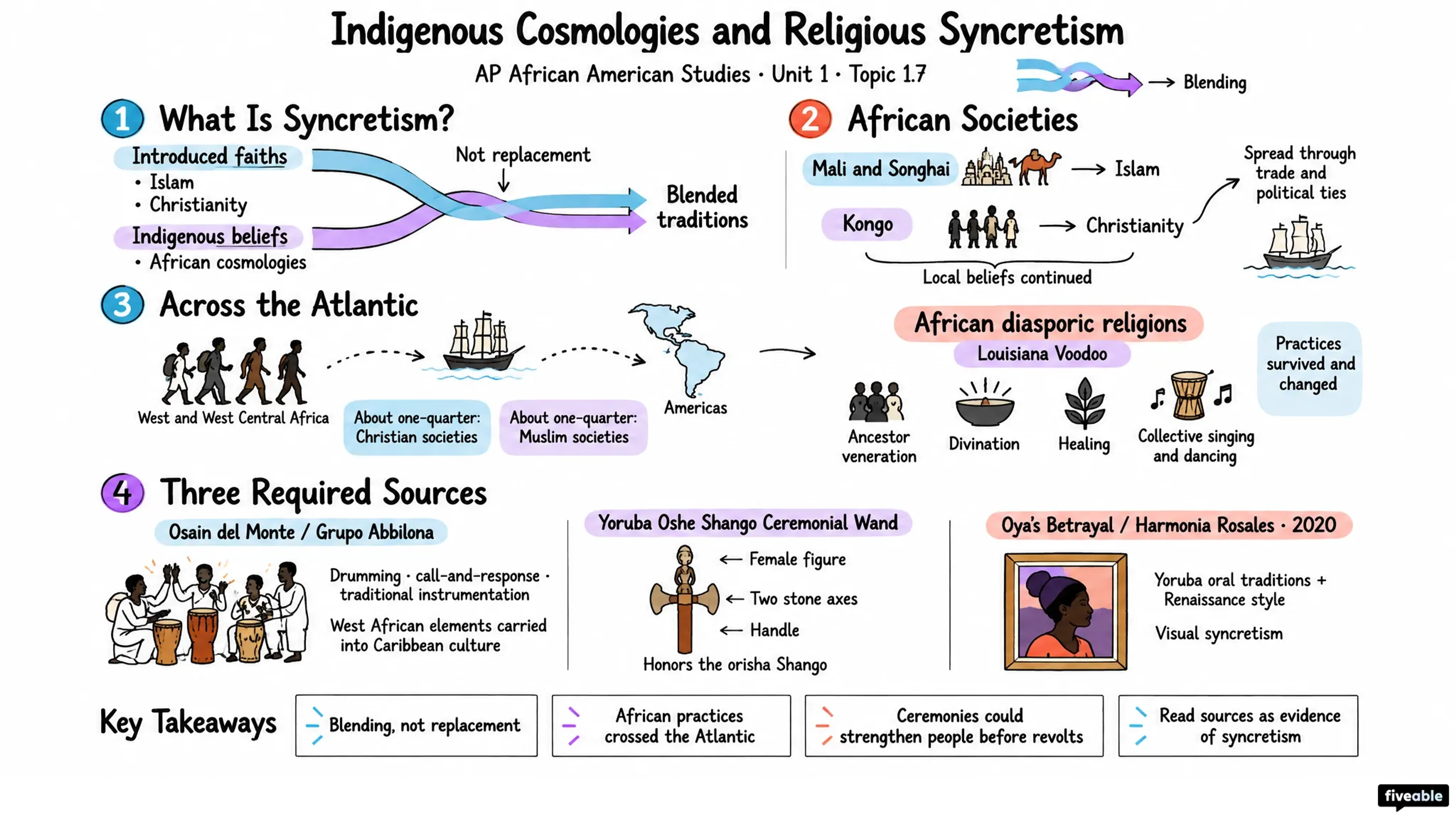
Definition: Blending of introduced faiths (Islam, Christianity) with Indigenous spiritual beliefs and cosmologies.

African examples: Mali/Songhai adopted Islam; Kongo adopted Christianity—subjects blended local practices with new religions.

Transatlantic transfer: ~25% of enslaved Africans arriving in North America came from Christian societies; ~25% from Muslim societies. Syncretic practices survived in Americas.

Surviving practices: Veneration of ancestors, divination, healing, collective singing/dancing—evident in Louisiana Voodoo and other African diasporic religions.

Spiritual resistance: Enslaved Africans performed syncretic ceremonies to strengthen themselves before leading revolts.

Example: Yoruba oshe Shango wand (ceremonial object honoring orisha Shango, deity of thunder/fire/lightning). Afro-Cuban performances illustrate syncretism.

The rest of the Unit 1 sheet

6 more sections are on the one-page PDF:

  • African Geography & Settlement Patterns

  • Sudanic Empires: Ghana, Mali, Songhai

  • Southern & East Africa; Kingdom of Kongo

  • Bantu Expansion & Linguistic Diversity

  • Learning Traditions & Griots

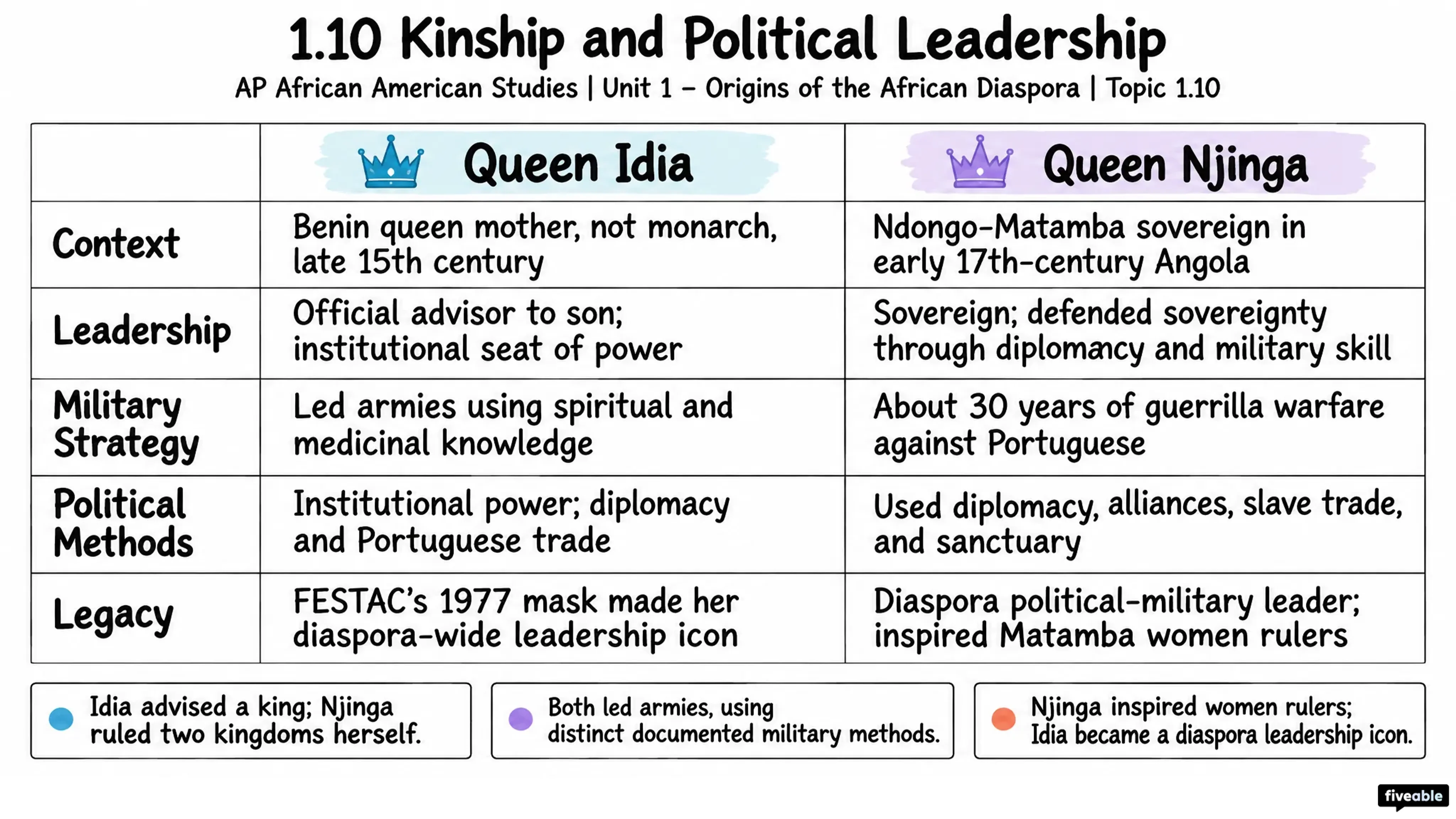
  • Women Leaders & Global Africans

Made by you

Visual Cheatsheets

Pick a Unit 1 topic and a format: flowchart, comparison chart, vocab sheet, Cornell notes and more. Ready in about a minute.

Printable PDF · from the Fiveable shop

AP African American Studies Unit 1 Cheatsheet

1 page · Origins of the African Diaspora · PDF

Visual Cheatsheets

One topic, the format you pick, ready in about a minute

Format

Topic

Language

Takes 30–60 seconds

Preview: Standard

Unit 1: Origins of the African Diaspora, topic by topic

Each topic has a full study guide. See the whole unit.