8.2 Impedance and admittance

🔌Intro to Electrical Engineering Unit 8 Review
8.2 Impedance and admittance
🔌 Intro to Electrical Engineering
Impedance and admittance are the tools you use to analyze AC circuits the same way you'd use resistance in DC circuits. They describe how components oppose or allow sinusoidal current flow, and they let you apply Ohm's law and other familiar techniques to circuits with capacitors and inductors.
Impedance combines resistance with reactance into a single complex number, while admittance is its reciprocal. Together, they make it possible to calculate voltage, current, and power in any AC circuit using straightforward algebra.
Impedance and Reactance
Impedance and its Components
Impedance () is the total opposition to current flow in an AC circuit, measured in ohms (). It has two parts: a real part (resistance) and an imaginary part (reactance).
Here, is resistance, is reactance, and is the imaginary unit. Resistance dissipates energy as heat, while reactance stores and releases energy without consuming it.
Reactance () is the opposition to current caused by capacitors and inductors. It's also measured in ohms. The net reactance in a circuit is:
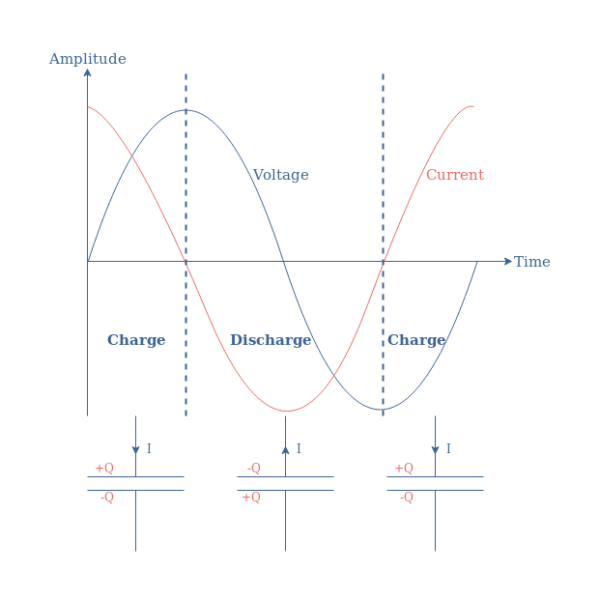
When , the circuit behaves inductively (current lags voltage). When , it behaves capacitively (current leads voltage).
Capacitive and Inductive Reactance
Capacitive reactance () comes from capacitors and is inversely proportional to both frequency and capacitance:
As frequency increases, a capacitor passes current more easily, so drops. For example, a capacitor at has . At , that drops to about .
Inductive reactance () comes from inductors and is directly proportional to frequency and inductance:
Higher frequencies mean the inductor opposes current more strongly. A inductor at has , but at it jumps to about .
Impedance Triangle and Phasor Representation
The impedance triangle is a right triangle that shows how , , and relate geometrically:
- Horizontal leg: resistance
- Vertical leg: reactance
- Hypotenuse: impedance magnitude
From this triangle you get two useful equations:
The angle is the phase angle between voltage and current. You can write impedance in either rectangular or polar form:
- Rectangular:
- Polar:
Both forms carry the same information. Rectangular form is convenient for adding impedances (series circuits), while polar form is convenient for multiplying and dividing (Ohm's law calculations).

Admittance
Admittance and its Components
Admittance () is the reciprocal of impedance. It represents how easily current flows, measured in siemens ().
- Conductance () is the real part, measured in siemens. It represents ease of current flow through resistance.
- Susceptance () is the imaginary part, also in siemens. It represents ease of current flow through reactive elements.
One common mistake: and are not simply and when both and are present in the same impedance. The simple reciprocal relationships and only hold when and appear in separate branches. For a single impedance , you need to compute:
So and .
Susceptance has two types: capacitive susceptance (, positive) and inductive susceptance (, negative), with .
Relationship between Admittance and Impedance
Admittance and impedance are reciprocals:
and
The practical reason both exist: impedance simplifies series circuit analysis (you just add impedances), while admittance simplifies parallel circuit analysis (you just add admittances). This mirrors how resistance works for series DC circuits and conductance works for parallel ones.
AC Circuit Analysis
Ohm's Law for AC Circuits
Ohm's law extends directly to AC circuits using phasors:
Here and are phasors with both magnitude and phase angle: and . The phase difference equals the impedance angle .
For series circuits, current is the same through every element:
For parallel circuits, voltage is the same across every element:
- (or equivalently, )
Notice how the parallel impedance formula becomes much cleaner when you use admittance instead.
Power in AC Circuits
Power in AC circuits has three components:
- Real power (): the actual power consumed, measured in watts ()
- Reactive power (): power that oscillates between source and reactive elements, measured in volt-amperes reactive ()
- Apparent power (): the total power "delivered" by the source, measured in volt-amperes ()
These three form a power triangle (just like the impedance triangle):
The power factor () tells you what fraction of the apparent power actually does useful work:
A power factor of 1 means all power is real (purely resistive load). A power factor near 0 means most power is reactive, which is inefficient. Utilities charge industrial customers penalties for low power factor because it forces them to supply large currents that don't do useful work.
See Fiveable more often in Google
Mark Fiveable as a preferred source and Google is more likely to show you our guides in Top Stories, with a "preferred" badge in AI Mode and AI Overviews.