2.5 Motion Equations for Constant Acceleration in One Dimension

🔋College Physics I – Introduction Unit 2 Review
2.5 Motion Equations for Constant Acceleration in One Dimension
🔋 College Physics I – Introduction
Kinematics equations let you predict where an object will be and how fast it'll be moving at any point in time, as long as the acceleration stays constant. That condition (constant acceleration) covers a surprising number of real situations: a car speeding up steadily, a ball in free fall, or an object sliding to a stop on a flat surface.
This section covers the four main equations you'll use and when to apply each one.
Kinematics Equations for Constant Acceleration in One Dimension
Displacement calculation for constant speed
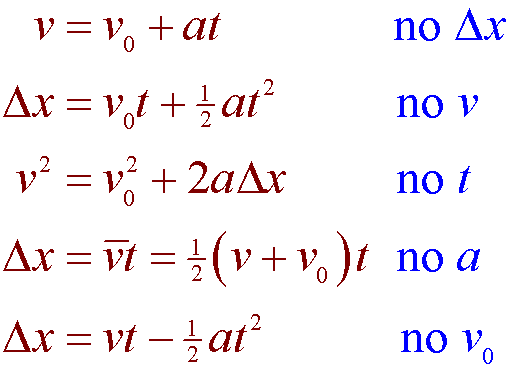
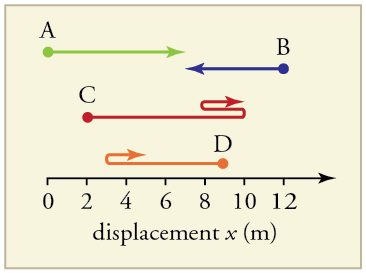
Displacement () is the change in position, calculated by subtracting initial position from final position:
For an object moving at constant speed (zero acceleration), displacement is straightforward:
where is the velocity (m/s) and is the time elapsed (s).
When an object is accelerating, its velocity changes over the interval, so you can't just use . Instead, use the average velocity:
Average velocity for constant acceleration is the midpoint of the starting and ending velocities:
This formula only works when acceleration is constant. If acceleration varies, the simple average won't give you the right answer.
Final velocity in acceleration scenarios
When an object accelerates at a constant rate, its final velocity is:
- = initial velocity (m/s)
- = constant acceleration (m/s²)
- = time elapsed (s)
Acceleration is the rate at which velocity changes over time. A positive means the object's velocity is increasing in the positive direction; a negative means it's increasing in the negative direction (which could mean slowing down or speeding up, depending on which way the object is moving).
A common pitfall: students assume negative acceleration always means "slowing down." That's only true if the object is moving in the positive direction. An object moving in the negative direction with negative acceleration is actually speeding up.
If the object starts from rest (), the equation simplifies to:
For example, a car pulling away from a stoplight starts at m/s. If it accelerates at m/s² for s, its final velocity is m/s.
Displacement and position for accelerating objects
To find displacement when acceleration is constant, use:
- = initial velocity (m/s)
- = constant acceleration (m/s²)
- = time elapsed (s)
The first term () accounts for the distance the object would cover at its initial speed alone. The second term () adds the extra distance gained (or lost) due to acceleration.
To find the final position rather than just displacement, add the initial position:
If the object starts from rest (), the equation reduces to:
This shows up constantly in free-fall problems. For an object dropped from rest near Earth's surface, m/s² (taking upward as positive). After s of free fall, the displacement is m, meaning the object has fallen 19.6 m downward.
There's one more equation worth knowing. When you don't have the time , use:
This connects velocity and displacement directly, skipping time altogether. It's especially useful for problems that ask "how fast is the object going after traveling a certain distance?"
Vectors and scalars in motion
Several quantities in these equations are vectors, meaning they have both magnitude and direction:
- Velocity has a speed (magnitude) and a direction. Positive and negative signs indicate direction along your chosen axis.
- Acceleration also has magnitude and direction. Its sign tells you which direction the velocity is changing.
- Position/displacement includes direction relative to a reference point.
Time is a scalar: it has magnitude only and is always positive.
Keeping track of signs is one of the most important skills in kinematics. Before solving any problem, choose a positive direction (usually to the right or upward) and assign signs to every vector quantity consistently. Most errors in kinematics come from sign mistakes, not from using the wrong equation.
See Fiveable more often in Google
Mark Fiveable as a preferred source and Google is more likely to show you our guides in Top Stories, with a "preferred" badge in AI Mode and AI Overviews.