3.4 Projectile Motion

🔋College Physics I – Introduction Unit 3 Review
3.4 Projectile Motion
🔋 College Physics I – Introduction
Projectile motion combines horizontal and vertical movement to create a parabolic path. By splitting the motion into two independent directions, you can predict where a projectile will land, how high it will go, and how fast it's moving at any point during flight.
Projectile Motion
Properties of projectile motion
A projectile is any object launched into the air that moves under the influence of gravity alone. Once it leaves the launcher (your hand, a cannon, a kicker's foot), gravity is the only force acting on it: . Air resistance is typically ignored in introductory problems, which means we're treating the motion as if it happens in a vacuum.
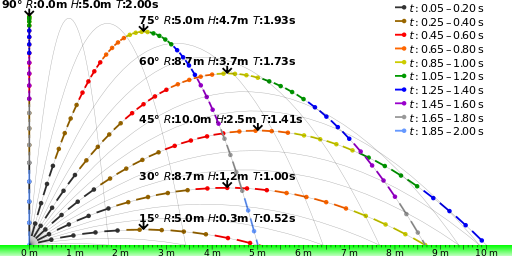
The resulting path is called the trajectory, and it's always a parabola. The shape of that parabola depends on two things: the initial speed () and the launch angle ().
- Range is the horizontal distance from launch to landing (assuming the projectile lands at the same height it was launched). A 45° launch angle maximizes range when there's no air resistance.
where is initial speed, is launch angle, and is gravitational acceleration (9.8 m/s²).
- Maximum height is the peak of the parabola, where the vertical velocity momentarily equals zero.
where is the initial vertical velocity.
- Displacement is the overall change in position from start to finish, which is a vector quantity (it has both magnitude and direction).

Projectile position and velocity calculations
The core technique is to separate motion into two independent components: horizontal (x) and vertical (y). These two directions don't affect each other.
- Horizontal motion has constant velocity because no horizontal force acts on the projectile.
- Vertical motion has constant acceleration (, downward) because gravity pulls the object toward Earth.
First, break the initial velocity into components:
Then use these equations at any time :
| Quantity | Horizontal | Vertical |
|---|---|---|
| Position | ||
| Velocity | (constant) |
Notice that never changes, while decreases on the way up, hits zero at the peak, and increases in the negative (downward) direction on the way down.
To find the total speed at any moment, combine the components using the Pythagorean theorem: . The direction of the velocity vector can be found with , where is the angle relative to the horizontal.
Problem-solving with independent motions
Here's a reliable approach for tackling projectile motion problems:
- List your knowns. Write down , , and any other given values. Calculate and right away.
- Identify the unknown you need to find (time of flight, range, max height, final velocity, etc.).
- Choose the right direction. Decide whether the unknown connects to horizontal motion, vertical motion, or both.
- Pick the appropriate equation from the table above and solve for the unknown.
- Combine components if the question asks for a total quantity (like speed or displacement magnitude).
A few things that come up repeatedly:
- Time is shared. Both components experience the same elapsed time. If you solve for using a vertical equation, you can plug that same into a horizontal equation.
- At the peak, . Setting lets you solve for the time to reach maximum height: .
- Symmetric flights. When a projectile lands at the same height it was launched, the total flight time is , and the speed at landing equals the launch speed.
- Vertical displacement is zero on return. If the projectile returns to its launch height, at landing. You can use this fact to solve for total flight time directly.
Fundamental principles
- Newton's laws govern projectile behavior. The only force acting is gravity (downward), so the only acceleration is , directed downward.
- Acceleration due to gravity is constant near Earth's surface at approximately .
- Projectile motion is the combination of constant velocity horizontally and constant acceleration vertically. Keeping these two directions separate is what makes the problems solvable.
See Fiveable more often in Google
Mark Fiveable as a preferred source and Google is more likely to show you our guides in Top Stories, with a "preferred" badge in AI Mode and AI Overviews.