34.3 Superstrings

🔋College Physics I – Introduction Unit 34 Review
34.3 Superstrings
🔋 College Physics I – Introduction
Introduction to Superstring Theory
Superstring theory attempts to unify quantum mechanics and general relativity into a single framework. These two pillars of modern physics are individually successful but fundamentally incompatible: quantum mechanics describes matter and energy at the subatomic scale, while general relativity describes gravity and the large-scale structure of the universe. Superstring theory proposes that the universe's most basic building blocks are tiny, one-dimensional strings of energy vibrating in multiple dimensions.
Concept of Superstring Theory
The core idea is that everything in the universe reduces to incredibly small vibrating strings of energy. Different vibration patterns of these strings produce different particles, much like different vibration patterns on a guitar string produce different musical notes.
- These strings are thought to be many orders of magnitude smaller than the smallest known subatomic particles (quarks, electrons)
- The theory aims to provide a "theory of everything" (TOE), a single coherent framework that can explain all known physical phenomena
- A TOE would resolve the central tension in physics: quantum mechanics works perfectly at tiny scales, general relativity works perfectly at large scales, but the two theories give contradictory answers when both apply (like inside black holes or at the Big Bang)
Unification in Superstring Theory
One of the most ambitious goals of superstring theory is unifying the four fundamental forces of nature: electromagnetic, weak nuclear, strong nuclear, and gravitational.
- The theory suggests these forces are different manifestations of a single, more fundamental force arising from string vibrations
- Gravity has been the hardest force to fit into a quantum framework. In superstring theory, gravity emerges naturally from the vibrations of closed loops of string propagating through spacetime. This offers a potential path toward a quantum theory of gravity.
- The theory also incorporates supersymmetry, a principle proposing a symmetry between fermions (matter particles) and bosons (force-carrying particles). Each known particle would have a heavier "superpartner." None of these superpartners have been detected yet, which remains an open challenge for the theory.

Implications for the Smallest Size
Superstring theory suggests a fundamental limit to the smallest possible size in the universe, known as the Planck length ().
- The Planck length is approximately meters. For perspective, that's about times the size of a proton.
- At this scale, the effects of quantum mechanics and gravity become equally important, and the concept of spacetime as a smooth continuum breaks down
- Strings themselves are thought to be roughly on the order of the Planck length, making them the ultimate limit of smallness
This has deep implications for the nature of space and time. Rather than being perfectly smooth and continuous (as classical physics assumes), the fabric of the universe may have a discrete, granular structure at the Planck scale.
Advanced Concepts in Superstring Theory
Several more advanced ideas have grown out of string theory research:
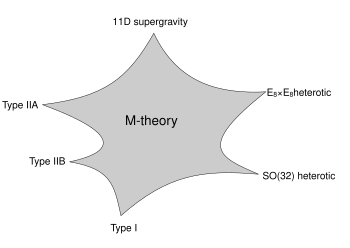
- M-theory: Physicists originally developed five different versions of string theory. M-theory, proposed in the 1990s, unifies all five into a single framework that requires 11 dimensions (10 of space plus 1 of time).
- Holographic principle: This suggests that all the information contained within a volume of space can be encoded on its lower-dimensional boundary. Think of it like a 3D image stored on a 2D surface.
- Duality: In string theory, seemingly different physical theories can turn out to be equivalent descriptions of the same underlying phenomena. This means two theories that look completely different mathematically can make identical physical predictions.
- AdS/CFT correspondence: A conjectured relationship between certain string theories defined in a curved spacetime (Anti-de Sitter space) and quantum field theories on its boundary. It has become one of the most active tools for studying quantum gravity, even beyond string theory itself.
These concepts remain theoretical. Superstring theory has not yet produced predictions that can be tested with current experiments, which is one of the main criticisms it faces. Still, it remains one of the leading candidates for unifying physics at the deepest level.
See Fiveable more often in Google
Mark Fiveable as a preferred source and Google is more likely to show you our guides in Top Stories, with a "preferred" badge in AI Mode and AI Overviews.