11.3 Pressure

🔋College Physics I – Introduction Unit 11 Review
11.3 Pressure
🔋 College Physics I – Introduction
Pressure in fluid systems describes how force gets distributed over an area. It's central to fluid statics because it explains how fluids push on surfaces, transmit forces, and behave at different depths. These ideas show up everywhere, from hydraulic brakes to dam engineering to scuba diving safety.
Pressure in Fluid Systems
Pressure and force relationship
Pressure is defined as the force acting perpendicular to a surface divided by the area of that surface:
where is pressure, is force, and is area. The SI unit is the pascal (Pa), where .
A few things to keep straight here:
- Pressure is a scalar quantity. It has magnitude but no direction. Force, by contrast, is a vector with both magnitude and direction.
- In a fluid at rest, pressure at any given point acts equally in all directions. This is a consequence of Pascal's principle, and it's the reason fluids can transmit force so effectively through hydraulic systems.
The scalar nature of pressure trips people up sometimes. Even though the force on a surface points in a specific direction (perpendicular to that surface), the pressure at a point in the fluid is the same regardless of which direction you consider.

Force calculations using pressure
Rearranging the definition of pressure gives you a direct way to find force:
Example: If a pressure of acts on a surface with area , the force on that surface is:
This relationship shows up in several practical systems:
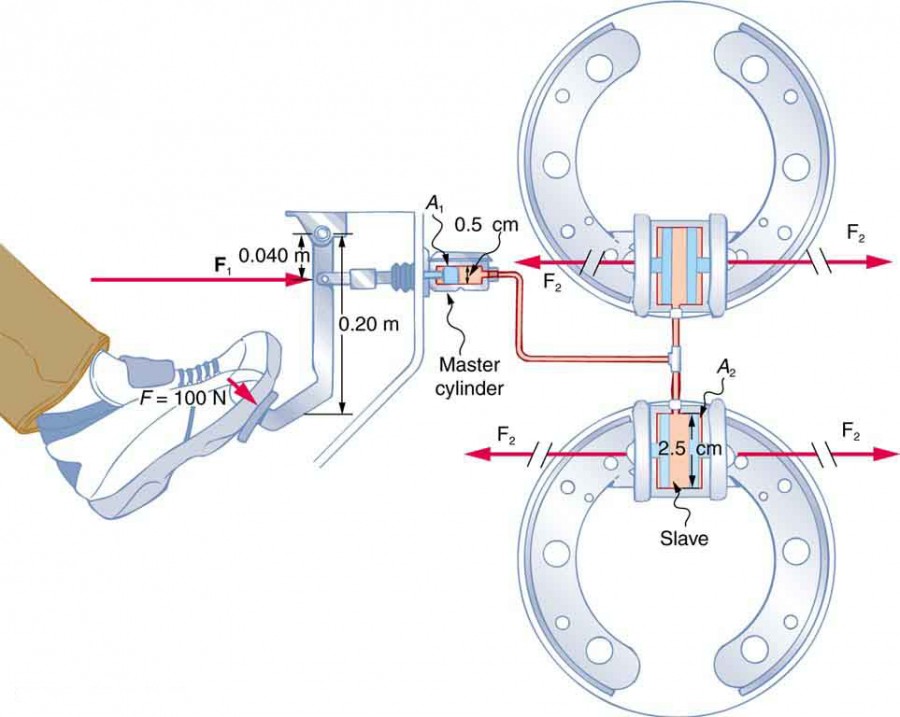
- Hydraulic systems (car brakes, lifts): A small force applied to a small-area piston creates pressure that acts on a larger-area piston, producing a much larger output force. The pressure is the same throughout the fluid, but the force scales with piston area.
- Pneumatic systems (air compressors, tires): Compressed air exerts pressure on the inner walls of a container or tire. The force on any section of wall depends on the pressure and the area of that section.
- Hydrostatic pressure (water tanks, pipes): The weight of fluid above a point creates pressure on container walls. Deeper sections of a tank wall experience greater force per unit area than sections near the top.
Pressure variation with fluid depth
Pressure in a fluid increases with depth because of the weight of the fluid stacked above. The relationship is given by the hydrostatic pressure formula:
where is the fluid density (in ), is the acceleration due to gravity (), and is the depth below the fluid surface.
Note that this formula gives the pressure due to the fluid alone, not including atmospheric pressure above the surface. To get the total (absolute) pressure at depth , you'd add atmospheric pressure: .
A useful benchmark: in water (), pressure increases by about () for every of depth.
This depth dependence has several important consequences:
- Scuba diving safety: A diver at depth experiences roughly of absolute pressure ( atmospheric + from the water). Rapid ascent can cause dissolved gases to form dangerous bubbles in the body.
- Structural design: The bottom of a dam or storage tank bears more pressure than the top. Taller containers need thicker walls at the base to handle the higher forces there.
- Fluid flow: A pressure difference between two points in a fluid can drive flow. This principle is used in water distribution systems and hydroelectric power generation.
- Buoyancy: The pressure on the bottom of a submerged object is greater than the pressure on its top. This pressure difference creates a net upward force, which is buoyancy.
Pressure measurement and types
There are three pressure terms you need to distinguish:
- Absolute pressure is the total pressure at a point, including the contribution from the atmosphere. It's what you'd calculate using .
- Gauge pressure is the pressure relative to atmospheric pressure: . Most everyday pressure readings (tire pressure, blood pressure) are gauge pressures. A gauge pressure of zero means the absolute pressure equals atmospheric pressure.
- Atmospheric pressure is the pressure exerted by the weight of the air above you. At sea level, it's approximately (or ).
Two common instruments for measuring pressure:
- A barometer measures atmospheric pressure. In a mercury barometer, atmospheric pressure supports a column of mercury about tall.
- A manometer measures pressure differences. It uses a U-shaped tube of liquid to compare the pressure of a gas to atmospheric pressure (open manometer) or to compare two pressures directly (closed manometer).
One more detail worth knowing: the hydrostatic pressure formula assumes the fluid is incompressible, meaning its density doesn't change with pressure. This works well for liquids like water. For gases, density changes significantly with pressure, so the formula is only a good approximation over small height differences.
See Fiveable more often in Google
Mark Fiveable as a preferred source and Google is more likely to show you our guides in Top Stories, with a "preferred" badge in AI Mode and AI Overviews.