23.7 Transformers

🔋College Physics I – Introduction Unit 23 Review
23.7 Transformers
🔋 College Physics I – Introduction
23.1
Induced Emf and Magnetic Flux
23.2
Faraday’s Law of Induction: Lenz’s Law
23.3
Motional Emf
23.4
Eddy Currents and Magnetic Damping
23.5
Electric Generators
23.6
Back Emf
23.7
Transformers
23.8
Electrical Safety: Systems and Devices
23.9
Inductance
23.10
RL Circuits
23.11
Reactance, Inductive and Capacitive
23.12
RLC Series AC Circuits
Transformers
Transformers change voltage levels between circuits using electromagnetic induction. They're essential to the electrical grid: power plants generate electricity at one voltage, but it needs to be stepped up for efficient long-distance transmission and then stepped back down for safe use in homes and businesses.
Components of Transformers
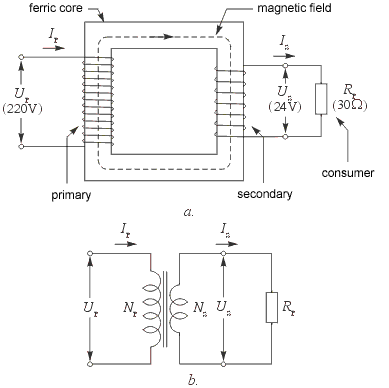
A transformer has three main parts working together:
- Primary coil receives alternating current (AC) from the power source.
- Secondary coil delivers the transformed voltage to the load (whatever device or circuit needs power).
- Iron core links the two coils by providing an efficient path for magnetic flux. Iron's high magnetic permeability concentrates the field and strengthens the coupling between coils.
The AC flowing through the primary coil creates a changing magnetic field in the iron core. That changing field, in turn, induces an electromotive force (EMF) in the secondary coil. This is Faraday's law at work. The induced EMF drives current through the secondary circuit, transferring energy from the primary side to the secondary side without any direct electrical connection between them.
Transformers only work with AC (or any changing current). A steady DC current produces a constant magnetic field, which means no change in flux and therefore no induced EMF in the secondary coil.
Transformer Equation Calculations
The transformer equation relates voltage, current, and the number of coil turns on each side:
- : Primary voltage
- : Secondary voltage
- : Number of turns in the primary coil
- : Number of turns in the secondary coil
- : Primary current
- : Secondary current
Notice that voltage and turns are directly proportional, but current is inversely proportional. If voltage goes up, current goes down by the same factor. This follows from conservation of energy: for an ideal transformer, power in equals power out (), so .
Example: A transformer has a primary voltage of 120 V, a secondary voltage of 24 V, and 500 turns in the primary coil. How many turns does the secondary coil have?
- Set up the ratio: →
- Solve for : turns
The voltage dropped by a factor of 5, so the number of turns also drops by a factor of 5. That quick ratio check is a good way to verify your answer.

Step-Up vs. Step-Down Transformers
The difference comes down to the turn ratio:
- Step-up transformers have more turns in the secondary coil than the primary (). This increases voltage () while decreasing current. Power plants use step-up transformers to boost voltage to hundreds of thousands of volts for long-distance transmission.
- Step-down transformers have fewer turns in the secondary coil than the primary (). This decreases voltage () while increasing current. These bring voltage down to levels safe for everyday use.
Why step up for transmission? Power lost to resistance in transmission lines is . By stepping voltage up and current down, you dramatically reduce those losses. Transmitting 100 MW at 500,000 V requires far less current than transmitting it at 10,000 V, which means far less energy wasted as heat in the wires.
A typical path through the grid looks like this:
- Power plant → step-up transformer boosts voltage (e.g., to 345,000 V) for high-voltage transmission lines
- Substation → step-down transformer reduces voltage (e.g., to 13,800 V) for local distribution
- Neighborhood transformer (on a utility pole or pad) → further steps down to 120 V or 240 V for residential use
Transformer Efficiency and Power Transmission
Real transformers aren't perfectly efficient, but well-designed ones come close (often above 95%).
Several factors affect performance:
- Eddy currents are loops of current induced in the iron core itself. They waste energy as heat. To minimize them, transformer cores are built from thin, insulated sheets of iron (called laminations) rather than a solid block.
- Hysteresis losses occur because energy is spent reversing the magnetic domains in the core each AC cycle. Using "soft" magnetic materials with narrow hysteresis loops reduces this.
- Resistive losses in the copper windings ( heating) also reduce efficiency.
Impedance matching is another transformer application. By choosing the right turn ratio, a transformer can make a load's impedance "look" different to the source, maximizing power transfer between them. This matters in audio systems and communications circuits.
Voltage regulation refers to how well a transformer maintains a steady output voltage as the load changes. An ideal transformer would keep perfectly constant, but in practice, internal resistance and leakage flux cause the output to drop slightly under heavy load.
See Fiveable more often in Google
Mark Fiveable as a preferred source and Google is more likely to show you our guides in Top Stories, with a "preferred" badge in AI Mode and AI Overviews.