16.10 Superposition and Interference

🔋College Physics I – Introduction Unit 16 Review
16.10 Superposition and Interference
🔋 College Physics I – Introduction
16.1
Hooke’s Law: Stress and Strain Revisited
16.2
Period and Frequency in Oscillations
16.3
Simple Harmonic Motion: A Special Periodic Motion
16.4
The Simple Pendulum
16.5
Energy and the Simple Harmonic Oscillator
16.6
Uniform Circular Motion and Simple Harmonic Motion
16.7
Damped Harmonic Motion
16.8
Forced Oscillations and Resonance
16.9
Waves
16.10
Superposition and Interference
16.11
Energy in Waves: Intensity
Wave Superposition and Interference
Wave superposition and interference explain how waves interact when they overlap. When two or more waves meet, their displacements combine to produce a new wave pattern. This can amplify waves, reduce them, or create entirely new patterns like standing waves and beats.
These principles show up everywhere: standing waves on guitar strings, beats heard when tuning instruments, and interference patterns in light. Understanding superposition gives you the tools to analyze any situation where waves coexist in the same space.
Principles of Wave Interference
The superposition principle states that when two or more waves overlap, the resulting displacement at any point equals the algebraic sum of the individual wave displacements at that point. "Algebraic" matters here because displacements can be positive (crests) or negative (troughs), so they can add or cancel.
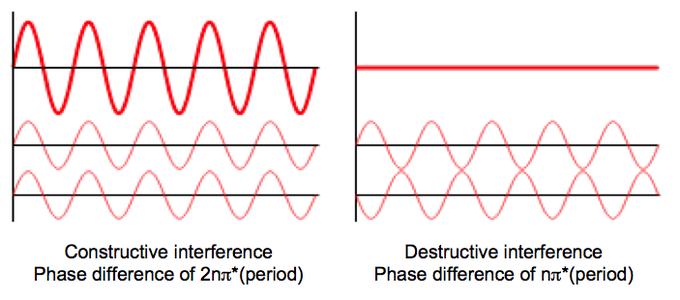
Constructive interference occurs when two waves are in phase, meaning their crests and troughs line up. The resulting wave has an amplitude equal to the sum of the individual amplitudes.
- This happens when the path length difference between the two waves is an integer multiple of the wavelength: , where
- Think of two identical ripples arriving at the same point at the same time. Their peaks stack on top of each other.
Destructive interference occurs when two waves are completely out of phase, meaning the crest of one aligns with the trough of the other. For two waves of equal amplitude, this produces zero displacement.
- This happens when the path length difference is an odd multiple of half the wavelength: , where
- If the amplitudes aren't equal, the resulting amplitude equals the difference between them rather than zero.
Partial interference is what happens most of the time in real situations. Waves are rarely perfectly in phase or perfectly out of phase. When the path length difference falls between the conditions above, the resulting amplitude lands somewhere between the constructive maximum and the destructive minimum.
The phase difference between two waves determines which type of interference you get. A phase difference of or gives constructive interference; a phase difference of gives destructive interference; anything else gives partial interference.
Frequencies of Standing Waves
Standing waves form when a wave is confined in a space and reflects back on itself. The original and reflected waves superpose to create a pattern that appears to stand still. The key features are nodes (points that never move) and antinodes (points that oscillate with maximum amplitude).
The fundamental frequency () is the lowest frequency that produces a standing wave. On a string fixed at both ends, the fundamental has one antinode in the center and nodes at each end.
where is the wave speed on the string and is the string's length.
Harmonics are standing wave patterns at higher frequencies, each an integer multiple of the fundamental:
, where
- The 2nd harmonic () has two antinodes and a node in the middle.
- The 3rd harmonic () has three antinodes and two interior nodes.
- Each successive harmonic fits one more half-wavelength into the string's length.
The wave speed on a string depends on the string's physical properties:
where is the tension in the string and is the linear mass density (mass per unit length, in kg/m). Increasing tension or decreasing mass density raises the wave speed, which raises all the standing wave frequencies. This is exactly what you do when you tighten or loosen a guitar string to change its pitch.
Resonance occurs when an external force drives a system at one of its natural frequencies. The system absorbs energy efficiently, and the amplitude of oscillation grows large. Every standing wave frequency is a natural frequency of the system.

Beat Frequency from Wave Superposition
Beats are the periodic rises and falls in loudness you hear when two waves of slightly different frequencies overlap. The combined wave's amplitude oscillates between loud (constructive interference) and soft (destructive interference) as the two waves drift in and out of phase with each other.
The beat frequency tells you how many times per second the volume cycles from loud to soft and back:
For example, if one tuning fork vibrates at 440 Hz and another at 442 Hz, you hear beats per second. That means the sound swells to maximum loudness 2 times each second.
This is a practical tool for tuning instruments. A musician plays a reference tone alongside their instrument's note. If they hear beats, the two frequencies don't match. As they adjust the instrument and the beat frequency drops toward zero, the frequencies converge. When the beats disappear, the instrument is in tune.
Wave Equations and Related Phenomena
The wave equation is the mathematical relationship that describes how waves propagate through a medium. At this level, the key takeaway is that wave behavior follows predictable rules governed by the medium's properties and the wave's frequency and wavelength.
Diffraction occurs when waves encounter an obstacle or pass through an opening. The wave bends around edges and spreads out, rather than traveling in a straight line. Diffraction is most noticeable when the size of the obstacle or opening is comparable to the wavelength. This is why you can hear someone talking around a corner (sound has long wavelengths) but can't see them (light has very short wavelengths).
See Fiveable more often in Google
Mark Fiveable as a preferred source and Google is more likely to show you our guides in Top Stories, with a "preferred" badge in AI Mode and AI Overviews.