34.2 General Relativity and Quantum Gravity

🔋College Physics I – Introduction Unit 34 Review
34.2 General Relativity and Quantum Gravity
🔋 College Physics I – Introduction
General Relativity and Gravity
General relativity describes gravity not as a force, but as the warping of spacetime by mass and energy. This framework predicts phenomena that Newtonian gravity can't explain, from the bending of light around massive objects to the existence of black holes. It also sets up one of the biggest unsolved problems in physics: how to reconcile gravity with quantum mechanics.
Light Bending in Gravity
Einstein's equivalence principle states that the effects of gravity are indistinguishable from the effects of acceleration in a small region of spacetime. One major consequence: gravity affects the path of light. A massive object curves the spacetime around it, and light traveling through that curved spacetime follows a curved path.
The more massive the object, the greater the curvature and the more the light bends.
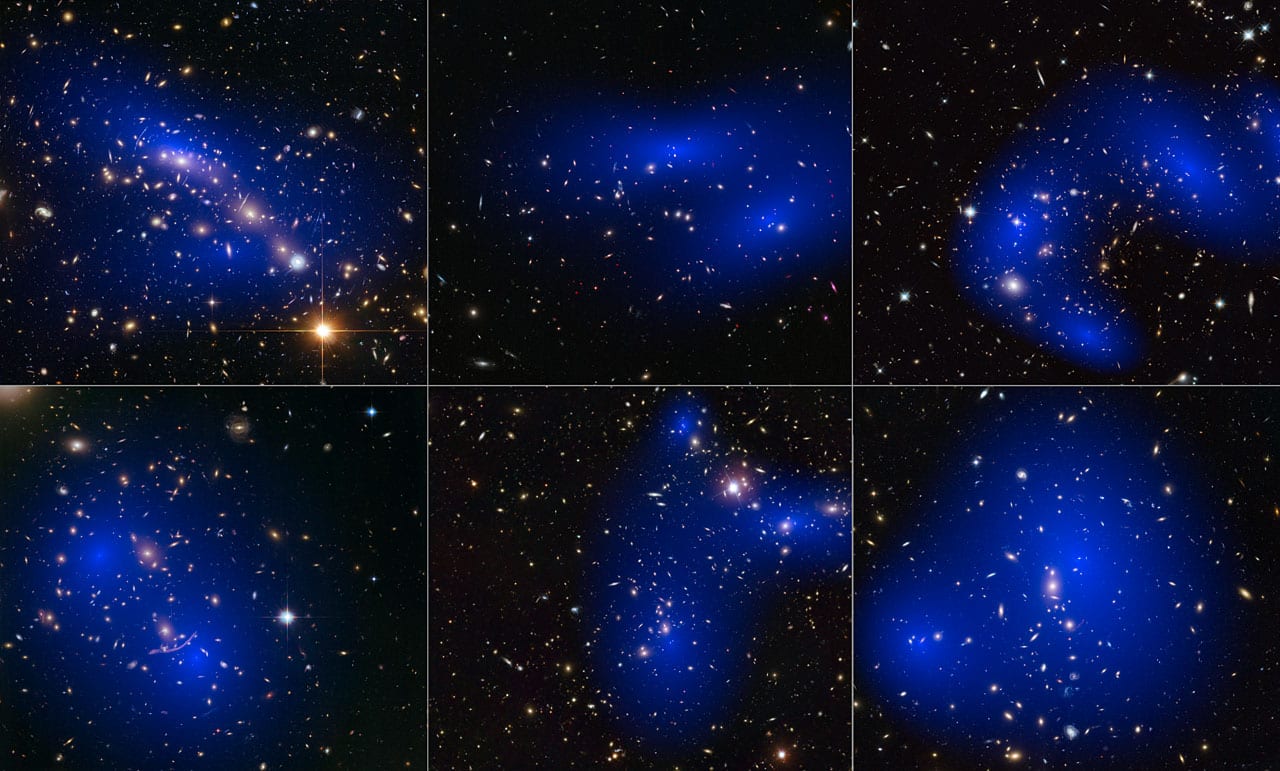
Gravitational lensing is the name for this bending of light by massive objects. When light from a distant source (like a galaxy or quasar) passes near a massive foreground object, the light's path bends, which can magnify, distort, or even create multiple images of the same source.
Gravitational lensing is useful in several ways:
- It lets astronomers observe distant galaxies and quasars that would otherwise be too faint to detect.
- It provides a way to detect dark matter, since dark matter bends light even though it's invisible. The lensing pattern reveals where dark matter is, giving indirect evidence for its existence.
- It helps measure the mass of galaxies and galaxy clusters by analyzing how much the light is bent and distorted.
Features of Black Holes
Black holes are regions of spacetime where gravity is so strong that nothing, including light, can escape. They form from the collapse of massive stars or from the merger of compact objects like neutron stars.
A few key features define black holes:
- Event horizon: The boundary around a black hole beyond which escape is impossible. Think of it as the point of no return.
- Schwarzschild radius: The radius of the event horizon, given by:
where is the gravitational constant, is the mass of the black hole, and is the speed of light. A more massive black hole has a larger Schwarzschild radius.
- Singularity: A point at the center of the black hole where spacetime curvature becomes infinite and the known laws of physics break down. The singularity is hidden behind the event horizon, so it can't be directly observed.
Black holes come in different size categories:
- Stellar-mass black holes form from collapsing massive stars and have masses ranging from a few to several tens of solar masses.
- Supermassive black holes sit at the centers of galaxies, with masses millions to billions of times that of the Sun. Sagittarius A*, at the center of the Milky Way, is a well-known example.
- Intermediate-mass black holes fall between the other two categories and are thought to form through mergers of smaller black holes or the collapse of dense star clusters.
Black holes can also emit gravitational waves, which are ripples in spacetime that propagate outward, especially during events like black hole mergers.

Unifying General Relativity and Quantum Mechanics
General Relativity vs. Quantum Mechanics
These two theories are the pillars of modern physics, but they govern very different domains:
- General relativity describes gravity as the curvature of spacetime. It applies to large-scale, high-mass systems like planets, stars, and galaxies. It successfully explains planetary orbits, light bending, and the expansion of the universe.
- Quantum mechanics describes the behavior of matter and energy at the subatomic scale, governing particles like electrons, photons, and quarks. It explains atomic structure, particle interactions, and material properties.
The problem is that these two theories are incompatible. General relativity is a classical theory (smooth, continuous spacetime), while quantum mechanics is built on discrete, probabilistic behavior. Under normal conditions this doesn't matter, because gravity is negligible at tiny scales and quantum effects are negligible at large scales.
But in extreme conditions, both gravity and quantum effects become significant at the same time. Black hole singularities and the very early universe are two examples. In these situations, neither theory alone gives a complete answer, and combining them produces mathematical contradictions.
A unified theory of quantum gravity would reconcile these two frameworks, describing gravity at the quantum scale and potentially unifying all four fundamental forces (gravity, electromagnetism, the strong nuclear force, and the weak nuclear force).
The leading candidate theories include:
- String theory: Proposes that fundamental particles are actually tiny vibrating strings. Different vibration patterns correspond to different particles, and the framework naturally includes a particle that mediates gravity (the graviton).
- Loop quantum gravity: Describes spacetime itself as a network of discrete loops rather than a smooth continuum, attempting to quantize gravity directly without requiring extra dimensions.
Quantum Gravity and the Planck Scale
The Planck scale represents the smallest meaningful length scale in physics, roughly meters. At this scale, quantum effects of gravity become significant, and our current theories can no longer be applied separately.
Stephen Hawking made key contributions connecting black holes to quantum mechanics, most notably predicting that black holes emit thermal radiation (now called Hawking radiation) due to quantum effects near the event horizon. This prediction links general relativity, quantum mechanics, and thermodynamics, and it remains one of the strongest hints about what a theory of quantum gravity might look like.
Developing a successful theory of quantum gravity is one of the biggest open challenges in theoretical physics. It will require new mathematical tools and, critically, experimental tests that can distinguish between competing theories.
See Fiveable more often in Google
Mark Fiveable as a preferred source and Google is more likely to show you our guides in Top Stories, with a "preferred" badge in AI Mode and AI Overviews.