10.7 Gyroscopic Effects: Vector Aspects of Angular Momentum

🔋College Physics I – Introduction Unit 10 Review
10.7 Gyroscopic Effects: Vector Aspects of Angular Momentum
🔋 College Physics I – Introduction
10.1
Angular Acceleration
10.2
Kinematics of Rotational Motion
10.3
Dynamics of Rotational Motion: Rotational Inertia
10.4
Rotational Kinetic Energy: Work and Energy Revisited
10.5
Angular Momentum and Its Conservation
10.6
Collisions of Extended Bodies in Two Dimensions
10.7
Gyroscopic Effects: Vector Aspects of Angular Momentum
Vector Aspects of Angular Momentum
Angular momentum doesn't just have a magnitude; it also has a direction. This vector nature is what makes gyroscopes work, explains why a spinning top stays upright, and even governs how Earth's axis slowly shifts over thousands of years. To work with angular momentum as a vector, you need a reliable way to find its direction.
Vector Aspects of Angular Momentum
Right-Hand Rule for Rotational Quantities
The right-hand rule gives you the direction of angular velocity (), angular momentum (), and torque (). All three are vectors that point along the axis of rotation, not along the direction of motion itself.
Here's how to apply it:
- Curl the fingers of your right hand in the direction the object is rotating.
- Your thumb points in the direction of the vector (, , or ).
For example, if a wheel spins counterclockwise when viewed from above, curl your right-hand fingers in that counterclockwise direction. Your thumb points upward, so points up along the axis.
For torque specifically, curl your fingers in the direction the applied force would cause the object to rotate. Your thumb then gives the direction of .
These vectors always point along the rotation axis, perpendicular to the plane of rotation. That can feel counterintuitive at first, but it's the only direction that stays consistent as the object spins.

Gyroscopic Effect and Applications
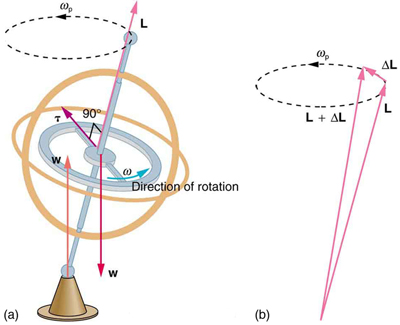
A gyroscope is a spinning object that resists changes to the orientation of its rotation axis. This happens because of conservation of angular momentum: once an object has a large , changing its direction requires an external torque. Without that torque, the axis stays fixed in space.
A typical gyroscope is a spinning rotor mounted on gimbals (rings that allow the rotor to rotate freely in any direction). As long as the rotor spins fast enough, the axis holds steady even if you tilt the frame around it.
Gyroscopic precession is the surprising behavior that occurs when you do apply a torque to a spinning object. Instead of tipping over in the direction you'd expect, the rotation axis moves perpendicular to the applied torque. Think of a spinning top that leans to one side: gravity pulls it downward, but instead of falling, the top's axis slowly sweeps out a circle. That circular motion of the axis is precession.
The precession rate depends on the relationship between the applied torque and the object's angular momentum. A larger (faster spin) means slower precession, while a larger torque speeds it up.
Common applications of gyroscopic effects include:
- Inertial navigation systems in aircraft and spacecraft, which track orientation without external references
- Gyrocompasses, which find true north based on Earth's rotation rather than magnetic fields
- Stabilization systems for cameras, telescopes, ships, and vehicles
Earth's Rotation as a Gyroscope
Earth spins on its axis once per day, giving it a large angular momentum. This makes Earth behave like a massive gyroscope, with its rotation axis tilted about 23.5° relative to the plane of its orbit around the Sun.
Earth isn't a perfect sphere. It bulges slightly at the equator, and the gravitational pulls of the Sun and Moon exert torques on that bulge. Just like a spinning top under the influence of gravity, Earth's axis precesses. This precession traces out a cone in space over a cycle of approximately 26,000 years. As a result, the position of the celestial poles slowly shifts. Right now, Polaris is close to the north celestial pole, but thousands of years from now, a different star will take that role.
Nutation is a smaller, periodic wobble superimposed on this precession. It's caused by variations in the Moon's gravitational torque as the Moon's orbit shifts over a cycle of about 18.6 years. Nutation produces small oscillations in the precession rate and in the tilt of Earth's axis.
Together, precession and nutation gradually change the orientation of Earth's axis, which shifts the timing of equinoxes and solstices over long periods.
Rotational Dynamics and Energy
A few key quantities tie together everything in rotational motion:
- Moment of inertia () measures how much an object resists angular acceleration. It depends not just on total mass, but on how that mass is distributed relative to the rotation axis. Mass farther from the axis means a larger .
- Rotational kinetic energy is given by . A fast-spinning object with a large moment of inertia stores a lot of rotational energy.
- Angular acceleration () is the rate of change of angular velocity. Newton's second law for rotation is , so a larger torque or a smaller moment of inertia produces a greater angular acceleration.
These quantities work together in rigid body dynamics, where you analyze the motion of solid objects that don't deform. The shape and mass distribution of a rigid body determine its moment of inertia, which in turn controls how it responds to applied torques.
See Fiveable more often in Google
Mark Fiveable as a preferred source and Google is more likely to show you our guides in Top Stories, with a "preferred" badge in AI Mode and AI Overviews.