16.2 Period and Frequency in Oscillations

🔋College Physics I – Introduction Unit 16 Review
16.2 Period and Frequency in Oscillations
🔋 College Physics I – Introduction
16.1
Hooke’s Law: Stress and Strain Revisited
16.2
Period and Frequency in Oscillations
16.3
Simple Harmonic Motion: A Special Periodic Motion
16.4
The Simple Pendulum
16.5
Energy and the Simple Harmonic Oscillator
16.6
Uniform Circular Motion and Simple Harmonic Motion
16.7
Damped Harmonic Motion
16.8
Forced Oscillations and Resonance
16.9
Waves
16.10
Superposition and Interference
16.11
Energy in Waves: Intensity
Oscillations: Period and Frequency
Oscillatory motion is any motion that repeats itself in a regular cycle. Period and frequency are the two quantities that describe how that repetition happens: how long each cycle takes, and how many cycles fit into a second. These two ideas show up everywhere, from pendulum clocks to AC power grids, so getting comfortable with them now pays off throughout the course.
Calculation of Oscillation Periods
Period () is the time it takes to complete one full oscillation. It's measured in seconds (s).
Frequency () is the number of complete oscillations that occur per second. It's measured in hertz (Hz), where 1 Hz = 1 cycle per second.
These two quantities are linked by a simple pair of formulas:
So if you know one, you can always find the other.
For specific oscillating systems, you can calculate the period directly:
- Simple pendulum:
- = length of the pendulum (in meters)
- = acceleration due to gravity ()
- Notice that mass doesn't appear here. A heavier pendulum bob swings with the same period as a lighter one, as long as the length stays the same.
- Mass-spring system:
- = mass attached to the spring (in kg)
- = spring constant, which measures the spring's stiffness (in N/m)
- Here mass does matter, but length doesn't. A stiffer spring (larger ) gives a shorter period.
- Angular frequency () is another way to express how fast something oscillates: It's measured in radians per second (rad/s) and connects oscillatory motion to circular motion, which becomes useful when you study SHM equations.

Period vs. Frequency Relationship
Period and frequency are inversely related. When one goes up, the other goes down by the same factor.
- Doubling the frequency cuts the period in half.
- Tripling the period reduces the frequency to one-third.
If you were to plot frequency on the y-axis against period on the x-axis, you'd get a hyperbolic curve (the shape of ). The curve never touches either axis because neither nor can be zero for a real oscillation.
A quick example to make this concrete: a guitar string vibrating at Hz (the note A above middle C) has a period of
That's about 2.3 milliseconds per cycle.
Real-World Applications of Oscillations
Pendulum clocks rely on the pendulum period formula to keep time. Adjusting the pendulum length changes the period and therefore the clock's accuracy. Grandfather clocks use long pendulums (around 1 m), which gives a period close to 2 seconds. Smaller desk clocks use shorter pendulums with shorter periods to tick more rapidly.
Musical instruments and tuning forks produce sound at specific frequencies. Higher frequencies correspond to higher-pitched notes (think piccolo or violin), while lower frequencies produce lower-pitched notes (bassoon or double bass). A standard tuning fork vibrates at 440 Hz, and instrument makers rely on precise frequency control to stay in tune.
Alternating current (AC) electrical systems oscillate at a fixed frequency. In North America, AC runs at 60 Hz; in most of Europe and Asia, it's 50 Hz. For a 60 Hz system:
That means the current completes a full cycle roughly every 17 milliseconds.
Vibrations in machines and structures are analyzed using period and frequency to prevent dangerous conditions. Resonance occurs when an external force drives a system at its natural frequency, causing vibration amplitudes to grow dramatically. Engineers design bridges, buildings, and engines to have natural frequencies that differ from expected driving frequencies, avoiding resonance-related failures.
Harmonic Oscillator Characteristics
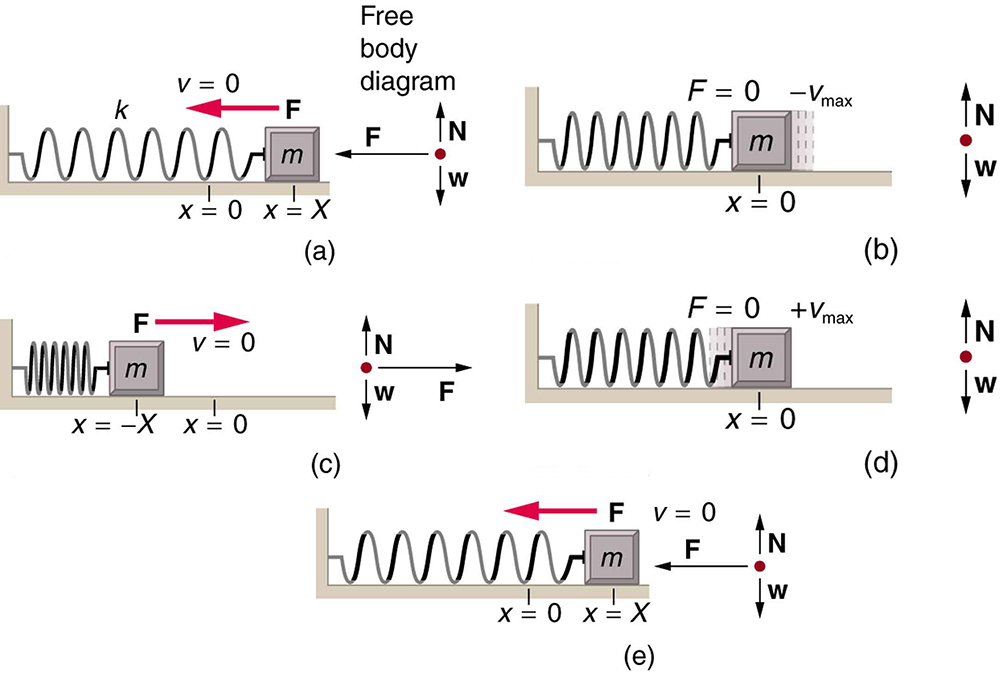
A harmonic oscillator is any system that, when displaced from equilibrium, experiences a restoring force proportional to the displacement. That proportionality is what makes the resulting motion sinusoidal (smooth, wave-like).
- Equilibrium position is the point where the net force on the object is zero. For a mass on a spring, it's the natural resting length of the spring.
- Displacement is how far the object is from equilibrium at any moment.
- Restoring force always points back toward equilibrium. For a spring, this is described by Hooke's Law: , where the negative sign indicates the force opposes the displacement.
When the restoring force is exactly proportional to displacement (and no friction or other forces interfere), the system undergoes simple harmonic motion (SHM). In SHM, the period stays constant regardless of amplitude, which is why pendulum clocks work so reliably for small swings.
See Fiveable more often in Google
Mark Fiveable as a preferred source and Google is more likely to show you our guides in Top Stories, with a "preferred" badge in AI Mode and AI Overviews.