29.6 Conversion of Pyruvate to Acetyl CoA

🥼Organic Chemistry Unit 29 Review
29.6 Conversion of Pyruvate to Acetyl CoA
🥼 Organic Chemistry
29.1
An Overview of Metabolism and Biochemical Energy
29.2
Catabolism of Triacylglycerols: The Fate of Glycerol
29.3
Catabolism of Triacylglycerols: β-Oxidation
29.4
Biosynthesis of Fatty Acids
29.5
Catabolism of Carbohydrates: Glycolysis
29.6
Conversion of Pyruvate to Acetyl CoA
29.7
The Citric Acid Cycle
29.8
Carbohydrate Biosynthesis: Gluconeogenesis
29.9
Catabolism of Proteins: Deamination
29.10
Some Conclusions about Biological Chemistry
Pyruvate Dehydrogenase Complex
The pyruvate dehydrogenase complex (PDC) converts pyruvate into acetyl CoA, connecting glycolysis to the citric acid cycle. Without this step, the two-carbon units from glucose breakdown can't enter the citric acid cycle for further oxidation. The reaction takes place in the mitochondrial matrix, so pyruvate must first be transported across the mitochondrial membranes after being produced in the cytoplasm during glycolysis.

Top images from around the web for Process of oxidative decarboxylation
Carbohydrate Metabolism · Anatomy and Physiology View original
Is this image relevant?
Oxidation of Pyruvate and the Citric Acid Cycle | OpenStax Biology 2e View original
Is this image relevant?
Oxidation of Pyruvate and the Citric Acid Cycle | OpenStax Biology 2e View original
Is this image relevant?
Carbohydrate Metabolism · Anatomy and Physiology View original
Is this image relevant?
Oxidation of Pyruvate and the Citric Acid Cycle | OpenStax Biology 2e View original
Is this image relevant?
Process of Oxidative Decarboxylation
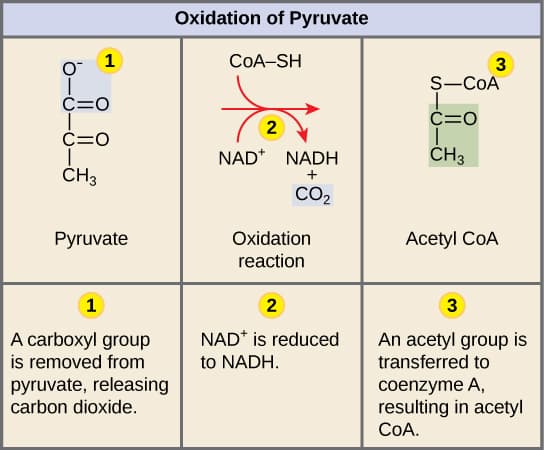
The name tells you exactly what happens: oxidative decarboxylation means a carboxyl group is removed as (decarboxylation) while the remaining fragment is oxidized. Pyruvate is a three-carbon molecule. One carbon leaves as , and the remaining two-carbon unit is oxidized and attached to coenzyme A, forming acetyl CoA.
The overall reaction:
Notice that is reduced to here. That will later donate its electrons to the electron transport chain.
The PDC is a massive multienzyme complex built from three enzyme components:
- Pyruvate dehydrogenase (E1) catalyzes the decarboxylation of pyruvate
- Dihydrolipoyl transacetylase (E2) transfers the resulting acetyl group to CoA
- Dihydrolipoyl dehydrogenase (E3) regenerates oxidized lipoamide so the cycle can repeat
Five cofactors participate: thiamin diphosphate (TPP), lipoic acid, coenzyme A (CoA), FAD, and . Each plays a distinct role in the sequence of steps described below.

Role of Thiamin Diphosphate
Thiamin diphosphate (TPP) is derived from vitamin B1 (thiamine) and is bound to the active site of E1. Its job is to make the first step possible: breaking the C–C bond between the carboxyl group and the -carbon of pyruvate.
Why is TPP needed? After is released, the remaining two-carbon fragment carries a negative charge that would be unstable on its own. TPP acts as an electron sink, stabilizing that negative charge on the hydroxyethyl intermediate. Without TPP, the decarboxylation wouldn't proceed efficiently.
The mechanism at E1 works like this:
- The reactive carbanion carbon of TPP attacks the carbonyl carbon of pyruvate, forming a covalent adduct.
- This bond formation promotes loss of from the carboxyl group.
- The result is a hydroxyethyl-TPP intermediate, which carries the two-carbon unit forward to the next step.
This is why thiamine (vitamin B1) deficiency causes serious metabolic problems. Without enough TPP, the PDC can't function properly, and pyruvate accumulates instead of entering the citric acid cycle.

Key Reactions in the Pyruvate Dehydrogenase Complex
The full conversion happens in three sequential steps, each catalyzed by a different enzyme component:
Step 1: Decarboxylation (E1, pyruvate dehydrogenase)
- TPP on E1 attacks the carbonyl carbon of pyruvate, forming a covalent adduct.
- is released, generating the hydroxyethyl-TPP intermediate.
Step 2: Acyl transfer (E2, dihydrolipoyl transacetylase)
- The hydroxyethyl group is transferred from TPP to the lipoyl group covalently attached to E2. During this transfer, the hydroxyethyl group is oxidized to an acetyl group, forming an acetyl-lipoamide intermediate. The lipoamide's disulfide bond is reduced in the process.
- CoA then attacks the acetyl group, releasing acetyl CoA and leaving behind reduced lipoamide (dihydrolipoamide).
Step 3: Regeneration of oxidized lipoamide (E3, dihydrolipoyl dehydrogenase)
- The reduced lipoamide must be reoxidized so E2 can function again.
- E3 oxidizes dihydrolipoamide using FAD as an electron acceptor, producing .
- is then reoxidized by transferring its electrons to , generating .
A key feature of the PDC is substrate channeling: the intermediates are passed directly between active sites on the complex rather than diffusing freely into solution. This makes the process faster and prevents reactive intermediates from being lost or causing side reactions.
Cellular Respiration Overview
Pyruvate-to-acetyl-CoA conversion sits at a critical junction in cellular respiration. Here's where it fits in the larger pathway:
- Glycolysis breaks glucose into two pyruvate molecules in the cytoplasm.
- Pyruvate oxidation (this reaction) converts pyruvate to acetyl CoA in the mitochondrial matrix.
- The citric acid cycle fully oxidizes the acetyl group from acetyl CoA, producing , , , and GTP.
- The electron transport chain accepts electrons from and , passing them through protein complexes in the inner mitochondrial membrane to build a proton gradient.
- Oxidative phosphorylation uses that proton gradient to drive ATP synthase, producing the bulk of the cell's ATP.
The PDC is tightly regulated because it controls the flow of carbon into the citric acid cycle. It's inhibited by its own products (acetyl CoA and ) and activated when energy demand is high (high levels of , CoA, and AMP). This ensures the cell doesn't waste resources converting pyruvate when acetyl CoA is already abundant.
See Fiveable more often in Google
Mark Fiveable as a preferred source and Google is more likely to show you our guides in Top Stories, with a "preferred" badge in AI Mode and AI Overviews.