22.5 Acidity of Alpha Hydrogen Atoms: Enolate Ion Formation

🥼Organic Chemistry Unit 22 Review
22.5 Acidity of Alpha Hydrogen Atoms: Enolate Ion Formation
🥼 Organic Chemistry
Acidity of Alpha Hydrogen Atoms and Enolate Ion Formation
Alpha hydrogens sit on the carbon directly next to a carbonyl group, and they're surprisingly acidic compared to most C–H bonds. Understanding why they're acidic and how their removal generates enolate ions is the foundation for nearly every reaction in this unit, from aldol additions to Claisen condensations.

Top images from around the web for Formation of enolate ions
20.6: Aldol reaction - Chemistry LibreTexts View original
Is this image relevant?
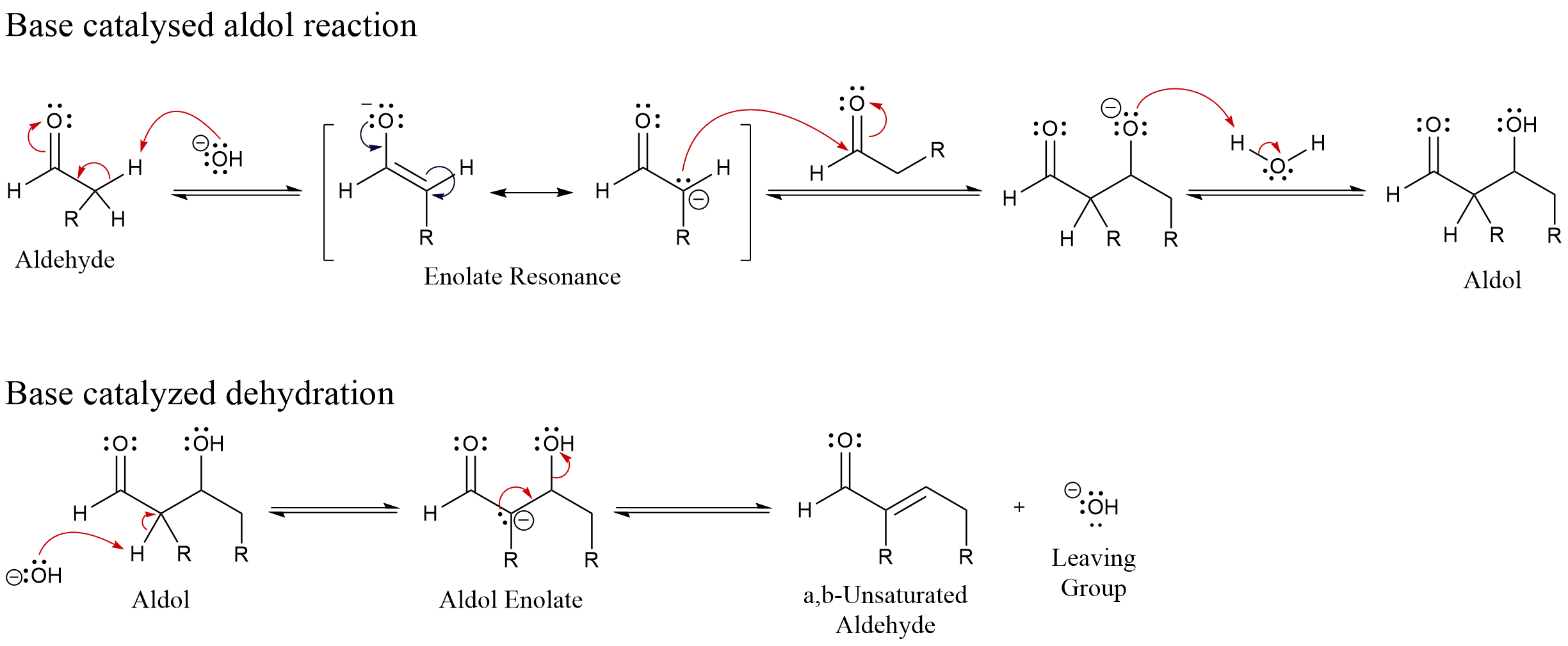
File:Enolate aldol mechanism.png - Wikipedia View original
Is this image relevant?
20.6 Aldol reaction | Organic Chemistry II View original
Is this image relevant?
20.6: Aldol reaction - Chemistry LibreTexts View original
Is this image relevant?
File:Enolate aldol mechanism.png - Wikipedia View original
Is this image relevant?
Formation of Enolate Ions
An enolate ion forms when a strong base removes an alpha hydrogen from a carbonyl compound (aldehyde, ketone, or ester). The alpha carbon is the one directly adjacent to the group, and any hydrogen on that carbon is called an alpha hydrogen.
Why is this hydrogen removable in the first place? Because the resulting anion is resonance-stabilized. Once the proton is removed, the negative charge isn't stuck on carbon. It delocalizes between the alpha carbon and the carbonyl oxygen through the system:
Resonance structures of an enolate: Structure 1 — negative charge on the alpha carbon (carbanion form) Structure 2 — negative charge on the oxygen (enolate form)
The oxygen-bearing structure is the major contributor because oxygen handles negative charge better than carbon.
This delocalization is what makes alpha hydrogens far more acidic ( for ketones) than typical C–H bonds ().
Lithium diisopropylamide (LDA) is the go-to base for enolate formation. Two features make it ideal:
- It's a very strong base (conjugate acid ), strong enough to fully deprotonate most carbonyl compounds.
- Its bulky isopropyl groups make it a poor nucleophile, so it removes the proton rather than attacking the carbonyl carbon.
The enolate ion is the conjugate base of the original carbonyl compound. Once formed, it can act as either a nucleophile at carbon or at oxygen, depending on the reaction conditions.

Acidity of Carbonyl Compounds
Not all alpha hydrogens are equally acidic. The identity of the carbonyl functional group matters because it determines how well the enolate's negative charge is stabilized.
General acidity order (least to most acidic alpha H):
| Compound Type | Approximate | Why |
|---|---|---|
| Ester | ~25 | Ester oxygen donates electrons into carbonyl, reducing its electron-withdrawing effect |
| Ketone | ~20 | Moderate electron withdrawal by the carbonyl |
| Aldehyde | ~17 | Less steric and electronic stabilization than ketones; slightly more acidic |
| Carboxylic acid | ~5 (O–H) | The O–H proton is far more acidic; alpha H is still ~20, but the O–H is lost first |
A few additional points on acidity trends:
- Thioesters are more acidic than regular esters. Sulfur is less electronegative than oxygen, so it doesn't donate electron density into the carbonyl as effectively. That leaves the carbonyl more electron-withdrawing, which better stabilizes the enolate.
- Lower = stronger acid = easier to deprotonate. Always connect values back to enolate stability.

Impact of Multiple Carbonyls on Acidity
When two carbonyl groups flank the same carbon (a 1,3-dicarbonyl or beta-dicarbonyl arrangement), the alpha hydrogen between them becomes dramatically more acidic.
Examples include 1,3-diketones () and beta-keto esters (). Compare that to a simple ketone at . That's a difference of roughly in acidity.
The reason is straightforward: removing the proton between two carbonyls lets the negative charge delocalize across both groups, giving three resonance contributors instead of two. More delocalization means a more stable conjugate base, which means a more acidic proton.
Within a beta-dicarbonyl molecule, acidity follows a clear hierarchy:
- Hydrogens flanked by two carbonyl groups are the most acidic.
- Hydrogens next to one carbonyl are less acidic, though still more acidic than a non-activated C–H bond.
This enhanced acidity has practical consequences: beta-dicarbonyl compounds can be deprotonated with relatively mild bases like sodium ethoxide () or even sodium hydroxide, rather than requiring LDA. That makes them especially useful in synthetic reactions like Claisen condensations and malonic ester syntheses, where carbon–carbon bonds form under mild conditions.
Enolate Formation and Related Concepts
- Keto-enol tautomerism is closely related to enolate chemistry. The enol form (with an O–H and ) is a protonated version of the enolate. Tautomerism is an equilibrium between keto and enol forms; enolate formation is a deprotonation that generates the anion.
- Kinetic vs. thermodynamic enolates: When a ketone has alpha hydrogens on both sides of the carbonyl, the base and conditions determine which enolate forms. LDA at low temperature () gives the kinetic enolate (less substituted, faster to form). A weaker base at higher temperature with equilibration gives the thermodynamic enolate (more substituted, more stable).
- Base strength matters. A base whose conjugate acid has a higher than the alpha hydrogen's will drive deprotonation essentially to completion. If the base is weaker, you get an equilibrium mixture with only partial enolate formation.
See Fiveable more often in Google
Mark Fiveable as a preferred source and Google is more likely to show you our guides in Top Stories, with a "preferred" badge in AI Mode and AI Overviews.