12.5 Spectroscopy and the Electromagnetic Spectrum

🥼Organic Chemistry Unit 12 Review
12.5 Spectroscopy and the Electromagnetic Spectrum
🥼 Organic Chemistry
12.1
Mass Spectrometry of Small Molecules: Magnetic-Sector Instruments
12.2
Interpreting Mass Spectra
12.3
Mass Spectrometry of Some Common Functional Groups
12.4
Mass Spectrometry in Biological Chemistry: Time-of-Flight (TOF) Instruments
12.5
Spectroscopy and the Electromagnetic Spectrum
12.6
Infrared Spectroscopy
12.7
Interpreting Infrared Spectra
12.8
Infrared Spectra of Some Common Functional Groups
Electromagnetic radiation interacts with molecules in specific, predictable ways. Light can cause bonds to vibrate, molecules to rotate, or electrons to jump between energy levels. These interactions are the foundation of spectroscopy, which you'll use throughout organic chemistry to figure out what molecules look like.
Different types of radiation excite different molecular motions. Infrared light causes bond vibrations, while UV and visible light trigger electronic transitions. By studying which wavelengths a molecule absorbs, you can work backward to deduce its structure and functional groups.
Electromagnetic Radiation and Spectroscopy

Top images from around the web for Electromagnetic radiation and organic molecules
Infrared spectroscopy - Wikipedia View original
Is this image relevant?
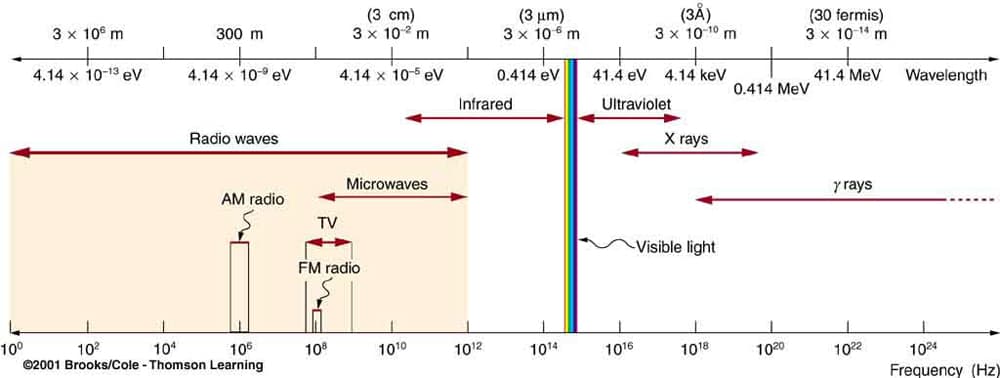
Photon Energies and the Electromagnetic Spectrum | Physics View original
Is this image relevant?
6.1 Electromagnetic Energy – Chemistry View original
Is this image relevant?
Infrared spectroscopy - Wikipedia View original
Is this image relevant?
Photon Energies and the Electromagnetic Spectrum | Physics View original
Is this image relevant?
Electromagnetic radiation and organic molecules
Electromagnetic radiation consists of oscillating electric and magnetic fields traveling through space as waves. Three properties characterize these waves:
- Wavelength (): the distance between consecutive wave peaks
- Frequency (): the number of wave cycles per second (measured in Hz)
- Energy (): directly proportional to frequency, inversely proportional to wavelength
A molecule absorbs a photon when the photon's energy exactly matches the energy gap between two of the molecule's energy levels. This causes the molecule to jump from a lower energy state to a higher one.
Different molecular motions require different amounts of energy:
- Bond vibrations (stretching and bending) absorb infrared (IR) radiation
- Electronic transitions (electrons moving between orbitals) absorb ultraviolet (UV) and visible light, which is higher in energy than IR
Wavelengths that aren't absorbed simply pass through the sample. That's why some materials appear transparent to certain types of radiation.

Energy levels and transitions
Molecules have discrete (quantized) energy levels, meaning they can only exist in specific energy states:
- Ground state: the lowest energy configuration
- Excited states: higher energy configurations the molecule can be promoted to
Two key processes connect these levels:
- Absorption: the molecule takes in a photon and moves to a higher energy level
- Emission: the molecule releases a photon and drops back to a lower energy level
Electronic transitions involve redistributing electrons among molecular orbitals. These transitions require significantly more energy than vibrational transitions, which is why electronic spectroscopy uses UV/visible light while vibrational spectroscopy uses lower-energy IR light.

Photon energy calculations
The Planck equation relates a photon's energy to its frequency and wavelength:
- = energy of the photon (joules)
- = Planck's constant ( J·s)
- = frequency (Hz)
- = speed of light ( m/s)
- = wavelength (meters)
The key relationship to internalize: frequency and wavelength are inversely proportional. Higher frequency means shorter wavelength and higher energy. Lower frequency means longer wavelength and lower energy.
The electromagnetic spectrum, ordered from lowest to highest energy:
- Radio waves — longest wavelengths, lowest energies
- Microwaves — used in ovens; cause molecular rotations
- Infrared (IR) — causes bond vibrations; the basis of IR spectroscopy
- Visible light — the narrow range your eyes detect
- Ultraviolet (UV) — causes electronic transitions; used in UV-Vis spectroscopy
- X-rays — high enough energy to interact with inner-shell electrons
- Gamma rays — shortest wavelengths, highest energies; from nuclear processes
For organic chemistry, you'll mostly work in the IR and UV-Vis regions.
Interpretation of infrared spectra
IR spectroscopy measures how much infrared radiation a sample absorbs. The result is plotted as percent transmittance (%T) on the y-axis versus wavenumber () on the x-axis.
Wavenumber is the reciprocal of wavelength, expressed in . Higher wavenumber means higher energy. This is the standard x-axis unit in IR spectroscopy, and the axis runs from high wavenumber on the left to low wavenumber on the right.
Reading the spectrum takes some practice. Absorption peaks point downward (toward lower %T), because less light is transmitted at wavelengths where the molecule absorbs. A dip in the spectrum means the molecule is absorbing at that wavenumber.
Different functional groups absorb at characteristic wavenumber ranges. The most important ones to memorize:
- O–H and N–H stretches: 3200–3600 (broad for O–H in alcohols and carboxylic acids; medium for N–H in amines)
- C–H stretches: 2800–3300 (nearly every organic molecule shows these)
- C≡C and C≡N stretches: ~2100–2300 (alkynes and nitriles)
- C=O stretches: 1650–1800 (strong, sharp peaks for ketones, aldehydes, esters, carboxylic acids)
- C=C stretches: 1600–1680 (alkenes; often weaker than C=O)
When analyzing an IR spectrum, you're looking for two things: which peaks are present and which are absent. The presence of a broad absorption around 3300 suggests an O–H or N–H group. The absence of a strong peak near 1700 tells you there's likely no carbonyl group.
You can also compare an unknown compound's spectrum against reference spectra. The region below ~1500 is called the fingerprint region because its complex pattern of peaks is unique to each molecule, much like an actual fingerprint.
The Beer-Lambert law () relates absorbance to the concentration of a sample (), the path length of the sample cell (), and the molar absorptivity (). While you'll encounter this more in UV-Vis spectroscopy, it's the principle that allows spectroscopy to be used for quantitative analysis, not just identification.
See Fiveable more often in Google
Mark Fiveable as a preferred source and Google is more likely to show you our guides in Top Stories, with a "preferred" badge in AI Mode and AI Overviews.