20.4 Substituent Effects on Acidity

🥼Organic Chemistry Unit 20 Review
20.4 Substituent Effects on Acidity
🥼 Organic Chemistry
20.1
Naming Carboxylic Acids and Nitriles
20.2
Structure and Properties of Carboxylic Acids
20.3
Biological Acids and the Henderson–Hasselbalch Equation
20.4
Substituent Effects on Acidity
20.5
Preparing Carboxylic Acids
20.6
Reactions of Carboxylic Acids: An Overview
20.7
Chemistry of Nitriles
20.8
Spectroscopy of Carboxylic Acids and Nitriles
Substituent Effects on Acidity
The acidity of a carboxylic acid depends heavily on what other groups are attached to the molecule. Electron-withdrawing groups (EWGs) stabilize the conjugate base and make the acid stronger, while electron-donating groups (EDGs) destabilize it and make the acid weaker. This topic connects acid-base chemistry to the electronic effects you've been studying all semester.

Top images from around the web for Effects of electron-withdrawing substituents
6.2. Resonance | Organic Chemistry 1: An open textbook View original
Is this image relevant?
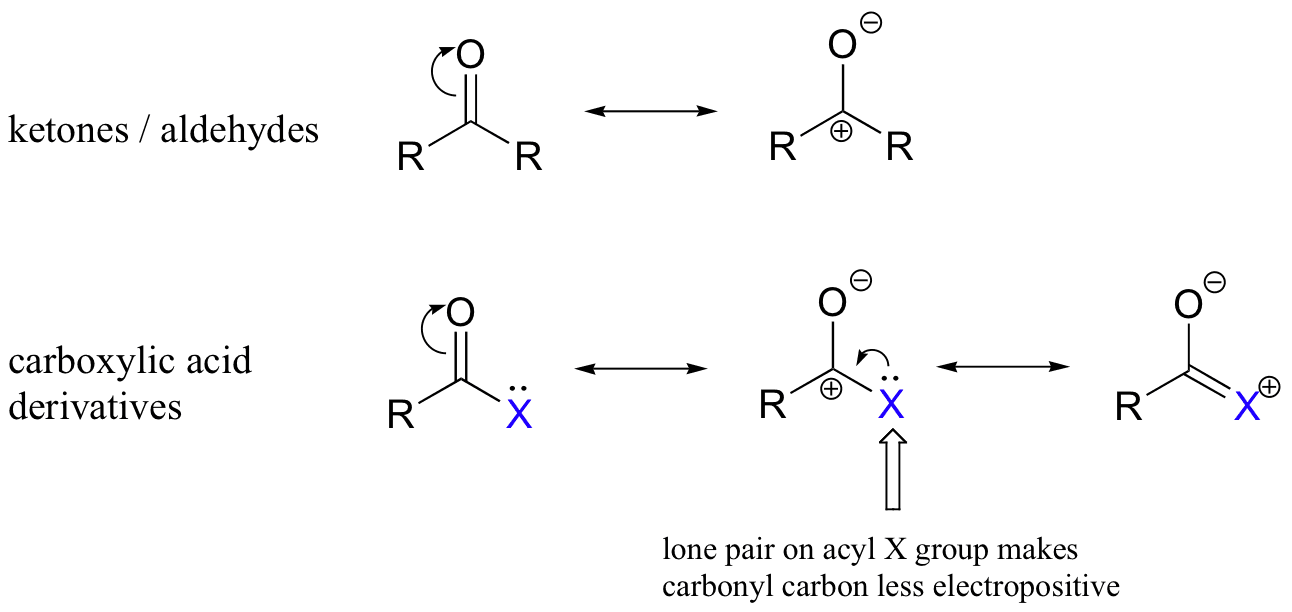
22.1. Introduction | Organic Chemistry II View original
Is this image relevant?
6.2. Resonance | Organic Chemistry 1: An open textbook View original
Is this image relevant?
6.2. Resonance | Organic Chemistry 1: An open textbook View original
Is this image relevant?
22.1. Introduction | Organic Chemistry II View original
Is this image relevant?
Effects of Electron-Withdrawing Substituents
The core idea here is conjugate base stability. When a carboxylic acid loses a proton, it forms a carboxylate anion with a negative charge. Anything that helps spread out (delocalize) that negative charge will stabilize the conjugate base and shift the equilibrium toward dissociation.
Electron-withdrawing substituents do exactly this. They pull electron density away from the carboxylate through two mechanisms:
- Inductive effect: Electronegative atoms pull electrons through sigma bonds. This operates through-bond and weakens with distance.
- Resonance effect: Groups with pi systems (like or ) can delocalize the negative charge through conjugation.
The result is a larger and a lower . Remember, , so as goes up, goes down.
A classic comparison: acetic acid (, ) vs. trifluoroacetic acid (, ). Replacing three hydrogens with three fluorines dramatically increases acidity because fluorine's strong inductive withdrawal stabilizes the carboxylate.
Common electron-withdrawing substituents to know:
- Halogens (, , , ): primarily inductive effect. Fluorine is the strongest because it's the most electronegative.
- Nitro () and cyano (): both inductive and resonance withdrawal, making them very powerful EWGs.
- Carbonyl groups (, ): withdraw primarily through resonance.
The more electronegative the substituent and the closer it is to the acidic group, the greater the effect on acidity.

Acidity of Substituted Benzoic Acids
Benzoic acid () serves as the reference point. Substituents on the ring either increase or decrease acidity relative to this value.
Electron-withdrawing groups increase acidity:
- They stabilize the benzoate conjugate base by pulling electron density away from the carboxylate.
- Stronger EWGs produce greater increases in acidity. The approximate ordering by acid-strengthening ability:
- For example, para-nitrobenzoic acid has a , noticeably more acidic than benzoic acid itself.
Electron-donating groups decrease acidity:
- They push electron density toward the carboxylate, destabilizing the negative charge on the conjugate base.
- Approximate ordering by acid-weakening ability (strongest EDG first):
- For example, para-aminobenzoic acid () is less acidic than benzoic acid.
Position matters. This is where students often get tripped up:
- Para substituents interact with the carboxylate through resonance across the ring. EWGs at the para position can directly delocalize the negative charge through alternating pi bonds.
- Ortho substituents have strong effects due to both inductive proximity and resonance, though steric effects can complicate things at the ortho position.
- Meta substituents cannot participate in direct resonance with the carboxylate group. They influence acidity mainly through the inductive effect, which makes their impact weaker than ortho or para placement.
A para-nitro group on benzoic acid increases acidity more than a meta-nitro group because the para position allows direct resonance withdrawal from the carboxylate. The meta position does not.

Substituent Effects on Aromatic Reactivity
The same electronic effects that control acidity also control how the aromatic ring behaves in electrophilic aromatic substitution (EAS). This connection is worth understanding clearly.
EWGs deactivate the ring toward EAS. They decrease electron density in the pi system, making the ring a weaker nucleophile and slower to react with electrophiles. EWGs also direct incoming electrophiles to the meta position. For example, nitrobenzene reacts with to give predominantly meta-bromonitrobenzene.
EDGs activate the ring toward EAS. They increase electron density, making the ring more nucleophilic and more reactive. EDGs direct incoming electrophiles to the ortho and para positions. For example, anisole (-phenyl) reacts with to give mainly 2-bromoanisole and 4-bromoanisole.
The pattern connecting acidity and reactivity:
- Substituents that increase acidity (EWGs) deactivate the ring toward EAS
- Substituents that decrease acidity (EDGs) activate the ring toward EAS
This makes intuitive sense. An EWG pulls electrons away from both the carboxylate (stabilizing the conjugate base, increasing acidity) and the ring (reducing nucleophilicity, slowing EAS). The electronic effect is consistent; it just has different consequences depending on what you're looking at.
Molecular Structure and Acidity
Several structural features beyond substituent identity affect how acidic a compound is:
- Bond polarity: A more polarized bond (due to nearby electronegative groups) makes the proton easier to lose. Drawing Lewis structures helps you see where electron density is concentrated or depleted.
- Conjugate base stability: This is always the deciding factor. Any structural feature that stabilizes the anion formed after deprotonation will increase acidity. Resonance delocalization, inductive effects, and orbital hybridization all contribute.
- Hydrogen bonding in solution: Intramolecular hydrogen bonding (especially in ortho-substituted benzoic acids) can stabilize the conjugate base and increase acidity beyond what electronic effects alone would predict. Solvent hydrogen bonding also influences measured values.
- Distance from the acidic group: Inductive effects fall off rapidly with the number of bonds between the substituent and the carboxylate. A chlorine on the alpha carbon has a much larger effect than one three carbons away.
See Fiveable more often in Google
Mark Fiveable as a preferred source and Google is more likely to show you our guides in Top Stories, with a "preferred" badge in AI Mode and AI Overviews.