22.2 Reactivity of Enols: α-Substitution Reactions

🥼Organic Chemistry Unit 22 Review
22.2 Reactivity of Enols: α-Substitution Reactions
🥼 Organic Chemistry
Enol Reactivity and α-Substitution Reactions
Enols are the reactive form of carbonyl compounds that allow chemistry to happen at the α-carbon. Because the enol tautomer places a nucleophilic carbon-carbon double bond right next to an electron-donating hydroxyl group, it reacts readily with electrophiles. The result is α-substitution: the α-hydrogen gets replaced by a new group, and the carbonyl is restored.

Top images from around the web for Nucleophilic behavior of enols
22.1. Introduction | Organic Chemistry II View original
Is this image relevant?
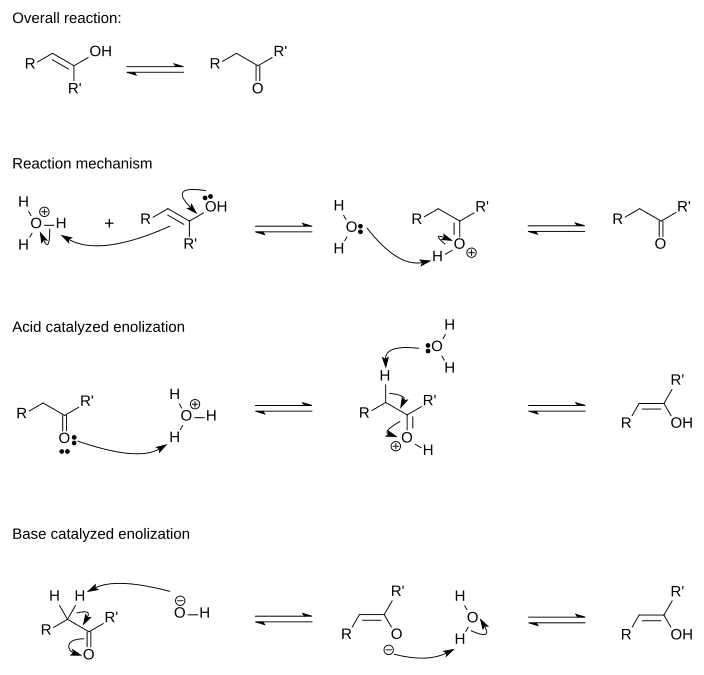
Keto–enol tautomerism - Wikipedia View original
Is this image relevant?
6.5. Lewis acids & bases, electrophiles & nucleophiles | Organic Chemistry 1: An open textbook View original
Is this image relevant?
22.1. Introduction | Organic Chemistry II View original
Is this image relevant?
Keto–enol tautomerism - Wikipedia View original
Is this image relevant?
Nucleophilic Behavior of Enols
The carbon-carbon double bond in an enol is electron-rich, which makes the α-carbon nucleophilic. But enols are actually more nucleophilic than ordinary alkenes, and the reason comes down to the oxygen.
- The lone pairs on the hydroxyl oxygen donate electron density into the double bond through resonance. You can draw a resonance structure that places negative charge on the α-carbon and positive charge on oxygen.
- This extra electron density at the α-carbon makes it a better nucleophile toward electrophiles like , protons, or carbonyl carbons of other molecules.
- Enols exist in equilibrium with their keto form through keto-enol tautomerism. For most simple carbonyl compounds, the keto form dominates heavily at equilibrium, but even a small concentration of enol is enough to drive α-substitution reactions forward.
Why more reactive than alkenes? A regular alkene has no heteroatom feeding electron density into the double bond. The enol's hydroxyl group acts like a built-in electron donor, raising the HOMO energy of the double bond and making it a stronger nucleophile.

Mechanism of Enol-Electrophile Reactions
The general mechanism for α-substitution through an enol follows these steps:
-
Nucleophilic attack from the α-carbon. The electron pair from the double bond attacks the electrophile (), forming a new bond at the α-carbon. This breaks the double bond.
-
Formation of an oxocarbenium ion intermediate. After the double bond electrons are used for the new bond, a positive charge develops on the oxygen (think of it as a protonated carbonyl). This cation is stabilized by resonance between the oxygen lone pairs and the carbon.
-
Deprotonation restores the carbonyl. A base (often solvent) removes the proton from the group, regenerating the double bond. The final product is a neutral α-substituted carbonyl compound.
The net transformation: the α-hydrogen has been replaced by the electrophile, and the carbonyl group is back. This is why it's called a substitution rather than an addition.

Enols vs. Alkenes in Electrophilic Reactions
Enols and alkenes both react with electrophiles, but the outcomes are fundamentally different.
- Regioselectivity: Alkenes follow Markovnikov's rule, with the electrophile adding to form the more stable carbocation. Enols don't follow Markovnikov's rule; the hydroxyl group directs the electrophile specifically to the α-carbon every time.
- Addition vs. substitution: When an alkene reacts with , you get a dibromo addition product (both carbons gain a new bond). When an enol reacts with , you get an α-bromoketone because the carbonyl reforms. The enol undergoes substitution, not addition.
- Why substitution for enols? The key difference is that the enol intermediate can lose a proton from oxygen to regenerate a stable bond. Alkenes have no comparable driving force, so they simply add both parts of the electrophile across the double bond.
- Stereochemistry: The α-carbon in the oxocarbenium intermediate is -hybridized and planar, so if the α-carbon was a stereocenter, the electrophile can attack from either face. This often leads to racemization at the α-position. Alkene additions, by contrast, can be stereospecific (anti addition of , for example).
Common α-Substitution Reactions
These are the major reaction types that proceed through enol (or enolate) intermediates:
- α-Halogenation: Treatment of a ketone or aldehyde with or under acidic conditions generates the enol, which attacks the halogen. The product is an α-haloketone (or aldehyde). Under basic conditions, the reaction goes through the enolate and can be difficult to stop at monosubstitution because each halogen makes the remaining α-hydrogens more acidic.
- Aldol reaction: An enol (or enolate) from one carbonyl compound attacks the electrophilic carbonyl carbon of another, forming a β-hydroxy carbonyl product. This is one of the most important C–C bond-forming reactions in organic chemistry.
- Kinetic vs. thermodynamic control: The choice of base, solvent, and temperature determines which enolate forms. The kinetic enolate (less substituted) forms faster at low temperature with a strong, bulky base like LDA. The thermodynamic enolate (more substituted, more stable) forms at higher temperature with equilibrating conditions. Which enolate you generate directly controls the regiochemistry of the α-substitution product.
See Fiveable more often in Google
Mark Fiveable as a preferred source and Google is more likely to show you our guides in Top Stories, with a "preferred" badge in AI Mode and AI Overviews.