12.2 Interpreting Mass Spectra

🥼Organic Chemistry Unit 12 Review
12.2 Interpreting Mass Spectra
🥼 Organic Chemistry
12.1
Mass Spectrometry of Small Molecules: Magnetic-Sector Instruments
12.2
Interpreting Mass Spectra
12.3
Mass Spectrometry of Some Common Functional Groups
12.4
Mass Spectrometry in Biological Chemistry: Time-of-Flight (TOF) Instruments
12.5
Spectroscopy and the Electromagnetic Spectrum
12.6
Infrared Spectroscopy
12.7
Interpreting Infrared Spectra
12.8
Infrared Spectra of Some Common Functional Groups
Mass Spectrometry

Top images from around the web for Molecular ion peak identification
Frontiers | The use of ion mobility mass spectrometry to probe modulation of the structure of ... View original
Is this image relevant?
Organic chemistry 33: Mass spectrometry View original
Is this image relevant?
Mass spectrum - Wikipedia View original
Is this image relevant?
Frontiers | The use of ion mobility mass spectrometry to probe modulation of the structure of ... View original
Is this image relevant?
Organic chemistry 33: Mass spectrometry View original
Is this image relevant?
Molecular Ion Peak Identification
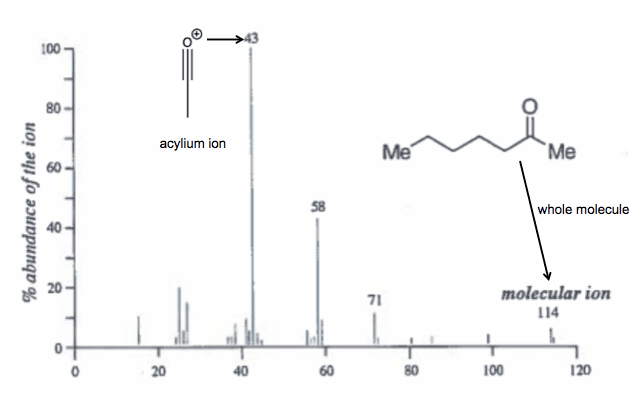
The molecular ion peak ( or ) represents the intact molecule after it loses one electron during ionization. This is typically the highest m/z value you'll see in the spectrum, and it directly tells you the molecular mass of the compound.
Isotope peaks appear at M+1 and M+2 because elements naturally exist as mixtures of isotopes:
- The M+1 peak comes largely from , which contributes about 1.1% intensity per carbon atom. A molecule with 6 carbons will show an M+1 peak roughly 6.6% the height of .
- The M+2 peak is especially useful for detecting halogens and sulfur. gives an M+2 peak about 32% the size of , gives one about 98% (nearly equal height), and contributes about 4.4%.
These isotope patterns are diagnostic. If you see an M+2 peak that's roughly one-third the height of , that strongly suggests chlorine. If M+2 is nearly the same height as , think bromine.
The nitrogen rule is a quick check: an odd molecular mass means the compound contains an odd number of nitrogen atoms. An even molecular mass means zero or an even number of nitrogens. This works because nitrogen has an even atomic mass (14) but an odd valence (3), which is unique among the common organic elements (C, H, N, O, S, halogens).

Mass Spectra Fragmentation Patterns
Fragmentation happens when the ionized molecule has enough excess energy to break bonds, producing smaller charged fragments. Each fragment appears as a peak at a lower m/z value than the molecular ion. The base peak is the most intense peak in the spectrum (assigned 100% relative abundance), and it may or may not be the molecular ion.
Common fragmentation types to recognize:
- Alpha cleavage: A bond directly attached to a heteroatom or functional group breaks, losing a substituent like (loss of 15) or (loss of 29). This is especially common with amines, ethers, and carbonyl compounds.
- Beta cleavage: A bond one position removed from a heteroatom breaks, often producing a resonance-stabilized cation (such as an oxocarbenium ion from an ether or alcohol).
- Retro Diels-Alder: A cyclohexene ring fragments into a diene and a dienophile. Look for this whenever you suspect a six-membered ring with unsaturation.
- McLafferty rearrangement: A hydrogen on a carbon gamma to a carbonyl migrates to the carbonyl oxygen, followed by beta cleavage. This produces a neutral alkene and an enol radical cation. It requires a six-membered transition state, so the carbonyl compound needs a chain of at least three carbons.
Characteristic fragment m/z values can point you toward specific groups:
- m/z 15:
- m/z 29: (formyl) or (ethyl)
- m/z 31: (methoxy, suggests an ether or methanol derivative)
- m/z 43: (propyl) or (acetyl, common in methyl ketones)
- m/z 45: (ethoxy)
- m/z 77: (phenyl, a strong indicator of an aromatic ring)
- m/z 91: (tropylium/benzyl cation, very stable and often the base peak in benzyl-containing compounds)
Note that some m/z values (like 29 and 43) can correspond to more than one fragment. Context from the rest of the spectrum helps you decide which assignment makes sense.

High-Resolution Mass Spectrometry Analysis
Standard (low-resolution) mass spectrometry gives you a nominal mass, which is just the integer value. High-resolution mass spectrometry (HRMS) measures mass to four or more decimal places, which lets you pin down the exact molecular formula.
This matters because different molecular formulas can share the same nominal mass. For example, (propanol, exact mass 60.0575) and (glycolaldehyde, exact mass 60.0211) both have a nominal mass of 60, but HRMS easily distinguishes them.
How exact mass works:
- Each isotope has a precise, non-integer mass (e.g., = 12.0000 by definition, = 1.00783, = 15.9949).
- The exact mass of a molecule is the sum of these precise isotopic masses for the most abundant isotope of each element.
- You compare your measured exact mass against calculated values for candidate formulas. A match within a few ppm (parts per million) confirms the formula.
Common HRMS instruments include time-of-flight (TOF) and Fourier transform ion cyclotron resonance (FT-ICR) analyzers. FT-ICR provides the highest mass accuracy but is more expensive.
HRMS alone can't distinguish between structural isomers (like n-butanol vs. tert-butanol) since they share the same molecular formula and exact mass. However, their fragmentation patterns differ because different bonds break in different structural arrangements, so combining HRMS with fragmentation analysis can help you tell isomers apart.
Ionization and Mass Analysis
The ionization method you choose affects how much fragmentation you see:
- Electron impact (EI) bombards molecules with high-energy electrons (typically 70 eV). This causes extensive fragmentation, giving you rich structural information but sometimes a weak or absent molecular ion peak.
- Chemical ionization (CI) is gentler. It uses a reagent gas to transfer a proton to the analyte, producing less fragmentation and a stronger molecular ion signal (often seen as ). CI is useful when you need to confirm the molecular mass but EI breaks the molecule apart too much.
After ionization, the mass analyzer separates ions by their m/z ratio. The main types are:
- Quadrupole: Common, relatively inexpensive, good for routine analysis
- Time-of-flight (TOF): Separates ions by flight time through a tube; lighter ions arrive first. Capable of high resolution.
- Magnetic sector: Uses a magnetic field to bend ion paths; high resolution but bulkier instruments
The spectrum plots m/z on the x-axis against relative abundance on the y-axis. Every peak's intensity is expressed as a percentage of the base peak (the tallest peak, set to 100%).
See Fiveable more often in Google
Mark Fiveable as a preferred source and Google is more likely to show you our guides in Top Stories, with a "preferred" badge in AI Mode and AI Overviews.