29.8 Carbohydrate Biosynthesis: Gluconeogenesis

🥼Organic Chemistry Unit 29 Review
29.8 Carbohydrate Biosynthesis: Gluconeogenesis
🥼 Organic Chemistry
29.1
An Overview of Metabolism and Biochemical Energy
29.2
Catabolism of Triacylglycerols: The Fate of Glycerol
29.3
Catabolism of Triacylglycerols: β-Oxidation
29.4
Biosynthesis of Fatty Acids
29.5
Catabolism of Carbohydrates: Glycolysis
29.6
Conversion of Pyruvate to Acetyl CoA
29.7
The Citric Acid Cycle
29.8
Carbohydrate Biosynthesis: Gluconeogenesis
29.9
Catabolism of Proteins: Deamination
29.10
Some Conclusions about Biological Chemistry
Gluconeogenesis is the pathway your body uses to synthesize glucose from non-carbohydrate precursors like pyruvate, lactate, glycerol, and certain amino acids. It's critical for maintaining blood glucose levels when dietary carbohydrates are unavailable, such as during fasting or prolonged exercise. Understanding this pathway also means understanding how it relates to glycolysis, since the two pathways share many intermediates but are not simple reverses of each other.
Gluconeogenesis Overview

Top images from around the web for Purpose of gluconeogenesis
Gluconeogenesis - Wikipedia View original
Is this image relevant?
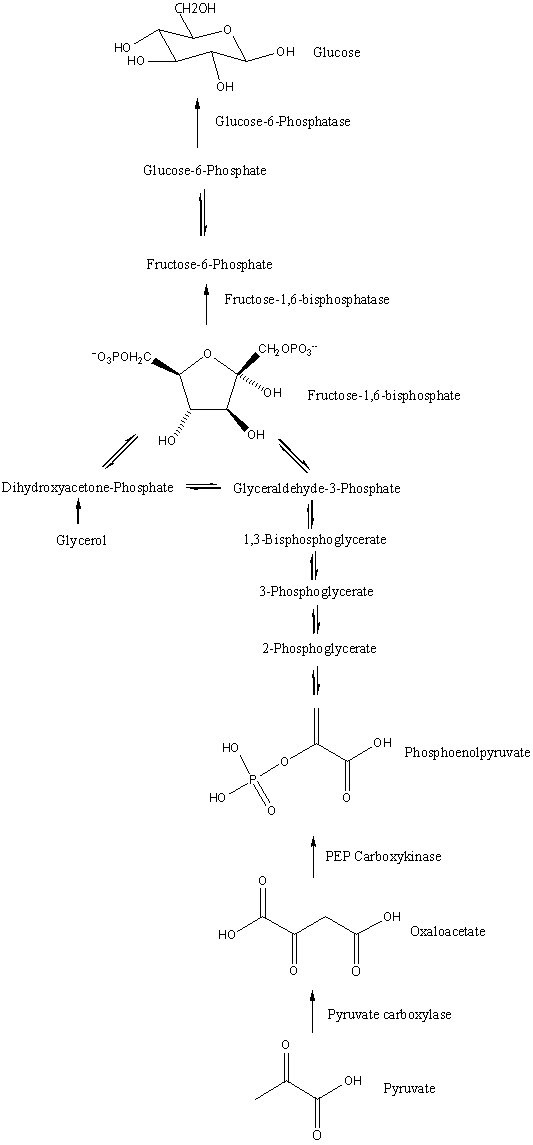
Gluconeogenesis - Wikipedia View original
Is this image relevant?
File:Glycolytic and gluconeogenic pathways.jpg - Wikimedia Commons View original
Is this image relevant?
Gluconeogenesis - Wikipedia View original
Is this image relevant?
Gluconeogenesis - Wikipedia View original
Is this image relevant?
Purpose of gluconeogenesis
Certain tissues depend on a constant glucose supply. Red blood cells lack mitochondria and rely entirely on glycolysis, while the brain consumes roughly 120 g of glucose per day under normal conditions. Gluconeogenesis ensures these tissues stay fueled when you haven't eaten in a while or when glycogen stores run low.
- Synthesizes glucose from non-carbohydrate precursors: pyruvate, lactate, glycerol, and glucogenic amino acids
- Occurs primarily in the liver (~90%) and to a lesser extent in the kidneys
- Becomes upregulated when glycogen stores are depleted, helping maintain blood glucose in the normal range (~70–100 mg/dL)
- Lactate from anaerobic glycolysis in muscle can be shuttled to the liver and converted back to glucose via gluconeogenesis (this is the Cori cycle)
Gluconeogenesis Pathway

Steps in the gluconeogenesis pathway
The pathway converts two molecules of pyruvate into one molecule of glucose through 11 enzyme-catalyzed steps. Seven of these steps use the same enzymes as glycolysis (just running in reverse), but three irreversible glycolytic steps require entirely different enzymes. Those bypass reactions are the key to understanding gluconeogenesis.
-
Pyruvate → Oxaloacetate (catalyzed by pyruvate carboxylase)
- Requires biotin as a cofactor, plus ATP and
- This reaction occurs in the mitochondrial matrix
-
Oxaloacetate → Malate (catalyzed by malate dehydrogenase)
- Requires NADH; this step allows oxaloacetate to be transported out of the mitochondrion (oxaloacetate itself cannot cross the inner mitochondrial membrane)
-
Malate → Phosphoenolpyruvate (PEP) (catalyzed by PEP carboxykinase)
- Requires GTP; releases
- This step occurs in the cytosol (in humans)
-
PEP → 2-Phosphoglycerate (catalyzed by enolase)
-
2-Phosphoglycerate → 3-Phosphoglycerate (catalyzed by phosphoglycerate mutase)
-
3-Phosphoglycerate → 1,3-Bisphosphoglycerate (catalyzed by phosphoglycerate kinase)
- Consumes ATP (the reverse of the ATP-generating glycolytic step)
-
1,3-Bisphosphoglycerate → Glyceraldehyde-3-phosphate (catalyzed by glyceraldehyde-3-phosphate dehydrogenase)
- Requires NADH
-
Glyceraldehyde-3-phosphate → Dihydroxyacetone phosphate (DHAP) and then both triose phosphates are combined: Glyceraldehyde-3-phosphate + DHAP → Fructose-1,6-bisphosphate (catalyzed by aldolase)
-
Fructose-1,6-bisphosphate → Fructose-6-phosphate (catalyzed by fructose-1,6-bisphosphatase)
- Hydrolysis of phosphate; this is the second bypass reaction
-
Fructose-6-phosphate → Glucose-6-phosphate (catalyzed by phosphohexose isomerase)
-
Glucose-6-phosphate → Glucose (catalyzed by glucose-6-phosphatase)
- This enzyme is found only in liver and kidney, which is why these organs can release free glucose into the blood; muscle lacks this enzyme
Overall energy cost: Converting 2 pyruvate → 1 glucose requires 4 ATP, 2 GTP, and 2 NADH. That's a significant energy investment, which is why gluconeogenesis only ramps up when the body truly needs glucose.
Gluconeogenesis vs Glycolysis Mechanisms
Gluconeogenesis and glycolysis are reciprocal pathways. Glycolysis breaks glucose down to pyruvate (generating ATP), while gluconeogenesis builds glucose back up from pyruvate (consuming ATP). They share seven reversible enzymatic steps, but gluconeogenesis cannot simply run glycolysis backward because three glycolytic reactions are thermodynamically irreversible. Those steps are bypassed by different enzymes:
| Irreversible Glycolysis Step | Glycolytic Enzyme | Gluconeogenic Bypass Enzyme(s) |
|---|---|---|
| Pyruvate → PEP | Pyruvate kinase | Pyruvate carboxylase + PEP carboxykinase |
| Fructose-6-phosphate → Fructose-1,6-bisphosphate | Phosphofructokinase-1 (PFK-1) | Fructose-1,6-bisphosphatase |
| Glucose → Glucose-6-phosphate | Hexokinase/Glucokinase | Glucose-6-phosphatase |
The bypass enzymes make gluconeogenesis thermodynamically favorable in the synthetic direction by coupling the reactions to ATP/GTP hydrolysis or phosphate hydrolysis.

Hormonal regulation
The two pathways are reciprocally regulated so they don't run simultaneously in the same cell (which would waste ATP in a futile cycle):
- Glucagon (released during fasting) and cortisol (released during stress) stimulate gluconeogenesis and inhibit glycolysis
- Insulin (released after eating) stimulates glycolysis and inhibits gluconeogenesis
- At the enzyme level, fructose-2,6-bisphosphate is a key regulator: it activates PFK-1 (glycolysis) and inhibits fructose-1,6-bisphosphatase (gluconeogenesis). Glucagon lowers fructose-2,6-bisphosphate levels, tipping the balance toward gluconeogenesis.
Metabolic Regulation and Integration
Role in energy metabolism and glucose homeostasis
Gluconeogenesis doesn't operate in isolation. It connects to several other metabolic pathways and helps regulate the flow of carbon through your metabolism.
- Amino acid metabolism: Glucogenic amino acids (such as alanine, glutamate, and aspartate) can be converted to TCA cycle intermediates or pyruvate, which then feed into gluconeogenesis. This is especially important during prolonged fasting, when muscle protein is broken down to supply glucose precursors.
- Lipid metabolism: Glycerol released from triglyceride breakdown in adipose tissue enters gluconeogenesis as dihydroxyacetone phosphate (DHAP). Note that fatty acids cannot be net converted to glucose in animals, because acetyl-CoA from -oxidation cannot produce net oxaloacetate in the TCA cycle.
- Cori cycle: Lactate produced by anaerobic glycolysis in muscle travels to the liver, where gluconeogenesis converts it back to glucose. This glucose returns to muscle, completing the cycle.
- Glucose-alanine cycle: Similar to the Cori cycle, but muscle exports nitrogen as alanine rather than lactate. The liver deaminates alanine to pyruvate, uses it for gluconeogenesis, and channels the nitrogen into the urea cycle.
Together, these connections allow gluconeogenesis to maintain blood glucose homeostasis while recycling carbon skeletons and coordinating energy metabolism across tissues.
See Fiveable more often in Google
Mark Fiveable as a preferred source and Google is more likely to show you our guides in Top Stories, with a "preferred" badge in AI Mode and AI Overviews.