12.6 Infrared Spectroscopy

🥼Organic Chemistry Unit 12 Review
12.6 Infrared Spectroscopy
🥼 Organic Chemistry
12.1
Mass Spectrometry of Small Molecules: Magnetic-Sector Instruments
12.2
Interpreting Mass Spectra
12.3
Mass Spectrometry of Some Common Functional Groups
12.4
Mass Spectrometry in Biological Chemistry: Time-of-Flight (TOF) Instruments
12.5
Spectroscopy and the Electromagnetic Spectrum
12.6
Infrared Spectroscopy
12.7
Interpreting Infrared Spectra
12.8
Infrared Spectra of Some Common Functional Groups
Infrared Spectroscopy

Top images from around the web for Functional groups in IR spectra
AMT - Analysis of functional groups in atmospheric aerosols by infrared spectroscopy: systematic ... View original
Is this image relevant?
Chemical Bonding introduction View original
Is this image relevant?
AMT - Analysis of functional groups in atmospheric aerosols by infrared spectroscopy: systematic ... View original
Is this image relevant?
Chemical Bonding introduction View original
Is this image relevant?
Functional Groups in IR Spectra
Each functional group absorbs infrared radiation at characteristic wavenumbers, which makes IR spectroscopy one of the fastest ways to figure out what functional groups are present in an unknown compound. When you look at an IR spectrum, you're essentially reading a map of the molecule's bonds.
Here are the key absorption ranges you need to know:
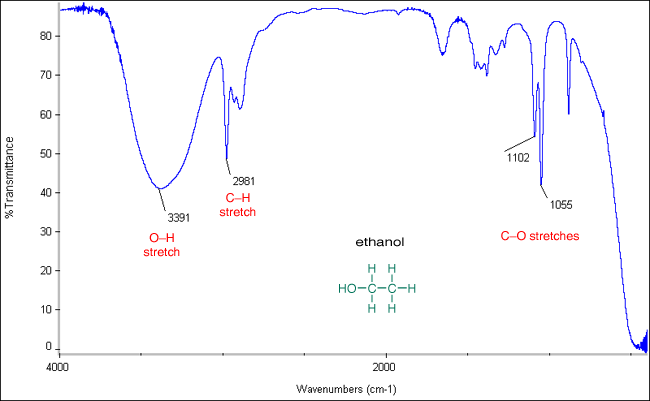
- O-H stretch (alcohols): 3200–3600 cm, typically a broad peak due to hydrogen bonding (methanol, ethanol)
- N-H stretch (amines): 3300–3500 cm, often shows two peaks for primary amines (methylamine, aniline)
- C-H stretch (alkanes): 2850–2960 cm, present in almost every organic molecule
- CC stretch (alkynes): 2100–2260 cm, a relatively weak and sharp absorption (acetylene, propyne)
- C=O stretch (carbonyls): 1700–1725 cm for carboxylic acids, though other carbonyls like ketones and aldehydes also appear nearby (acetic acid, benzoic acid)
- C=C stretch (alkenes): 1620–1680 cm, can be weak or absent in symmetric alkenes (ethene, propene)
A useful way to remember the layout: the left side of the spectrum (high wavenumber, ~3500 cm) is where single bonds to light atoms like O-H and N-H absorb. Triple bonds appear around 2100–2300 cm. Double bonds show up around 1600–1800 cm.
Peak intensity reflects how much the dipole moment changes during the vibration. Highly polar bonds like O-H and C=O produce strong, prominent peaks. Less polar bonds like CC often give weak peaks that are easy to miss.
Peak shape tells you about the molecular environment:
- Broad peaks suggest hydrogen bonding or a range of bonding environments. The classic example is the wide O-H stretch in alcohols and the even broader O-H in carboxylic acids.
- Sharp peaks indicate a more uniform environment, like the well-defined C-H stretches in alkanes.
Molecular Vibrations and IR Radiation
IR spectroscopy works because molecules absorb infrared radiation when the frequency of the light matches the natural vibrational frequency of a bond. The absorbed energy increases the amplitude of that vibration, and the instrument records this as a dip (or peak) in the spectrum.
Not every vibration shows up on an IR spectrum, though. A vibration is only IR-active if it causes a change in the molecule's dipole moment. That's why symmetric molecules like and don't absorb IR radiation.
Molecular vibrations fall into two main categories:
Stretching vibrations involve changes in bond length:
- Symmetric stretching: both bonds lengthen and shorten in phase (like the symmetric stretch of )
- Asymmetric stretching: one bond lengthens while the other shortens (like the asymmetric stretch of , which is IR-active because it changes the dipole)
Bending vibrations involve changes in bond angle:
- In-plane bending: includes scissoring and rocking motions (the scissoring of )
- Out-of-plane bending: includes wagging and twisting motions
The frequency of a vibration depends on two factors: atom mass and bond strength. Think of it like a spring connecting two balls. A stiffer spring (stronger bond) vibrates faster, giving a higher wavenumber. Heavier balls (heavier atoms) vibrate slower, giving a lower wavenumber. This is why O-H stretches appear at high wavenumbers (~3400 cm) while C-I stretches appear at much lower wavenumbers.

Wavenumber Calculations in IR Spectroscopy
IR spectra use wavenumber () instead of wavelength on the x-axis. Wavenumber is the reciprocal of wavelength and is reported in cm:
where must be in centimeters. Since IR wavelengths are usually given in micrometers (m), you need to convert first.
Steps to calculate wavenumber from wavelength:
- Convert wavelength from m to cm by dividing by 10,000 (since 1 m = cm)
- Take the reciprocal to get wavenumber in cm
Example: Find the wavenumber for light with a wavelength of 5 m.
- Convert:
- Calculate:
This falls right in the triple-bond region, so you'd expect to see alkyne or nitrile absorptions near this wavenumber.
Advanced IR Spectroscopy Techniques
Fourier Transform Infrared Spectroscopy (FTIR) is the standard modern approach. Instead of scanning one wavelength at a time, FTIR uses an interferometer to collect data across the entire spectral range simultaneously. The raw data (called an interferogram) is then converted into a usable spectrum through a Fourier transform. This makes FTIR much faster and more sensitive than older dispersive instruments.
Attenuated Total Reflectance (ATR) is a sampling method often paired with FTIR. ATR lets you analyze solid or liquid samples directly without dissolving them or pressing them into pellets. The sample is placed on a crystal, and infrared light undergoes total internal reflection inside the crystal, generating an evanescent wave that penetrates slightly into the sample surface.
For quantitative work, the Beer-Lambert law connects how much light a sample absorbs to the concentration of the absorbing species and the path length of the sample. This allows you to use IR not just to identify functional groups but also to measure how much of a substance is present.
See Fiveable more often in Google
Mark Fiveable as a preferred source and Google is more likely to show you our guides in Top Stories, with a "preferred" badge in AI Mode and AI Overviews.