9.1 Naming Alkynes

🥼Organic Chemistry Unit 9 Review
9.1 Naming Alkynes
🥼 Organic Chemistry
9.1
Naming Alkynes
9.2
Preparation of Alkynes: Elimination Reactions of Dihalides
9.3
Reactions of Alkynes: Addition of HX and X2
9.4
Hydration of Alkynes
9.5
Reduction of Alkynes
9.6
Oxidative Cleavage of Alkynes
9.7
Alkyne Acidity: Formation of Acetylide Anions
9.8
Alkylation of Acetylide Anions
9.9
An Introduction to Organic Synthesis
Naming Alkynes
Alkynes are hydrocarbons that contain at least one carbon-carbon triple bond (). Naming them correctly is a core skill you'll use throughout organic synthesis, so it's worth getting the IUPAC rules down solid now. The system builds directly on what you already know from naming alkanes and alkenes, with a few key differences.

Top images from around the web for Alkyne naming conventions
Hydrocarbons | Introductory Chemistry – Lecture & Lab View original
Is this image relevant?
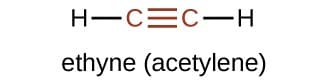
Hydrocarbons | Introductory Chemistry – Lecture & Lab View original
Is this image relevant?
Alkyne Naming Conventions
The suffix -yne replaces -ane to indicate a triple bond, just like -ene does for double bonds. Here's the step-by-step process for naming a simple alkyne:
- Find the longest continuous chain that contains the triple bond. This is your parent chain, even if a longer chain exists elsewhere in the molecule.
- Number the chain so the triple bond gets the lowest possible locant. The carbon closest to the triple bond is assigned number 1.
- Name the parent chain using the corresponding alkane name, but replace -ane with -yne. Place the locant for the triple bond directly before the -yne suffix.
- Name and number any substituents, then list them alphabetically before the parent name.
If the triple bond is equidistant from both ends of the chain, start numbering from the end nearest to the first substituent.
Examples:
- : But-1-yne (4-carbon chain, triple bond at position 1)
- : Pent-2-yne (5-carbon chain, triple bond at position 2)
A quick note on terminology: alkynes where the triple bond is at the end of the chain (like but-1-yne) are called terminal alkynes. Those with the triple bond in the interior (like pent-2-yne) are internal alkynes. This distinction matters a lot for reactivity, which you'll see later in this unit.
Alkynyl Substituents
When an alkyne acts as a substituent on a larger parent chain rather than being the parent chain itself, you name it as an alkynyl group. These are formed by removing one hydrogen from a terminal alkyne.
The suffix -ynyl replaces -yne to indicate the substituent form.
Examples:
- : Ethynyl (2-carbon alkynyl group)
- : 2-Propynyl (3-carbon group, triple bond at position 2; also commonly called propargyl)
You'll encounter alkynyl substituents when the triple bond is on a side chain and a longer parent chain takes priority in naming.
Naming Complex Alkynes
Molecules with multiple triple bonds or a mix of double and triple bonds require a few additional rules.
Multiple triple bonds:
- Use -diyne for two triple bonds, -triyne for three, and so on.
- List the positions of all triple bonds as locants separated by commas.
- Example: is penta-1,4-diyne (5-carbon chain, triple bonds at positions 1 and 4).
Compounds with both double and triple bonds (enynes):
- Choose the longest chain that contains both the double and triple bonds.
- Number the chain to give the lowest set of locants to the multiple bonds taken together.
- If there's a tie, the double bond gets the lower number. (This is a 2013 IUPAC recommendation that reversed the old rule where triple bonds had priority.)
- Use the combined suffix -en-...-yne, with the double bond locant before -en- and the triple bond locant before -yne.
Examples:
- : Pent-1-en-3-yne (double bond at C1, triple bond at C3)
- : Hex-1-en-4-yne (double bond at C1, triple bond at C4)
Structural Considerations
A few points to keep in mind as you practice:
- Isomers can arise from different positions of the triple bond along the chain (positional isomers) or from branching. For example, but-1-yne and but-2-yne share the molecular formula but have different structures and different physical properties.
- The general molecular formula for an alkyne with one triple bond is , giving alkynes a degree of unsaturation of 2. This is useful when working backward from a molecular formula to figure out possible structures.
- Each triple bond consists of one sigma bond and two pi bonds. That geometry forces the two triple-bond carbons and the atoms directly attached to them into a linear arrangement (bond angle of 180°). Keep this in mind when drawing structures, because it affects the overall shape of the molecule.
See Fiveable more often in Google
Mark Fiveable as a preferred source and Google is more likely to show you our guides in Top Stories, with a "preferred" badge in AI Mode and AI Overviews.