22.3 Alpha Halogenation of Aldehydes and Ketones

🥼Organic Chemistry Unit 22 Review
22.3 Alpha Halogenation of Aldehydes and Ketones
🥼 Organic Chemistry
Alpha Halogenation of Aldehydes and Ketones
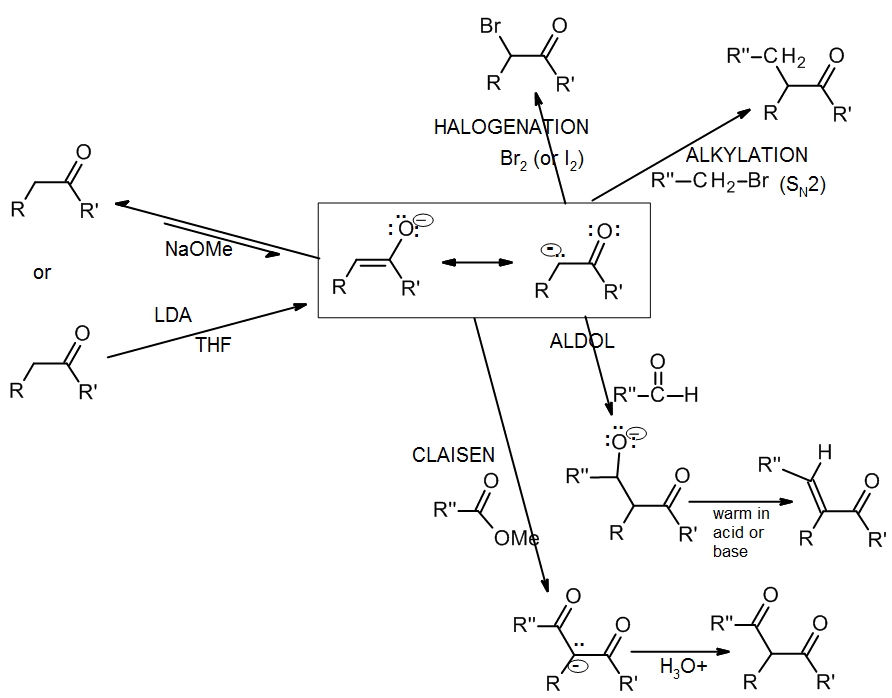
Alpha halogenation replaces a hydrogen on the carbon next to a carbonyl group with a halogen (Cl, Br, or I). The reaction proceeds through an enol intermediate, where the enol's nucleophilic double bond attacks the electrophilic halogen. The resulting alpha-halo carbonyl compounds are versatile synthetic intermediates, particularly alpha-bromo ketones, which can be converted into alpha,beta-unsaturated ketones and other useful products.

Top images from around the web for Mechanism of alpha halogenation
Hell-Volhard-Zelinsky halogenation - wikidoc View original
Is this image relevant?
20.6 Aldol reaction | Organic Chemistry II View original
Is this image relevant?
6.5. Lewis acids & bases, electrophiles & nucleophiles | Organic Chemistry 1: An open textbook View original
Is this image relevant?
Hell-Volhard-Zelinsky halogenation - wikidoc View original
Is this image relevant?
20.6 Aldol reaction | Organic Chemistry II View original
Is this image relevant?
Mechanism of Alpha Halogenation
The mechanism differs depending on whether acid or base catalysis is used. Under acid-catalyzed conditions, the process follows these steps:
- Protonation of the carbonyl oxygen. The acid catalyst protonates the carbonyl oxygen, making the alpha hydrogens more acidic and promoting enolization.
- Enol formation (enolization). The alpha carbon loses a proton, forming the enol tautomer. This intermediate has a double bond between the alpha carbon and the carbonyl carbon, with a hydroxyl group () on what was the carbonyl carbon. This is keto-enol tautomerism.
- Electrophilic attack by the halogen. The enol's electron-rich double bond acts as a nucleophile and attacks (where or ). The halogen adds to the alpha carbon.
- Proton transfer and product formation. Loss of a proton from the oxygen regenerates the carbonyl and gives the alpha-halogenated product (e.g., chloroacetone, alpha-bromoacetophenone).
A critical detail: under acid-catalyzed conditions, the rate-determining step is enol formation, not the halogen attack. This means the reaction rate depends on how fast the enol forms, not on the identity or concentration of the halogen. This has a major consequence for selectivity: because the halogenated product is not significantly more reactive than the starting material under acidic conditions, monohalogenation is relatively easy to achieve.

Kinetics of Alpha Halogenation
Because enolization is rate-determining under acid catalysis, the rate law is:
The halogen concentration does not appear in the rate law. This means that whether you use , , or , the rate of enolization is the same. However, the overall reactivity trend still holds in practice because chlorine is the strongest electrophile and reacts most readily with the enol once it forms, while iodine is the weakest.
A few other points on reactivity:
- Aldehydes vs. ketones: Aldehydes generally enolize more readily than ketones because they have less steric hindrance around the alpha carbon, making enol formation easier.
- Reaction conditions: Chlorination and bromination typically proceed at or near room temperature. Iodination often requires heating because iodine is a weaker electrophile and the reaction is thermodynamically less favorable.
Watch out for base-catalyzed conditions. Under basic conditions, the enolate ion is the reactive intermediate instead of the enol. The enolate is a stronger nucleophile, and the alpha-halo product is more acidic at the alpha position than the starting material (the halogen is electron-withdrawing). This means the product enolizes faster than the starting material, leading to polyhalogenation. With methyl ketones under basic conditions, this drives the haloform reaction, where all three alpha hydrogens are replaced.

Synthesis from Alpha-Bromo Ketones
Alpha-bromo ketones are especially useful because they can be converted to alpha,beta-unsaturated ketones through dehydrohalogenation (elimination of HBr). Here's how:
- A base (such as or ) abstracts a proton from the carbon adjacent to the alpha-bromo carbon (the beta position relative to the new double bond).
- The electrons from the broken bond form a new double bond as the bromide leaves. This follows an E2 mechanism, where proton abstraction and bromide departure happen simultaneously.
- The resulting product has a double bond conjugated with the , forming the alpha,beta-unsaturated carbonyl system.
Stereochemistry matters here. E2 elimination requires an anti-periplanar arrangement, meaning the hydrogen being removed and the bromide must be on opposite sides of the bond (180° dihedral angle). The geometry of the starting alpha-bromo ketone determines which stereoisomer of the product forms.
Alpha,beta-unsaturated ketones are valuable intermediates in synthesis:
- They undergo 1,4-conjugate addition (Michael addition), where nucleophiles add to the beta carbon rather than the carbonyl carbon.
- They serve as dienophiles in Diels-Alder reactions due to the electron-withdrawing carbonyl group activating the double bond.
See Fiveable more often in Google
Mark Fiveable as a preferred source and Google is more likely to show you our guides in Top Stories, with a "preferred" badge in AI Mode and AI Overviews.