19.12 Biological Reductions

🥼Organic Chemistry Unit 19 Review
19.12 Biological Reductions
🥼 Organic Chemistry
19.1
Naming Aldehydes and Ketones
19.2
Preparing Aldehydes and Ketones
19.3
Oxidation of Aldehydes and Ketones
19.4
Nucleophilic Addition Reactions of Aldehydes and Ketones
19.5
Nucleophilic Addition of H2O: Hydration
19.6
Nucleophilic Addition of HCN: Cyanohydrin Formation
19.7
Nucleophilic Addition of Hydride and Grignard Reagents: Alcohol Formation
19.8
Nucleophilic Addition of Amines: Imine and Enamine Formation
19.9
Nucleophilic Addition of Hydrazine: The Wolff–Kishner Reaction
19.10
Nucleophilic Addition of Alcohols: Acetal Formation
19.11
Nucleophilic Addition of Phosphorus Ylides: The Wittig Reaction
19.12
Biological Reductions
19.13
Conjugate Nucleophilic Addition to α,β‑Unsaturated Aldehydes and Ketones
19.14
Spectroscopy of Aldehydes and Ketones
Biological Reductions
Biological reductions convert carbonyl compounds (aldehydes and ketones) into alcohols through hydride transfer. These reactions are central to cellular metabolism, powering both energy production and biosynthesis. Understanding them also reinforces the nucleophilic addition mechanism you've been studying throughout this unit.
Two important examples of hydride-mediated reductions are the Cannizzaro reaction and NADH-dependent enzymatic reduction. The Cannizzaro reaction is a purely chemical process limited to non-enolizable aldehydes, while NADH reductions are enzyme-catalyzed, work on both aldehydes and ketones, and produce a single stereoisomer.

Top images from around the web for Mechanism of Cannizzaro reaction
Cannizzaro reaction - wikidoc View original
Is this image relevant?
Cannizzaro reaction - wikidoc View original
Is this image relevant?
Cannizzaro reaction - wikidoc View original
Is this image relevant?
Cannizzaro reaction - wikidoc View original
Is this image relevant?
Cannizzaro reaction - wikidoc View original
Is this image relevant?
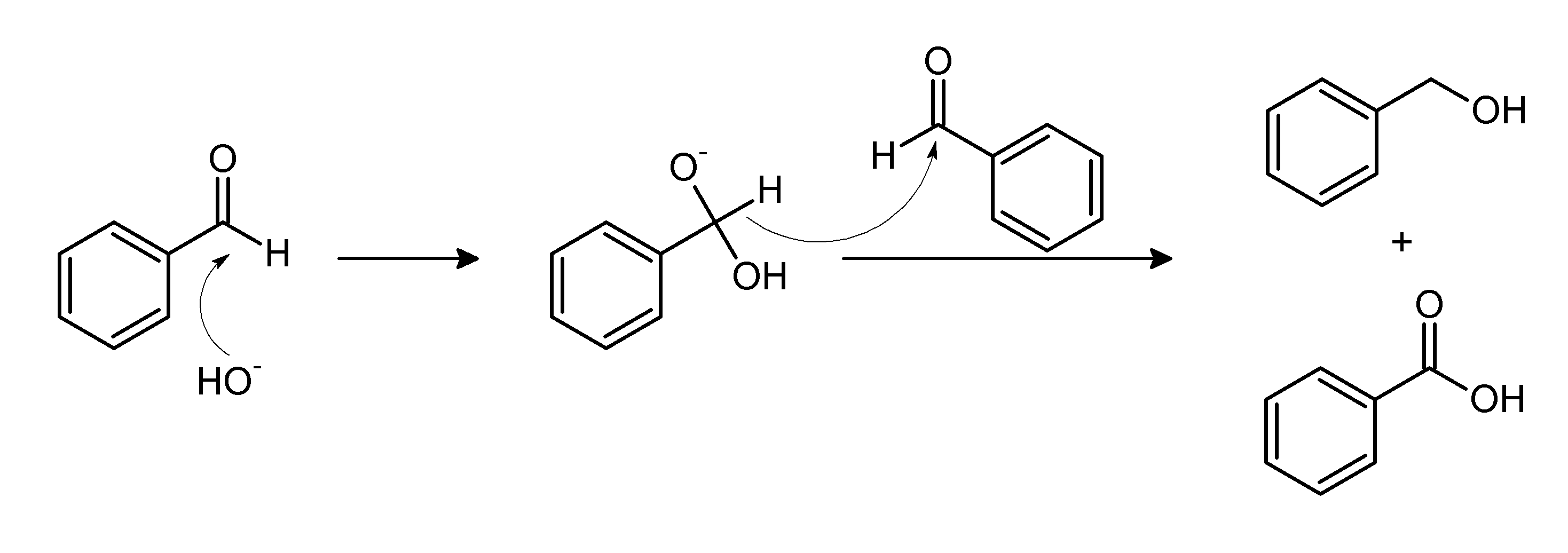
Mechanism of the Cannizzaro Reaction
The Cannizzaro reaction is a base-induced disproportionation: one molecule of a non-enolizable aldehyde is oxidized while another is reduced. "Non-enolizable" means the aldehyde has no α-hydrogens, so it can't undergo enolization or aldol chemistry. Formaldehyde () and benzaldehyde () are classic substrates.
The mechanism proceeds in four key steps:
- Nucleophilic addition of to the carbonyl carbon of one aldehyde molecule, forming a tetrahedral alkoxide intermediate.
- Hydride transfer from that tetrahedral intermediate to the carbonyl carbon of a second aldehyde molecule. The first molecule is oxidized to a carboxylate, and the second is reduced to an alkoxide.
- Proton transfer from water to the newly formed alkoxide, yielding the alcohol product.
- The net result is one equivalent of alcohol and one equivalent of carboxylate salt from two equivalents of aldehyde.
Notice that the aldehyde acts as both the hydride donor and the hydride acceptor. This is why the reaction is called a disproportionation.

NADH as a Biological Reducing Agent
NADH (Nicotinamide Adenine Dinucleotide, reduced form) is the cell's primary hydride-delivery molecule. Structurally, it contains a nicotinamide ring (the business end that carries the hydride), connected to a ribose-phosphate-adenine framework.
The reduction works like this:
- The substrate (an aldehyde or ketone) binds in the active site of an enzyme such as alcohol dehydrogenase or lactate dehydrogenase.
- NADH delivers a hydride () from the C-4 position of its nicotinamide ring to the electrophilic carbonyl carbon, forming a tetrahedral alkoxide intermediate.
- A proton from an amino acid residue in the enzyme's active site (or from solvent) is transferred to the alkoxide, yielding the alcohol product.
- NADH is oxidized to in the process and must be regenerated for the cycle to continue.
Cannizzaro vs. NADH reduction:
- Both involve hydride transfer to a carbonyl carbon
- Cannizzaro is base-induced, works only on non-enolizable aldehydes, and is not stereospecific
- NADH reduction is enzyme-catalyzed, works on aldehydes and ketones, and is stereospecific
- In the Cannizzaro reaction, the hydride comes from another aldehyde molecule; in NADH reduction, it comes from the nicotinamide ring of NADH

Stereochemistry in Biological Reductions
Enzyme active sites are chiral environments, so biological reductions deliver the hydride to one specific face of the carbonyl. This makes them stereospecific, producing only one enantiomer of the alcohol product.
A well-known example is the reduction of pyruvate by lactate dehydrogenase (LDH):
- Pyruvate binds in the enzyme's active site with a defined orientation.
- NADH transfers a hydride specifically to the re face of pyruvate's carbonyl.
- This produces exclusively L-lactate (the (S)-enantiomer), not a racemic mixture.
Other examples of stereospecific biological reductions:
- β-Hydroxybutyrate dehydrogenase reduces acetoacetate to (R)-β-hydroxybutyrate
- Glyceraldehyde-3-phosphate dehydrogenase processes 3-phosphoglyceraldehyde with defined stereochemical outcome
The contrast with lab chemistry is striking. A simple reduction of an asymmetric ketone gives a racemic mixture because the hydride can attack either face equally. Enzymes eliminate that ambiguity by holding the substrate in a fixed orientation relative to the hydride source.
Enzymes in Biological Reductions
The enzymes that catalyze these reductions belong to the oxidoreductase class. A few features make them effective:
- Substrate specificity: the active site is shaped to bind particular molecules, so each enzyme catalyzes a narrow set of reactions.
- Cofactor dependence: NADH (or the related ) acts as a cofactor, meaning the enzyme alone can't perform the reduction. The cofactor supplies the hydride.
- Stereocontrol: the rigid geometry of the active site dictates which face of the carbonyl receives the hydride, ensuring a single stereochemical outcome every time.
See Fiveable more often in Google
Mark Fiveable as a preferred source and Google is more likely to show you our guides in Top Stories, with a "preferred" badge in AI Mode and AI Overviews.