22.6 Reactivity of Enolate Ions

🥼Organic Chemistry Unit 22 Review
22.6 Reactivity of Enolate Ions
🥼 Organic Chemistry
Enolate Ion Reactivity
Enolate ions are the workhorses of carbonyl alpha-substitution chemistry. They're resonance-stabilized anions that act as nucleophiles, attacking electrophiles at either the alpha carbon or the oxygen. Compared to enols, enolates are far more reactive and give you much more control over synthetic outcomes.

Top images from around the web for Enolate ions vs enols
20.6 Aldol reaction | Organic Chemistry II View original
Is this image relevant?
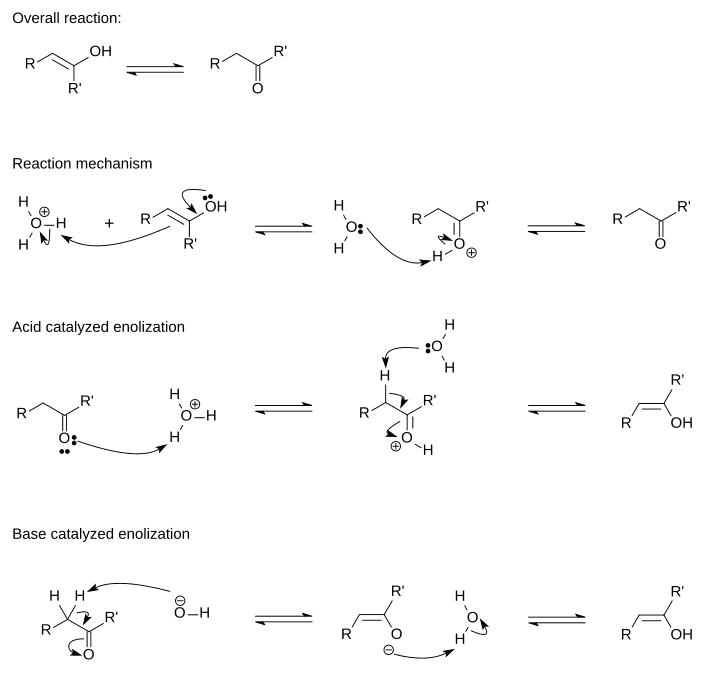
Keto–enol tautomerism - Wikipedia View original
Is this image relevant?
20.6 Aldol reaction | Organic Chemistry II View original
Is this image relevant?
Keto–enol tautomerism - Wikipedia View original
Is this image relevant?
Enolate Ions vs. Enols
Enolate ions and enols both place reactivity at the alpha position, but they differ in stability and nucleophilic strength.
- Enolate ions have their negative charge delocalized through resonance between the alpha carbon and the carbonyl oxygen. This resonance stabilization makes them relatively stable and strongly nucleophilic at both sites.
- Enols, by contrast, are neutral species. The electron density sits mainly on the oxygen (as an O–H bond), and there's no resonance-stabilized anion. This makes enols weaker nucleophiles.
Because of that delocalized charge, enolate ions react with a much broader range of electrophiles than enols can, including alkyl halides, acid chlorides, and other carbonyl compounds.
Keto-enol tautomerism describes the equilibrium between a ketone (or aldehyde) and its enol form. For most simple carbonyl compounds, the keto form dominates heavily. Enolate ions, however, are generated deliberately using a base, which removes an alpha hydrogen to produce the resonance-stabilized anion.
Enolate Reactions with Electrophiles
Enolate ions are ambident nucleophiles, meaning they can react through either the alpha carbon or the oxygen. Which site reacts depends on the electrophile and the reaction conditions.
Reaction at the alpha carbon (C-alkylation):
- The alpha carbon attacks an electrophile in an fashion, producing α-substituted carbonyl compounds.
- For example, treating an enolate with methyl iodide () gives an α-alkylated ketone or ester.
- This pathway is favored with softer, less reactive electrophiles like primary alkyl halides.
Reaction at oxygen (O-alkylation):
- The oxygen attacks the electrophile, forming enol ethers or enol esters.
- For example, reaction with an acid chloride like acetyl chloride can produce a β-keto ester through an addition-elimination mechanism.
- Harder, more reactive electrophiles and certain counterion/solvent combinations tend to favor O-alkylation.
Aldol reaction:
- An enolate ion can also act as a nucleophile toward the carbonyl group of another aldehyde or ketone. This produces a β-hydroxy carbonyl compound (an aldol product), which is a foundational C–C bond-forming reaction in organic synthesis.

Base-Promoted α-Halogenation of Ketones
In base-promoted halogenation, a strong base first generates the enolate, which then reacts with a halogen source at the alpha carbon.
- A strong base (such as ) abstracts an alpha hydrogen to form the enolate ion.
- The enolate attacks a halogen molecule (, , or ) at the alpha carbon, installing one halogen.
The major challenge here is controlling the extent of halogenation. Once one halogen is introduced, the remaining alpha hydrogens become more acidic (the electron-withdrawing halogen stabilizes the next enolate even further). This means a second and third halogenation happen more easily than the first, leading to mixtures of mono-, di-, and trihalogenated products.
The haloform reaction is a direct consequence of this problem:
- If all three alpha hydrogens are replaced, the trihalomethyl group () is cleaved by base, yielding a carboxylate salt and a haloform (, , or ).
- This reaction is actually useful as a diagnostic test (the iodoform test with / gives yellow precipitate for methyl ketones).
Strategies to limit multiple halogenation:
- Use low temperatures to slow the reaction after monohalogenation.
- Control stoichiometry carefully (one equivalent of halogen).
- Use a strong, bulky, non-nucleophilic base like LDA (lithium diisopropylamide) to quantitatively form the enolate before adding the halogen. Since LDA irreversibly deprotonates the ketone, you generate exactly one equivalent of enolate and can trap it with one equivalent of halogen.
Enolate Formation and Stability
Not all alpha hydrogens are equal. When a carbonyl compound has more than one type of alpha hydrogen, you can form different enolates depending on the conditions.
- Kinetic enolate: Formed at the less substituted alpha carbon. Favored by strong, bulky bases (like LDA) at low temperature (), because the less hindered proton is removed faster.
- Thermodynamic enolate: The more substituted enolate, which is more stable due to greater alkyl substitution of the double bond. Favored by weaker bases (like ) at higher temperatures, where equilibration can occur.
The of the alpha hydrogens determines how easily an enolate forms. More acidic alpha hydrogens (lower ) lose their proton more readily. Electron-withdrawing groups near the alpha position lower the , making enolate formation easier. For reference, typical values: ketone alpha-H ≈ 20, ester alpha-H ≈ 25, 1,3-diketone alpha-H ≈ 9.
See Fiveable more often in Google
Mark Fiveable as a preferred source and Google is more likely to show you our guides in Top Stories, with a "preferred" badge in AI Mode and AI Overviews.